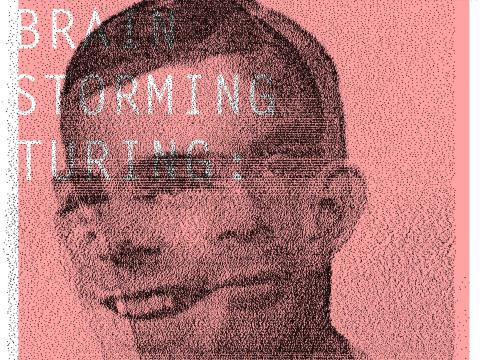
Brainstorming Turing: Celebrating Alan Turing + 25 Years of AI and Society Journal
100 years have passed since Alan Turing was born and we celebrate this historically important individual together with many organizations around the world. We look to show his eccentric creativity in addition to reminding all of the huge contribution he made to computation and artificial intelligence. Short talks by computer / neuro / nano scientists and humanists are accompanied by artists inspired by Turing’s legacy and persona. Additionally, students from UCLA will participate with their ideas of how Turing informs and inspires their work and lives in this time when social networking, robotics and automatic brains are part of daily life.
2012 also marks 25 years since the establishment of AI & Society journal that owes its formation to Turing’s legacy. The Art | Sci center is partnering with this interdisciplinary publication to honor Turing and all those who have contributed over the years. A special issue based on the symposium is planned.
DIYbio is an organization that aims to help make biology a worthwhile pursuit for citizen scientists, amateur biologists, and DIY biological engineers who value openness and safety. This will require mechanisms for amateurs to increase their knowledge and skills, access to a community of experts, the development of a code of ethics, responsible oversight, and leadership on issues that are unique to doing biology outside of traditional professional settings.
About the event:
DIYbio is defined differently depending on who you talk to, so we'll be giving an overview on what it means to us and why we're excited about it. Applications include: re-purposing household appliances for the makings of lab equipment, using molecular gastronomy to expand your culinary repertoire, "domestic" microbiology with kombucha and kefir and setting up a synthetic biology lab in your garage to make your own modified bacteria. People will also get a chance to make their own potato plastic keepsake from ingredients you can find in the grocery store.
Friday 4-8pm: Symposium
Saturday 10am-3pm: Workshop and Exhibition
a symposium exploring new forms of biological and engineering research beyond the university and the corporation and an exhibition and bio-faire for exploring new forms of participation, open science and do it yourself biology.
With:
Gaymon Bennet (SynBERC and Ars-Synthetica.net, Berkley,)
Jason Bobe (DIYBio.org and The Personal Genome Project, Cambridge, MA)
Roger Brent (Fred Hutchison Cancer Center, Seattle)
Phil Lukeman (Cal Poly Pomona)
Hugh Rienhoff (MyDaughtersDNA.org, Berkeley)
Meredith Paterson (Hacker, Belgium)
Victoria Vesna (UCLA Art|Science Center, UCLA Design Media Arts, Los Angeles)
Moderated by:
Christopher Kelty (UCLA Center for Society and Genetics, Los Angeles)
A symposium exploring new forms of public participation in biological research, raising questions and cultivating ideas about how life could and should be studied. Panelists will address issues including do-it-yourself biology, open source science, at home medical genetics, bio-art, and novel ethical engagements with science at the cutting edge. Event schedule includes: Friday, a panelist discussion with artists, scientists and normal people; Saturday, workshops and an open-house exhibition throughout.
Today the life sciences are blooming with possibility. The Human Genome Project is at an end, but the answers it promised remain elusive. Older models of gene action and genetic determinism are crumbling, even as huge pharmaceutical corporations and federally funded university laboratories—Big Bio—continue to drive the research agenda. But just past the frontiers of law and order, a handful of outsiders are trying to remake biology in radical new ways. Synthethetic Biology, DIY Biology, recreational genetics, nanobiotechnology, open source science, patient-driven clinical research, bio-art all in their own ways are challenging Big Bio, and inviting you, the public, to participate.
But can “outlaw biology” really have an effect? What can a band of do-it-yourself biologists teaching themselves to do gel electrophoresis at home really accomplish? Can synthetic and nano-bio engineering cure malaria, as they claim, or just make yogurt glow? Who is “the public” and is it really involved in a meaningful way? What’s good—or bad—about customizing genetic research to explore forgotten diseases
or rare disorders? Can the model that made open source software a success also work in biology? Can artists teach biologists a few things about life, or biologists teach artists something about making? When biology is outlawed, will only outlaws do biology?
Citizen Science | DIY Biology | Nano Hacking | At-Home Clinical Research | Recreational Genetics | Synthetic Biology | Open Source Science | Ars Synthetica | Genetic Art