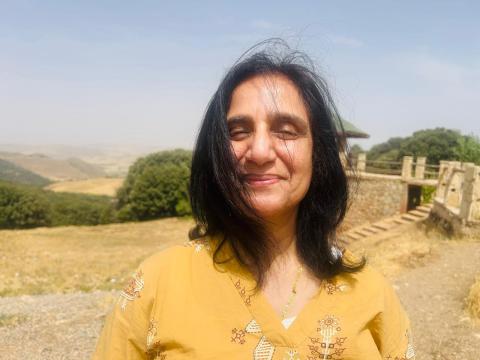
Artist Pat Badani joins Victoria Vesna for a philosophical and socially contextual conversation about bread and food in the time of pandemic. For Badani, who uses bread making in her work, the process is intimate, material, and deeply connected to time. She is interested in how during times of crises, humans are drawn to the essential, and how this is symbolized by the relationships between humans, yeast, water and wheat.
Pat Badani reminds us that collaboration and collective actions are vital during these times, not only between artists and scientists, but also between other species.
Iain discusses how he and his students at Montclair University are responding to the pandemic through community mobilization of medical resources, maintaining safe connections with individuals through foraging, and thinking critically about how we can use this time to reimagine and redevelop our social, economic and political systems.
"What does wellbeing look like?" "What do we want to look like at the end of this?"
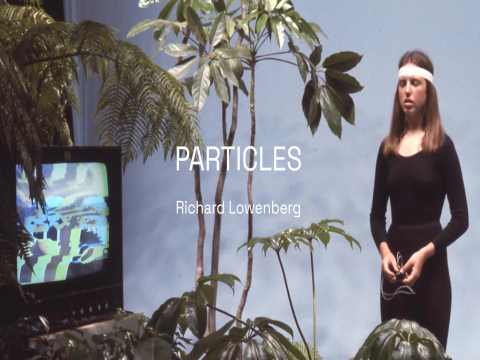
These are two questions Iain Kerr, Co-Director MIX Lab and Instructor of Innovation Design at Montclair University, talks with us about in the 3rd episode of PARTICLES. Iain discusses how he and his students at Montclair University are responding to the pandemic through community mobilization of medical resources, maintaining safe connections with individuals through foraging, and thinking critically about how we can use this time to reimagine and redevelop our social, economic and political systems.
Iain Kerr is a designer, systems thinker, and social entrepreneur, working at the intersection of creativity, ecology, and emergent systems. With a background in Architecture, Design, Art and Philosophy, he brings a unique perspective to issues of social innovation, design and entrepreneurship. His work is focused on inventing novel creative processes to transform seemingly intractable problems into problems worth having. Iain has spent the last two decades developing and teaching unique transformative models of creative processes.
As the co-director of the MIX Lab, Iain has developed new curriculum for using 3D printing to activate design thinking processes far from the normal realms of Industrial Design and Engineering. This innovative curriculum is at the heart of the lab’s certificate program in Innovation Design and Rapid Prototyping, as well as at the forefront of re-imagining Design Thinking as a powerful tool of innovation at all scales of action.
We got a quick chance to catch Ariel (Levi) Simons and Ben Sax in the midst of their city-wide hospital & maker mobilization project to hear more about their vital work located at the CRASH (Collaborative Research Association of Social Hacktivity) Space. Together they have worked to unify hospitals with makers seeing production as a separate entity from distribution. This project urges hospitals to drive the content of what's needed most, and then makers respond by producing and delivering that content.
Levi Simons is currently a biology graduate student at USC and is involved in research ranging from modeling light pollution, to improving shellfish farming, and developing new methods of monitoring the health of streams. Before embarking on his current career of ecology and aquaculture research, Levi has also worked as a high school science teacher in the Los Angeles area. Over the years he and his students have been involved in projects ranging from the design of insect traps, to monitoring nuclear fallout from the Fukushima meltdown, and mapping the chemistry of the Los Angeles river. He currently lives with his wife in Koreatown and draws daily inspiration from watching his cats sleep while leaving for work.
Ben Sax is an interactive artist, patented inventor, and social entrepreneur based in Los Angeles. He’s the founder of Perceptoscope, an interactive public arts initiative devoted to engaging people with the places around them through interactive sculpture and immersive public media. He received his BA from Wesleyan University (2007) with a double major in Film Studies and Philosophy, with additional focus in interactive art, installation, and experimental music.
Ben was the inaugural Artist-in-Residence at the SupplyFrame DesignLab, an Arts for LA ACTIVATE Cultural Policy Fellow, and a National Arts Strategies Creative Community Fellow. His documentaries have been aired on public television and incorporated into museum exhibitions. As an Arts Scientist, his prototyping and field research have been supported by the Knight Foundation and the National Science Foundation.
ROGER MALINA, ALYCE SANTORO, NINA CZEGLEDY, JOEL SLAYTON
FEATURING: ROGER MALINA, ALYCE SANTORO, NINA CZEGLEDY, JOEL SLAYTON
Victoria Vesna joins the Leonardo Post Pandemic Provocation Group to discuss, imagine and critically PROVOKE ideas for what our complex world might look like after the pandemic. Viewed from a multi-disciplinary vantage point, this conversation begins by taking a look at what's happening now then broadening out to how it's possible to grow out of this time as a more consciously interdependent species and world. This conversation is one in a series of Leonardo Post Pandemic Provocations.
PROVOCATIONS
Provocation 1:
In times like this, we need more un-necessary research.
NOT provocative:
Less un-necessary travel, email and texting and un-necessary consumption.
Provocation 2:
But above all we must re-define the un-necessary.
1. I suggest that in the post-pandemic world, creative practices (ones
that arouse the imagination, senses, and emotions? the marvelous? as
sought by both the Romantic Naturalists and the Surrealists) must be
embraced as essential forms of knowledge production in and of
themselves. These can be constructively applied. Not simply as
embellishment or in a support capacity? But in concert with science’s
rigorous and dispassionate methods.
2. The objective stance we are obliged to take as good scientists in
fact reinforces the notion that humans are autonomous entities/outside
observers, separate from one another and the Biosphere? The virus,
however, powerfully demonstrates the ways in which humanity is
interwoven with and inseparable from the vast milieu of planetary
systems and forces. Can dualism be applied when due, while undue
dualism is undone? [Alyce Santoro]
ABOUT ROGER MALINA
Roger Malina is a physicist, astronomer and Executive Editor of the Leonardo publications at MIT Press. With dual appointments as Professor of Arts and Technology and Professor of Physics at UT Dallas, his work focuses on connections among the natural sciences and arts, design and humanities.
Malina is the former Director of the Observatoire Astronomique de Marseille Provence (OAMP) in Marseille and was a member of its observational cosmology group which collaborated on investigations regarding the nature of dark matter and dark energy. He has been a member of the Mediterranean Institute for Advanced Study (Institut Méditerranéen de Recherches Avancées, IMERA), that contributes to trans-disciplinarity between the sciences and the arts and places emphasis on the human dimensions of the sciences.
ABOUT JOEL SLAYTON
Joel Slayton is a pioneering artist, researcher, and curator with over 35 years of experience involving art and technology. His work engages a wide range of practice including media, installation and performance and has been featured in over 100 exhibitions around the world. Joel is Professor Emeritus at San Jose State University where he was Founding Director of the CADRE Laboratory for New Media. Joel Slayton was 2018-2019 Stanford University Sterling Visiting Scholar in Department of Chemical Sysems and Biology in the School of Medicine. Joel was curator for the 5th LAST Festival Exhibition at the SLAC National Accelerator at Stanford University in 2018. From 2008-2016 Joel was Executive Director of ZERO1, a Silicon Valley based arts organization where he was responsible for the ZERO1 Biennial, an international exhibition program celebrating creativity and innovation in the arts. Joel serves on the Board of Directors of LEONARDO/ISAST (International Society for Arts, Science, and Technology) where he founded the Leonardo-MIT Press Book Series in 1999 and is a Senior Fellow of the Silicon Valley American Leadership Forum.
ABOUT NINA CZEGLEDY
Nina Czegledy an independent media artist, curator, and researcher with international and national academic affiliations is ased in Toronto, Canada. She collaborates on art& science& technology projects internationally. The paradigm shifts in the arts in a cross-cultural context, interdisciplinary education and practice, eco art and inter-generational issues inform her collaborations. Czegledy -originally from a science background- has curated many international interdisciplinary exhibitions and thematically connected conferences.
ABOUT ALYCE SANTORO
Alyce Santoro is a bio artist currently living and working in West Texas. Her recent work is concerned with sonic and visual challenges to prevailing “logics”. With an early background in biology and scientific illustration, she set out originally with the intention of making visible the invisible wonders of science and nature – however once on that journey Santoro encountered overlaps and paradoxes in the divergent approaches to art “versus” science and became instead focused on the cultural phenomena that cause these fields to be viewed as separate, and the ways that social imaginaries form and can shift.
Santoro recently received an MA in Nature-Culture-Sustainability Studies from Rhode Island School of Design. Her visual and sound pieces have appeared in over 50 exhibitions internationally related to innovative textiles; experimental musical scores; sound and listening; and social action and ecology.
Linda Weintraub formats this Particle episode as a commencement address to inspire an honest and positive response to this challenging moment. Through creative, critical analysis she reminds us that art can contribute to a beneficial outcome of the pandemic. Using the framework of the Minimalist movement of the 1960's, she illuminates that when things become stripped down and removed of context or knowing, we are left with essential facts and a real opportunity to look, feel, and respond with authenticity. From this place, perhaps we can create new and more sustainable perceptions and ways of being in the world and with one another.
Linda has had a substantial impact on us at the ArtSci Center. She has been involved with us since 2006, hosting workshops, lectures, and participating in a number of symposiums. Her work, lifestyle and presence have been vital and warmly influential to us all.
Linda Weintraub is a curator, educator, artist, and author of several popular books about contemporary art. She has earned her reputation by making the outposts of vanguard art accessible to broad audiences. The current vanguard, she believes, is propelled by environmental consciousness that is not only the defining characteristic of contemporary manufacturing, architecture, science, and philosophy; it is delineating contemporary art. Weintraub’s books exploring contemporary art and ecology include WHAT’s NEXT? Eco Materialism & Contemporary Art (2018), To LIFE! Eco Art in Pursuit of a Sustainable Planet (2012), and Avant-Guardians (2007), a series of textlets that include EcoCentric Topics: Pioneering Themes for Eco-Art; Cycle-Logical Art: Recycling Matters for Eco-Art; EnvironMentalities: Twenty-two Approaches to Eco-Art. Weintraub applies environmental concerns to her personal life by managing a sustainable homestead where she practices permaculture.
She served as the director of the Edith C. Blum Art Institute located on the Bard College campus where she toured many of the fifty exhibitions she curated, and published over twenty catalogues. Weintraub was the Henry Luce Professor of Emerging Arts at Oberlin College; and currently teaches in the Nomad9 MFA program at the University of Hartford. She is the curator of the Artnauts’ 20th Anniversary exhibition.
Clarissa Ribeiro sits down with Victoria Vesna to have an informal interview about her recent work - creating open-source face shields and masks so that everyone can have a means for protecting themselves. Clarissa distributes this work widely, but not through sharing materials – instead through sharing media so there is no contamination in the exchange. She also muses critically and philosophically about the separation humans create between us and other species, and even the language we use to further drive that separation. For example, she reminds us that we are not fighting the virus or at war with it. We are hosts for the virus and have a type of intimate relationship with it because our molecular bodies facilitate its development. Rather than being divisive, Clarissa believes we “must allow the virus inside” to promote adaptation, and a recognition that we are all one.
Clarissa Ribeiro has been involved with the ArtSci Center as a research fellow. She has also been a vital force in the Sci|Art Lab + Studio summer program, working as a lead instructor and facilitator. It was great to catch up with Clarissa in Brazil for this episode.
This ArtSci Particle features Stephanie Rothenberg, joining us from Buffalo, New York. Stephanie begins with a potent discussion of her work which is then followed by a conversation with Victoria about the necessity of sentience during this time, asking, “what senses do we still have available that allow us to remain connected?” Stephanie engages this question with her students and with her practice, working with social justice organizations, city planners and stakeholders to make artwork that has potential to effect change and help drive public and social progress. Stephanie also shares her perspective of teaching during this challenging time, considering how she can continue to empower and support her students on a virtual platform.
Stephanie Rothenberg’s interdisciplinary art draws from digital culture, science and economics to explore relationships between human designed systems and biological ecosystems. Moving between real and virtual spaces her work investigates the power dynamics of techno utopias, global economics and outsourced labor. She has exhibited throughout the US and internationally in venues including Eyebeam (US), Sundance Film Festival (US), Massachusetts Museum of Contemporary Art / MASS MoCA (US), House of Electronic Arts / HeK (CH), LABoral (ES), Transmediale (DE), and ZKM Center for Art & Media (DE). She is a recipient of numerous awards, most recently from the Harpo Foundation and Creative Capital. Residencies include ZK/U Zentrum für Kunst und Urbanistik in Berlin, TOKAS / Tokyo Art and Space, the Lower Manhattan Cultural Council Workspace, Eyebeam Art and Technology and the Santa Fe Art Institute. Her work is in the collection of the Whitney Museum of American Art and has been widely reviewed including Artforum, Artnet, The Brooklyn Rail and Hyperallergic. She is an ongoing participant and organizer in the MoneyLab research project at the Institute of Network Cultures and co-organizer of the 2018 MoneyLab 5 symposium that took place in Buffalo, NY. She is Associate Professor and Director of Graduate Studies in the Department of Art at SUNY Buffalo where she co-directs the Platform Social Design Lab, an interdisciplinary design studio collaborating with local social justice organizations.
We are so fortunate to be joined by artist Anna Dumitriu in Brighton, England for Episode 9 of Particles. Since Anna was a child, she has been thoroughly interested in the London Plague and subsequent infectious diseases - how they are carried and how myths and folklore develop around the unseen. Her work is now focused on these unseen characters, down to their DNA, and considers what roles and implications microorganisms carry in culture, science and economy. Anna leads us on a fascinating journey through her personal history, research and artwork to discuss the contemporary pandemic and imagines what might come from this time. Anna's work and words are reminders to us all that it necessary to conduct "unnecessary" research - following our own threads of what peaks our interests, in the idea that these seemingly unnecessary interests contribute to the world's body of knowledge carrying potentials that may lead to breakthroughs and unexpected collaborations and solutions.
Siddarth Ramakrishnan is interested in the cusp of disciplines and the dialog that arises at that juncture. Art and Science have long been thought to be completely divergent fields, but he believes that there is a lot to be discovered by blending the two, and by allowing scientists and artists to engage with one another. He has started an Art Science Collaborative at the University of Puget Sound that organizes salons, panels, and exhibitions. Currently he is a visiting Professor at the Borough Manhattan Community College part of the City University of New York.
This episode of Particles features the incredible Richard Ross in conversation with Victoria Vesna about his vital work and his perspective of our current position within the pandemic. Richard voices his belief that this time can be harnessed by younger generations to frame a new and different conversation for the future, asking, "how can we initiate a systemic change in how we think?" Within the context of his own work and activism, Richard talks about how he is tending to juveniles in incarceration by visiting, talking and sitting down with them to counter the effects of isolation so deeply felt by these kids. His work fosters dialogues for different points of views to transpire and consciousness and care to truly unfold. Richard’s work is inspiring, and heart felt. This is not an episode to be missed!