ECO-CENTRIC ART + SCIENCE: Prophesies and Predictions is an open-mic marathon symposium featuring artist and author in residence Linda Weintraub, nanoscientist James Gimzewski, evolutionary biologist Charles Taylor, environmentalist and author Ursula Heise, curator Sophie Lamparter, nano-toxicologist Olivia Osborne, and media art graduate students David Ertel + Symrin Chawla.
Spring artist-in-residence and author, Linda Weintraub’s forthcoming book: “WHAT’S NEXT? Eco Materialism and Contemporary Art” provides the opportunity for professors and students from multiple academic disciplines to share their predictions of the way ecology will impact the theory, practice, insight, re-evaluation, or revision in their discipline in the coming years.
Come whenever you can. Stay as long as you wish. Share your thoughts, too!
The Art|Sci team had the pleasure of attending the talk of architect and Art|Sci collaborator Philip Beesley last Friday (April 15th) as part of IPAM's Culture Analytics and User Experience Design workshop!
We had a chance to catch up with Philip after his presentation—Living Architecture Systems —and he was more than happy to think back on and discuss his Art|Sci installation of years past: Endothelium, a project which Philip prescribes as formative to his practice.
Jason Fahrion, Fasih Ahsan with UCLA IGEM, and Mick Lorusso
October 22, 2015
Workshop | 5-7pm
UCLA Art|Sci Gallery
5th Floor, California Nanosystems Institute
Through the projects of artist Jason Fahrion, who raises silkworms in his garage on local mulberry leaves, and the experiments of UCLA iGEM to genetically engineer unique types of silk for medicine and design, Seres Makers of Silk introduces participants to the processes involved in the production and transformation of silk. We will physically examine and compare silk samples from the lab and studio, while also watching live silk worms and learning how IGEM spins synthetic silk. And by listening to data sonification of DNA sequences from different organisms including spiders and silkworms, we will consider the possibilities and difficulties in genetically engineering silk for future applications.
Artist Kathy High presents the exhibition Waste Matters: You Are My Future, whichexplores immune systems as autopoiesis, capable of maintaining themselves, looking at research in fecal microbial transplants and gut biomes to better understand the important function of bacteria in our bodies. This project looks at the metaphor of interspecies love, immunology and bacteria as players.
KATHY HIGH (USA) is an interdisciplinary artist working in the areas of technology, science, speculative fiction and art. She produces videos and installations posing queer and feminist inquiries into areas of medicine/bio-science, and animal/interspecies collaborations. She hosts bio/ecology+art workshops and is creating an urban nature center in North Troy (NATURE Lab) with media organization The Sanctuary for Independent Media. High is Professor of Video and New Media in the Department of Arts, Rensselaer Polytechnic Institute in Troy, NY. She teaches documentary and experimental digital video production, history and theory, as well as biological arts.
Loren Kronemyer is an internationally exhibiting artist from Los Angeles, California. After graduating with a BFA in New Genres from the San Francisco Art Institute, she moved to Perth to work with the SymbioticA lab to obtain a Masters of Biological Arts degree at the University of Western Australia. By approaching living material with the tools of artistic research, Loren works to create poetic, yet absurd interactions between the individual and the environment, focusing on how creative impulse marks and alters the living world
EVENTS ARE FREE and light refreshments are on the house. Parking is in lot 9, by the hour $12 all day. Drive up to the top of the parking structure to reach the entrance of the building.
Lecture @ 2pm
Exhibition Openings: 5-7pm
Location: Lecture @ UCLA Broad Art Center, room 5240, Exhibition @ CNSI Gallery
Dark Skies is a work by Patricia Olynyk in Collaboration with Axi:Ome and Christopher Ottinger.
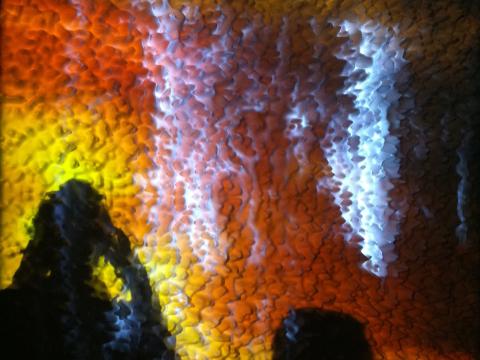
Dark Skies is a multi channel projection on CNC routed tiles inspired by the concept of biomimicry. The surfaces of the tiles themselves are based loosely on the shape and topography a wildmouse tastebud. The installation also includes an evocative soundscape, drawn primarily from field recordings captured at twilight in the Rocky Mountains during high summer. "Dark Skies" is an astronomical reference, referring to remote places free of hazy city light that allow for an extended view into deep space and time. This insight offers not only a unique perceptual and psychological experience but the promise of new discovery.
Patricia Olynyk is an artist whose prints and installations frequently employ microscopy and biomedical imaging technologies to explore the intersections between art and the life sciences. Currently she is Chair of the Leonardo Education and Art Forum (LEAF). Exhibition opening to follow the lecture.
DIYbio is an organization that aims to help make biology a worthwhile pursuit for citizen scientists, amateur biologists, and DIY biological engineers who value openness and safety. This will require mechanisms for amateurs to increase their knowledge and skills, access to a community of experts, the development of a code of ethics, responsible oversight, and leadership on issues that are unique to doing biology outside of traditional professional settings.
About the event:
DIYbio is defined differently depending on who you talk to, so we'll be giving an overview on what it means to us and why we're excited about it. Applications include: re-purposing household appliances for the makings of lab equipment, using molecular gastronomy to expand your culinary repertoire, "domestic" microbiology with kombucha and kefir and setting up a synthetic biology lab in your garage to make your own modified bacteria. People will also get a chance to make their own potato plastic keepsake from ingredients you can find in the grocery store.
DIYbio is an organization dedicated to making biology an accessible persuit for citizen scientists, amateur biologists, and biological engineers who value openness and safety. By making tangible tools of science accessible to local Southern California residents, along with sharing knowledge and resources to foster greater experimentation, members inspire discovery and share their passion in the larger community. Led by Sci-artist in residence Romie Littrell.
Friday 4-8pm: Symposium
Saturday 10am-3pm: Workshop and Exhibition
a symposium exploring new forms of biological and engineering research beyond the university and the corporation and an exhibition and bio-faire for exploring new forms of participation, open science and do it yourself biology.
With:
Gaymon Bennet (SynBERC and Ars-Synthetica.net, Berkley,)
Jason Bobe (DIYBio.org and The Personal Genome Project, Cambridge, MA)
Roger Brent (Fred Hutchison Cancer Center, Seattle)
Phil Lukeman (Cal Poly Pomona)
Hugh Rienhoff (MyDaughtersDNA.org, Berkeley)
Meredith Paterson (Hacker, Belgium)
Victoria Vesna (UCLA Art|Science Center, UCLA Design Media Arts, Los Angeles)
Moderated by:
Christopher Kelty (UCLA Center for Society and Genetics, Los Angeles)
A symposium exploring new forms of public participation in biological research, raising questions and cultivating ideas about how life could and should be studied. Panelists will address issues including do-it-yourself biology, open source science, at home medical genetics, bio-art, and novel ethical engagements with science at the cutting edge. Event schedule includes: Friday, a panelist discussion with artists, scientists and normal people; Saturday, workshops and an open-house exhibition throughout.
Today the life sciences are blooming with possibility. The Human Genome Project is at an end, but the answers it promised remain elusive. Older models of gene action and genetic determinism are crumbling, even as huge pharmaceutical corporations and federally funded university laboratories—Big Bio—continue to drive the research agenda. But just past the frontiers of law and order, a handful of outsiders are trying to remake biology in radical new ways. Synthethetic Biology, DIY Biology, recreational genetics, nanobiotechnology, open source science, patient-driven clinical research, bio-art all in their own ways are challenging Big Bio, and inviting you, the public, to participate.
But can “outlaw biology” really have an effect? What can a band of do-it-yourself biologists teaching themselves to do gel electrophoresis at home really accomplish? Can synthetic and nano-bio engineering cure malaria, as they claim, or just make yogurt glow? Who is “the public” and is it really involved in a meaningful way? What’s good—or bad—about customizing genetic research to explore forgotten diseases
or rare disorders? Can the model that made open source software a success also work in biology? Can artists teach biologists a few things about life, or biologists teach artists something about making? When biology is outlawed, will only outlaws do biology?
Citizen Science | DIY Biology | Nano Hacking | At-Home Clinical Research | Recreational Genetics | Synthetic Biology | Open Source Science | Ars Synthetica | Genetic Art