Exhibition

Image: 
Date for Content + Calendar: 
Saturday, 14 September 2024 - 2:00pm
Exhibitors / Artists: 

PST ART: Art & Science Collide

OPENING RECEPTION | Bill Fontana “Silent Echoes: Notre-Dame and the Dachstein Glacier”

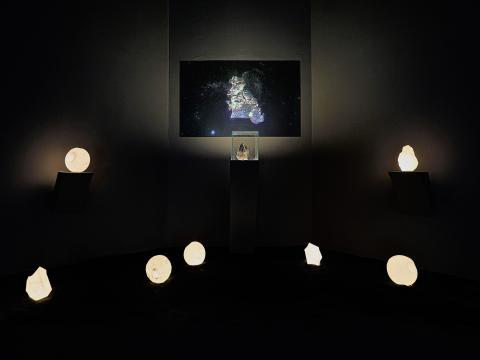
Bill Fontana’s Silent Echoes: Notre-Dame and the Dachstein Glacier is a duet between two sites of field recording: the melting Dachstein glacier in Austria, and the dormant bells of Notre-Dame after the 2019 fire. Together, they thread a sound sculpture that builds upon Fontana’s historic exploration of acoustic cubism through layered sound. The six-channel sound sculpture will be audible from Dickson Court adjacent to Royce Hall’s south entrance.

LOCATION:
UCLA Royce Hall, 3rd floor
10745 Dickson Ct
Los Angeles, CA 90095 United States + Google Map

Parking for Royce Hall is available in Parking Structure 5 located at:
340 Royce Drive,
Los Angeles, CA 90095.

Guest drop is closest at the turnaround at the front of Royce Hall located at:
10745 Dickson Court,
Los Angeles, CA 90095.

Click here to watch the Exhibitions & Performances: https://vimeo.com/showcase/12205941?share=copy&fl=sm&fe=fe

Newsletter: View the original Art|Sci newsletter

Image: 
Date for Content + Calendar: 
Friday, 30 August 2024 - 2:00pm to Sunday, 27 October 2024 - 5:00pm
Exhibitors / Artists: 

Victoria Vesna | Walter Gekelman | Haley Marks

We are thrilled to announce the premier of [SUN]Flower Plasma, a collaborative project by media artist Victoria Vesna, plasma physicist Walter Gekelman, and biomedical engineer Haley Marks.

This piece will be featured in the Elements! in Art and Tech exhibition, organized by Harvestworks Digital Media Arts Center as part of their Art and Technology Program on Governors Island.

Opening August 30, 2024 – Closing October 27, 2024
Artist Opening Saturday, August 31, from 2 – 4:30 pm

Location: Harvestworks Art and Technology Program Building 10a, Nolan Park Governors Island

More info:
https://www.harvestworks.org/aug-30-oct-27-elements-in-art-and-tech-exhi...
https://sunflowerplasma.com

---
This project resulted from years of dialogue between Victoria Vesna and plasma physicist Dr. Walter Gekelman, an expert in Alfvén waves who built one of the largest basic plasma machines in the world. In addition to gathering materials from the plasma lab, Victoria worked together with biomedical engineer Dr. Haley Marks to image sunflower parts, revealing their remarkable microscopic structures resembling the sun.
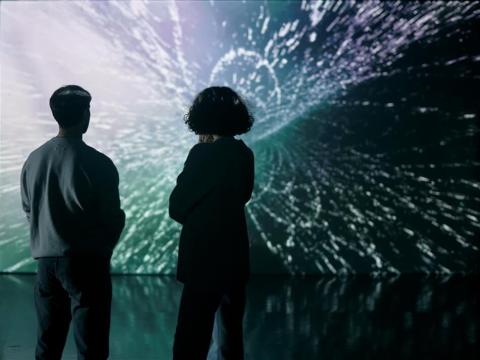
Building on the “Art + Physics = Energy” explorations, [SUN] Flower Waves delves into the ecological and geopolitical significance of sunflowers and the scientific importance of Alfvén waves. The installation features sound and images from the Large Plasma Device, solar wind data from NASA’s Parker Solar Probe, and natural recordings, offering an immersive meditation on solar energy and the cycle of creation and destruction. The sound was mixed at Harvestworks NY, adding an additional layer of depth to the experience.
Consider the sunflower, with its radiant bloom following the sun, and Alfvén waves, which are magnetohydrodynamic waves in plasma traveling along magnetic field lines. Both the sunflower and Alfvén waves exemplify a harmonious interaction between natural elements and forces, illustrating how art and science can intertwine to reveal deeper understandings.
The sunflower’s heliotropic movement, where it follows the path of the sun across the sky, is a natural manifestation of phototropism, a biological response to light. This elegant dance with the sun not only optimizes the plant’s ability to photosynthesize but also symbolizes growth, energy, and the intricate patterns found in nature.
Similarly, Alfvén waves propagate through the plasma of the sun’s corona and the interstellar medium, transporting energy along magnetic field lines. These waves play a crucial role in space weather phenomena, influencing solar wind and magnetic fields that impact our planet. The study of Alfvén waves provides insights into the dynamics of the sun and other astrophysical bodies, highlighting the delicate balance of forces at play in the universe.
By drawing parallels between the sunflower’s interaction with sunlight and the behavior of Alfvén waves in cosmic plasma, we can appreciate the interconnectedness of all things, from the smallest biological systems to the vast expanse of space. This connection underscores the importance of interdisciplinary approaches, where the principles of art and science converge to deepen our understanding of the world and inspire solutions to global challenges.

Newsletter: View the original Art|Sci newsletter

Image: 
Date for Content + Calendar: 
Saturday, 5 October 2024 - 5:00pm
Exhibitors / Artists: 

Bill Fontana

UCLA Art|Sci Center Presents Atmosphere of Sound: Sonic Art in Times of Climate Disruption | Part of Getty’s PST ART: Art & Science Collide initiative, related programs and exhibitions will run Sept 14, 2024, through June 7, 2025, launching with "Silent Echoes: Notre-Dame and the Dachstein Glaciersite" a site-specific sound installation by Bill Fontana

Opening Reception: Saturday, September 14
UCLA Royce Hall, Room 306 (Floor 3)
10745 Dickson Ct,
Los Angeles, CA 90095

>>Royce Hall
September 14-October 5, 2024: Bill Fontana’s Silent Echoes: Notre-Dame and the Dachstein Glacier is a duet between two sites of field recording: the melting Dachstein glacier in Austria, and the dormant bells of Notre-Dame after the 2019 fire. Together, they thread a sound sculpture that builds upon Fontana’s historic exploration of acoustic cubism through layered sound. The six-channel sound sculpture will be audible from Dickson Court adjacent to Royce Hall’s south entrance.

>>Nimoy Theater
September 14-October 5: At CAP UCLA’s Nimoy Theater, Bill Fontana will screen a two-channel version of Silent Echoes: Notre-Dame and the Dachstein Glacier on the building’s large outdoor marquee screens.

>>About "Atmosphere of Sound: Sonic Art in Times of Climate Disruption:"
Atmosphere of Sound: Sonic Art in Times of Climate Disruption is a series of exhibitions and performances, an app, and a publication highlighting eight Art|Sci artists in residence: Sholeh Asgary, Patricia Cadavid, Bill Fontana,Yolande Harris, Anna Nacher, Joel Ong, Iman Person, and Robertina Šebjanič; along with five local artists: Katie Grinnan, Rachel Mayeri, Christina McPhee, Amber Stucke, and Nina Waisman.
Read more:
http://artsci.ucla.edu/node/1621
https://soundofatmosphere.com
https://us8.campaign-archive.com/?e=%5BUNIQID%5D&u=9baf6baeafa7dd6c42a6d...

Directions and Parking:
Parking for Royce Hall is available in Parking Structure 5 located at: 340 Royce Drive, Los Angeles, CA 90095.
Guest drop is closest at the turnaround at the front of Royce Hall located at: 10745 Dickson Court, Los Angeles, CA 90095.

More info:
https://roycehall.org/visit/directions/

Newsletter: View the original Art|Sci newsletter

Image: 
Date for Content + Calendar: 
Wednesday, 24 April 2024 - 4:00pm
Exhibitors / Artists: 

Aaron Blaisdell

Aaron Blaisdell, UCLA Psychology Professor and Chair of the Behavioral Neuroscience

EVENT INFO
Exhibition opening: Wednesday, April 24th, 4- 6 pm
CNSI ArtSci Gallery, 5th floor
570 Westwood Plaza, Los Angeles, CA 90095

The exhibition will be on display through May 2nd, 2024
Please note that visits during workdays are by appointment only. Contact us at least a day in advance to schedule: artscicenter@gmail.com

Pigeons have provided a power house of knowledge on learning, memory, and cognition. Now, they also paint! The Blaisdell lab at UCLA has been studying pigeons making digital art using a touchscreen. The goal is to understand the "why" and the "how" of why pigeons make art. What can this tell us about human art? This exhibit features two collections from our pigeon artists. Step into the pigeon artist studio and see what they've been up to!

Dr. Blaisdell is a Psychology Professor and Chair of the Behavioral Neuroscience area at UCLA, overseeing the Comparative Cognition Lab and the Pigeon Art Project. As a member of the UCLA Brain Research Institute, the UCLA Integrative Center for Learning & Memory, and the UCLA Evolutionary Medicine program, Dr. Blaisdell has an extensive academic background with a BA in Anthropology from SUNY Stony Brook, an MS in Anthropology from Kent State University, a Ph.D. in Behavioral Neuroscience from SUNY Binghamton, and two years of NIH-funded postdoctoral training at Tufts University.

Get directions to CNSI: https://cnsi.ucla.edu/cryoem/location/
Concurrent with this exhibition, a LASER Talk will be held: http://artsci.ucla.edu/node/1716

Newsletter: View the original Art|Sci newsletter

Image: 
Date for Content + Calendar: 
Wednesday, 10 April 2024 - 4:00pm
Exhibitors / Artists: 

Hannah Landecker

EVENT INFO
Exhibition opening: Wednesday, April 10th, 4- 6 pm
CNSI ArtSci Gallery, 5th floor
570 Westwood Plaza, Los Angeles, CA 90095

The exhibition will be on display through April 17th, 2024

The images in this collection induct the viewer into a fantastic universe of textures and viscosities generated in the making of processed foods. In a set of advertisements exhumed from back issues of industry trade journals in food engineering from the 1960s through the 1990s, this exhibit explores the values and the chemistry of an otherworldly scene in which there are no lumps, inconsistencies, or bubbles. Emulsifiers, clouding agents, gums, thickeners, anti-foaming agents, and antioxidants ensure that the marshmallows remain eternally fluffy, the particles are all the same size, mixtures never separate, and the sauce stays on top. Produced by upstream chemical manufacturers and aimed at an audience of food processors, these messages were not intended for the end consumer - and indeed often extolled the invisibility of their products to the eating public. Now that the health impacts of highly processed foods are increasingly ringing alarm bells in medicine and epidemiology, and the environmental footprint of these industrialized systems of production becomes ever more evident, this exhibit invites the eating public to see into the process for themselves.
This exhibit leverages the deep collections of the UCLA Library system in bringing these material off the page and onto the wall. It is curated by the Hot Cling and Shear Magic Research Group, a team of UCLA undergraduates led by Professor Hannah Landecker, pied piper of the grim joy of historical excavation of apparently banal but terribly consequential social and technical events shaping our biological lives. The team, composed of undergraduates majoring in Human Biology and Society and Psychobiology, is comprised of Xian Zeng, Nicole Vasquez, Emily Sutherland, Kianna Satari, Manasi Sastry, Chloe Nelson, Max Kokka, Kiana Karimi, Rayna Irving, Sara Herron, Xavier Herrera, Haley Ficker, Lea Dahlke, and Shelsy Aragon.

Hannah Landecker, with a Ph.D. in Science and Technology Studies from MIT and a B.Sc. in Cell and Developmental Biology from the University of British Columbia, uses the tools of history and social science to study contemporary developments in the life sciences, and their historical taproots in the twentieth century. She has taught and researched in the fields of history of science, anthropology and sociology. At UCLA she is cross-appointed between the Institute for Society and Genetics, and the Sociology Department. She is currently working on a book called “American Metabolism,” which looks at transformations to the metabolic sciences wrought by the rise of epigenetics, microbiomics, cell signaling and hormone biology.
Landecker’s work focuses on the social and historical study of biotechnology and life science, from 1900 to now. She is interested in the intersections of biology and technology, with a particular focus on cells, and the in vitro conditions of life in research settings.

Get directions to CNSI: https://cnsi.ucla.edu/cryoem/location/
Concurrent with this exhibition, a LASER Talk will be held: http://artsci.ucla.edu/node/1712

Please note that visits during workdays are by appointment only. Contact us at least a day in advance to schedule: artscicenter@gmail.com

https://artsci.ucla.edu/node/1721

Newsletter: View the original Art|Sci newsletter

Image: 
Date for Content + Calendar: 
Saturday, 17 February 2024 - 6:00pm
Exhibitors / Artists: 

Victoria Vesna

Humans are just one species among millions, coexisting in an expansive living network. Immerse yourself in installations envisioned by artists, designers, scientists, technologists and changemakers from across 12 countries. Their cross-cultural and interdisciplinary collaborations open portals to a shared future, in which planet and people flourish together.

More information:
https://www.pem.org/exhibitions/our-time-on-earth
On view February 17 to June 9, 2024

Part of PEM’s Climate + Environment Initiative, this traveling exhibition from the Barbican Centre in London celebrates the power of global creativity to transform the conversation around the climate emergency. The structures and design featured in the exhibition are sourced from biodegradable, sustainable materials to minimize carbon footprint. We invite you to imagine our ideal future world. What will it look like? How will we use the precious time we have here? Technology has brought us closer to nature than we have ever been before, and Indigenous insight continues to reconnect us to our roots. What will it take to live together in harmony?

Walk up to a table set for dinner, but imagine the guests include a fox and a wasp. Plunge into a virtual ocean with magnified plankton, and peer through the layers of a tree to experience the microscopic foundations of life.

Our Time on Earth is produced and curated by the Barbican with guest curators FranklinTill and co-produced by Musée de la civilisation, Québec City, Canada. This exhibition is made possible by Carolyn and Peter S. Lynch and The Lynch Foundation. We thank James B. and Mary Lou Hawkes, Chip and Susan Robie, and Timothy T. Hilton as supporters of the Exhibition Innovation Fund. We also recognize the generosity of the East India Marine Associates of the Peabody Essex Museum.

Share your impressions, snapshots and tales with us on social media using #OurTimeOnEarth.

TOP IMAGE: Victoria Vesna, Noise Aquarium (detail), 2022. Installation view of the Our Time on Earth exhibition at the Barbican Centre. © Danann Breathnach Photography.

Image: 
Date for Content + Calendar: 
Tuesday, 26 September 2023 - 2:00pm
Exhibitors / Artists: 

Christoph Kilian

"The California Spangled Cat is a completely new breed of American Domestic feline. All the genetic magic that produces the lush spotted coats of the world's big cats has been duplicated for the small, perfect bodies of these leopards for your living room."

On Tuesday, September 26th, from 2 to 7 pm, the California Snow Leopard will be visible through a telescope placed on the rooftop of the UCLA Planetarium, buzzing with dragonflies.

The little creature with leopard spangles on a white coat found its way into the world paired with an accompanying silver bowl through the 1986 Neiman Marcus Christmas Book, an American luxury mail-order catalog. Its creator, Hollywood screenwriter Paul Casey Jr., developed the exclusive animal as a living memorial to its endangered relatives in the wild.

Fur coats were offered for sale in the same catalog just a few pages away. In addition to the high price of $1.400, the delivery time for the cat, which was difficult to breed in its snow-white form, was 8 months. The cat only found few buyers, and gradually Casey had to refocus his excitable mind on the more promising among his many projects. Thus, the process of the little leopard’s vanishment already began when it was born.

According to The International Cat Association, it has fully disappeared by now, foreshadowing a tragic parallel to its big relatives. In cat breeder circles, sometimes grey or ruddy specimens still appear and are, like the original, called “California Spangled”.

The white variant—the snow leopard—whose birth under the Californian sun was certainly the least expected and who was not even pictured in said Christmas catalog, but only evoked in enthusiastic words, dissolves, however, every day a little more - a possible improbability or improbable possibility, as also its name fades away.

The rare chance to capture the phantom through a telescope was therefore unforeseeable and revives the idea that the animal could be of enchanted nature.

About the artist:
Christoph Kilian, *1983, studied media arts at the Bauhaus University Weimar and the Academy of Media Arts Cologne. He lives between Cologne, Salzburg and Los Angeles, where he completed a guest study program at the ArtCenter College of Design in 2014 and currently is artist-in-residence at the UCLA Art|Sci Center. In a cross-media play and clash with technology, he constructs machine fairy tales that - often on the verge of futility - trace the magical.

Newsletter: View the original Art|Sci newsletter

Image: 
Date for Content + Calendar: 
Saturday, 22 July 2023 - 10:00am
Exhibitors / Artists: 

Victoria Vesna

This exhibition discusses the idea of cosmological elements through several lenses: the lens of science that questions what are the elements that constitute objects in the cosmos and the space in-between, elements that can also become central to study the universe and life on planet Earth. In that sense, a selection of cosmological elements also constitutes life on Earth as we humans know it. At the same time, we look at life on Earth and search for life in outer space based on several ideas that continuously built up throughout scientific and research endeavors of cultures throughout human history. Such culturally understood cosmological elements manifest in scientific studies, but also in human dreams and stories being told.

Newsletter: View the original Art|Sci newsletter

Image: 
Date for Content + Calendar: 
Wednesday, 14 June 2023 - 8:00pm
Exhibitors / Artists: 

Victoria Vesna

Curated by the Barbican Center of London and co-produced by Musée de la civilisation

The Musée de la civilisation is partnering with London's prestigious Barbican Centre to co-produce this major international exhibition.

First presented in London in summer 2022, the exhibition will come in 2023 to the Musée de la civilisation, where it will be adapted to reflect local climate issues and solutions.

Through a dozen immersive contemporary artworks—most of which were created specially for the exhibition—Our Time on Earth focuses on the solutions to the crisis and encourages us to dream up a better world together. Biodiversity conservation, agriculture and food, energy, mobility and transportation, construction and consumption are some of the themes addressed.

Visitors of all ages and from all walks of life will feel challenged by this unique exploration that has the power to change perceptions. They will even be able to take action, right in the exhibition room, by committing to concrete steps now!

Newsletter: View the original Art|Sci newsletter

Image: 
Date for Content + Calendar: 
Tuesday, 6 June 2023 - 12:00pm
Exhibitors / Artists: 

Dr. Kenneth Wells & Dr. Elyn Saks

For UCLA Health psychiatrist and researcher Dr. Kenneth Wells, the inspirational true-life tale of his friend, USC professor Elyn Saks, was a perfect fit for his other job: opera composer.
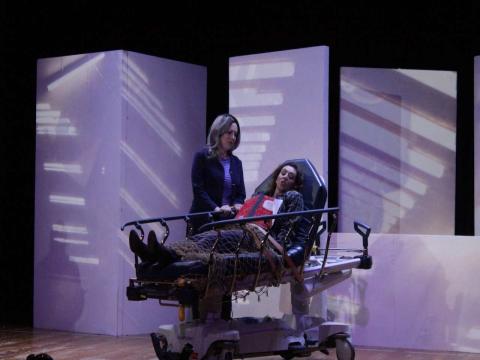
Wells has written a new opera based on Saks’ acclaimed 2007 memoir, “The Center Cannot Hold: My Journey Through Madness,” which details her lifelong experience with schizophrenia, from her first psychotic experiences in high school to ascending the ranks of academia at a prestigious law school. The opera, which will be performed in June at the Jane and Terry Semel Institute for Neuroscience and Human Behavior at UCLA, is the fourth written by Wells and the second about Saks.

Dr. Kenneth B. Wells, M.D., M.P.H., received his M.D. from UCSF and his M.P.H. from UCLA. He is a psychiatrist, a Senior Scientist at RAND, Professor of Psychiatry and Biobehavioral Sciences at the David Geffen School of Medicine and Professor of Health Services at the UCLA School of Public Health. He directs the Health Services Research Center of the Jane and Terry Semel Institute for Neuroscience and Human Behavior, which focuses on improving quality of care for psychiatric and neurological disorders across the lifespan.

Dr. Elyn R. Saks is associate dean and Orrin B. Evans Professor of Law, Psychology, and Psychiatry and the Behavioral Sciences at the University of Southern California Gould Law School, an expert in mental health law, and a MacArthur Foundation Fellowship winner. Saks lives with schizophrenia and has written about her experience with the illness in her award-winning best-selling autobiography, The Center Cannot Hold, published by Hyperion Books in 2007. She is also a cancer survivor.

This exciting conversation is scheduled to take place prior to the live workshop and performance dates on June 17, 23, and 25.

Watch online:

Newsletter: View the original Art|Sci newsletter

Pages