Ellen K. Levy is a multimedia artist and writer known for exploring art, science and technology interrelationships since the mid-1980s. Levy highlights them through exhibitions, educational and curatorial programs, and publications. Her graduate studies were at the School of the Museum of Fine Arts, Boston following a B.A. from Mount Holyoke College in Zoology. She was President of the College Art Association (2004-2006) before earning her doctorate (2012) from the University of Plymouth (UK) on the art and neuroscience of attention. She then was Special Advisor on the Arts and Sciences at the Institute for Doctoral Studies in the Visual Arts (2012-2017). She was a Distinguished Visiting Fellow in Arts and Sciences at Skidmore College (1999), a position supported by the Luce Foundation, and has taught many transdisciplinary classes and workshops (e.g., at The New School, Cooper Union, Brooklyn College, Banff). She has exhibited widely in the US and abroad. Levy’s solo exhibitions include the New York and National Academy of Sciences, and she was represented by Associated American Artists and Michael Steinberg Fine Arts (NYC) until they closed in 2009. Her work has been in landmark group exhibitions overseen by Lucy Lippard and Martin Kemp and in more recent exhibitions at Cyfest held in Saint Petersburg, Russia, at Ars Electronica and ISEA. She was guest editor of Art Journal’s special issue, “Contemporary Art and the Genetic Code” (1996), the first in-depth academic publication about genomics and art and has since pursued these topics in depth. She was twice an invited participant at Robert Wilson’s Art and Consciousness Workshop (Watermill, NY). Since 2009, she and Patricia Olynyk have co-directed the NY LASER, a forum in support of Leonardo/ISAST. With Charissa Terranova, she is co-editor of D'Arcy Wentworth Thompson's Generative Influences in Art, Design: From Forces to Forms (2021, Bloomsbury Press). Following the publication, attuned with pop artist Richard Hamilton who curated an exhibition devoted to Thompson’s insights in 1951 at the London ICA called "Growth and Form," she curated a related exhibition of contemporary art at Pratt Manhattan Gallery (NYC). Levy and Barbara Larson co-edit the “Science and the Arts Since 1750” book series of Routledge/Taylor & Francis Press.
Saturday, 10 December 2022 - 9:00am to Wednesday, 15 February 2023 - 6:00pm
Exhibitors / Artists:
Victoria Vesna
ALIEN STAR DUST: Signal to Noise is a multi-faceted and multi-disciplinary project premiered on March 10, 2020, in Vienna at the meteorite gallery of the Natural History Museum. This research-based art project invites viewers to gain an intimate understanding of the importance and complexity of dust.
Every creature contains hydrogen atoms, and every material element is manufactured in stars through fusion. We, along with our myriad siblings of animals, plants, insects, plankton, bacteria, fungi, and viruses, are created from stardust by nuclear fusion. We all function together in vibratory fields from the bottom up, just as nature and nanotechnology work.
Fosun Foundation (Shanghai) is a non-profit organization launched and supported by the Fosun Group and Fosun Foundation.
The center is located in the Bund Finance Center. The building houses four floors above ground and three below. It was designed by British design firm Foster + Partners and creative director Heatherwick Studio. The architectural highlight is the facade—a golden, rotating bamboo curtain that hangs from the third floor. A visual element that combines East and West resembles an ancient Chinese crown and a Western harp. For several hours each day, the screen rotates in time with music, a “dancing building” along the bund.
ALIEN STAR DUST: Signal to Noise is a multi-faceted and multi-disciplinary project premiered on March 10, 2020, in Vienna at the meteorite gallery of the Natural History Museum. This research-based art project invites viewers to gain an intimate understanding of the importance and complexity of dust.
Every creature contains hydrogen atoms, and every material element is manufactured in stars through fusion. We, along with our myriad siblings of animals, plants, insects, plankton, bacteria, fungi, and viruses, are created from stardust by nuclear fusion. We all function together in vibratory fields from the bottom up, just as nature and nanotechnology work.
This exhibition is a part of the NTU-GDAP program. Taking the form of a biennial competition, the Nanyang Technological University Global Digital Art Prize (NTU-GDAP) is where artistry, technological innovations, and scientific interests collide. It recognizes global artists, technologists, and scientists with extraordinary creativity in digitally mediated art, design, and cultural heritage.
This panel is a part of NTU-GDAP program. Taking the form of a biennial competition, the Nanyang Technological University Global Digital Art Prize (NTU-GDAP) is where artistry, technological innovations, and scientific interests collide. It recognizes global artists, technologists, and scientists with extraordinary creativity in digitally mediated art, design, and cultural heritage.
About the UCLA SCI ART SUMMER program:
In the highly competitive Sci|Art Studio + Lab, students are immersed in science and art practices to simultaneously develop and sharpen analytical and creative skills. This program prepares students for interdisciplinary thinking before they begin their undergraduate education. During this intensive two-week program, students make connections between cutting-edge scientific research, popular culture, and contemporary arts. Through historical retrospectives, surveys of current art-science collaborations, and science fiction movie screenings, students are exposed to the interface of science, art, and culture with a focus on multidisciplinary collaborations.
ART SCI SOUND WALK AT TEDx Manhattan Beach:
The audience is invited to a guided sound walk from the North side of the Tedx Exhibition to the South side. This unique sound walk creates a connection and opens a conversation between ocean and space. All visitors will have a chance to experience a collaborative composition by Patricia Cadavid, Anna Nacher, Ivana Dama, Clarissa Ribeiro and Victoria Vesna.
Robin Gose has been a STEM educator for more than 20 years, in both classroom and museum settings. She joined the MOXI team in November 2017 during its inaugural year as Santa Barbara’s newest hands-on science museum and destination for families. In this role, she oversees the museum’s operations, finances, fundraising, outreach, and programming to ensure alignment with the organization’s mission, “to ignite learning through interactive experiences in science and creativity.” She also cultivates relationships with supporters, business and civic leaders, schools, community partners, media, and more to further promote MOXI as a world-class institution for informal science learning.
Robin came to MOXI after three years as director of education at Thinkery in Austin, Texas where she cultivated the pedagogical vision of the institution and oversaw all programming, exhibits and facilities at the latest iteration of what was once the Austin Children’s Museum. Robin’s passion is to make science fun for young learners to promote their social, cognitive, and emotional development. She values providing authentic learning experiences for children to explore the world around them, with an emphasis on making science accessible to children from diverse backgrounds.
She earned her bachelor’s degree in geography and environmental resource management from the University of Texas, Austin. Robin began her career managing summer camps at the Austin Nature and Science Center before moving to Los Angeles to oversee programs at the California Science Center. She then transitioned to teaching K-5 science at an independent school in Los Angeles. During this time, she earned a doctorate degree in educational leadership from the University of California, Los Angeles, where her academic research focused on English language learners’ experiences in science classrooms.
Robin is an active volunteer in the Santa Barbara community, serving on the boards of Visit Santa Barbara and Downtown Santa Barbara as well as the Santa Barbara Botanic Garden’s Education Committee. She also serves on subcommittees for the Association of Children's Museums, the Association of Science and Technology Centers, and has been a grant proposal reviewer for the Institute of Museum and Library services for almost a decade.
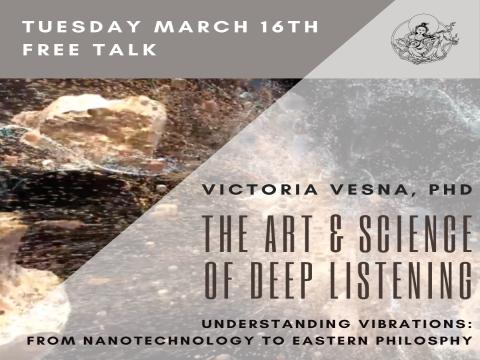
This talk will present NANO: a large-scale series of installations that premiered at LACMA in 2003. This art sci collaboration addressed issues of scale, perception, frequency, and vibrations that foreshadowed the impact of the invisible and inaudible on humans and, by extension, on all species. We will make a full circle to the most current work focused on plankton, stardust, and the atomic gold standard.
Friday, 7 October 2022 - 6:00pm to Sunday, 20 November 2022 - 6:00pm
Exhibitors / Artists:
Victoria Vesna
"I am Everywhere but Nowhere"
Exhibition Venue:
Seongsan Art Hall (B1, 1F, 2F, and outdoors on the premises), 3·15 Nuri Marine Park, Chang-dong Art Village Art Center, Jinhae Black & White, and Jinhae Jungwon Rotary
Alien Star Dust : Signal to Noise
7분 23초
Single channel video, Augmented Reality (AR)
In a Series of Monthly Animal Gatherings,
We Move Around the Wheel of the Chinese Zodiac. We are on the 9th Animal...MONKEY!
Featuring Fantastic People Born in the Sign of the MONKEY
.
.
Cristina Albu (Missouri)
Cristina Albu is an art historian, educator, and writer focusing on crossovers between contemporary art, cognitive sciences, and technology. She is Associate Professor of Contemporary Art History at University of Missouri-Kansas City (UMKC). Albu is the author of Mirror Affect: Seeing Self, Observing Others in Contemporary Art (Minnesota University Press, 2016) and the co-editor (with Dawna Schuld) of Perception and Agency in Shared Spaces of Contemporary Art (Routledge, 2018). Her writings have appeared in scholarly anthologies (e.g. Nervous Systems, Hybrid Practices, Framings, The Permanence of the Transient, Crossing Cultures) and journals (e.g. Afterimage, Artnodes, Camera Obscura, and the Comparative Media Arts Journal). At UMKC, Albu teaches courses on global contemporary art, participatory and site-specific tendencies, museum studies, and the role of emotion in art reception.
Girija Hariharan (India)
Girija Hariharan, is an artist and Muralist based out of Bangalore, India. She works with street art, large art installations and art intervention workshops to effect social change and community healing. Recognised as one of the top innovators of Bangalore, her street art and interviews have appeared in multiple publications. Along with traditional fine art mediums, Girija explores body art, music, poetry, tech art, graphic design, book covers, illustrations. Her original artworks are sold worldwide, with her primary themes amalgamate feminism, mythology, anthropology, environment and spirituality.
Mana Salehi (Spain)
Mana Salehi, video artist and researcher of Iranian origin, has lived and worked in Barcelona since 2004. She received her doctorate from the Faculty of Fine Arts of the University of Barcelona. The subject of her research and artistic production is “Water and the symbols of the garden in contemporary art”. She has done several researches in Japan, the United States and Iran. She has participated in various international and national solo and group exhibitions. In her work, she explores environmental crises and human emotions through visual poetics. She has been a professor of Visual Arts and new media at various universities in Tehran and has also organized a workshop at the Faculty of Fine Arts of the University of Barcelona.
In 2020 she was a member of the jury of the Asian Film Festival Barcelona organized by Casa Asia and, she was a professor of course secrets of Persian garden at Casa Asia.
Currently, she is displaying her recent video art The Voice of Saffron at the Royal Botanical Garden of Madrid.
She is also a member of Woman Eco Artists Dialog (WEAD) in the United States.
Organized by Warren Neidich in collaboration with UCLA Art Sci center, The Getty Research Center, The Saas-Fee Summer Institute of Art and the Museum of Neon Art.
Friday, September 23, 2022, 9:30 a.m. to 6:30 p.m.
UCLA California NanoSystems Institute (CNSI)
Presentation Space, 5th floor
570 Westwood Plaza
Building 114
Los Angeles, California
This conference endeavors to describe the role of art and artists in cognitive capitalism in which
the brain and mind are the new factories of the 21 st century. We are no longer only proletariats
working on assembly lines to create objects but cognitariats or mental labors working on screens
to produce Big Data which is sold to policing, governmental and cooperate entities. This has led
such authors as Byung-Chul Han, in his book Psycho-politics: Neoliberalism and New
Technologies of Power, to understand that in our moment biopower, Foucault’s power over life
as a form of the granular management of life, has transitioned to psychopower or psychopolitics
in which the mental laborers or cognitariats gladly give up their freedoms without direct coercion
to labor incessantly and overtime to interact with digitality. His new term for this is “smart
power”. But we are now on the doorstep of another transition almost or maybe as important as
that which transformed the agricultural/manufacturing economies into knowledge and
information economies. It is referred to as a neural based economy in which the material brain
and its neuroplasticity have become the focus of capitalistic commodification directly and
indirectly. Directly through technologies like brain computer interfaces, nootropics and cortical
implants and indirectly with Big Data, neuroeconomics and neural consumerism. In this neural
economy, psychopower has further transitioned to neural power where the material brain is put
to work. In psychopower and neuropower the body’s importance is reduced and subsumed by the
brain and mind. The brain, as understood here, is not restricted to the bony carapace of the skull
as cognitivists would have us believe but is a situated complex that extends into the socio-
political-cultural-ecological milieu with which it coevolves. Changes in the external milieu are
mirrored in the architectural composition of the brain through a process that Bernard Stiegler,
later in his life, referred to as exosomatic organogenesis, in which technical rather than genetic
evolution is at the core of the liberation and perfection of organ systems, especially the brain.
This brain-model is a diverse, variable, rhizomatic, intensive, becoming entity in constant
transformation. Consciousness is no longer understood as something restricted to and most
elegantly formed in humankind but rather is traced into the deep history of inorganic matter and
shared with plants and animals in non-hierarchical alignments.
This is the starting point for this symposium in which artists, architects, art historians, and
philosophers using their own practices, materials, histories, and apparatuses unveil the mysteries
of this becoming brain model. In fact, the power of art is its special alliance with the sensory,
perceptual, and cognitive as a source of emancipation, magic, and diversity in contradistinction
to cognitive neuroscientific models of aesthetics in which it becomes a map or model of data
points subject to forms of institutionalization, normalization, and demystification. This is where
the idea cognitive activism becomes evident as a reaction and form of dissensus against these
conservatisms. Key to this conference is Catherine Malabou’s entreaty that the brain is our
work, and we have the capacity to make our own brains if we have the fortitude to do so. In this
vein we also will engage with Victoria Pitts- Taylor in her book The Brain’s Body understands,
“the plastic, social brain also reveals neurobiology to be political-that is, capable of change and
transformation and open to social structures and their contestation.”
Faculty
David William Bates, Arne DeBoever, Jordan Crandall Anders Dunker, Igor Galligo, Katie
Grinnan, Karen Lofgren, David Rosenboom, Victoria Vesna, Anuradha Vikram, Pinar
Yoldas, Warren Neidich.