Opening March 7
Lecture @ 2pm
Exhibition Openings: 5-7pm
Location: Lecture @ UCLA Broad Art Center, room 5240, Exhibition @ CNSI Gallery
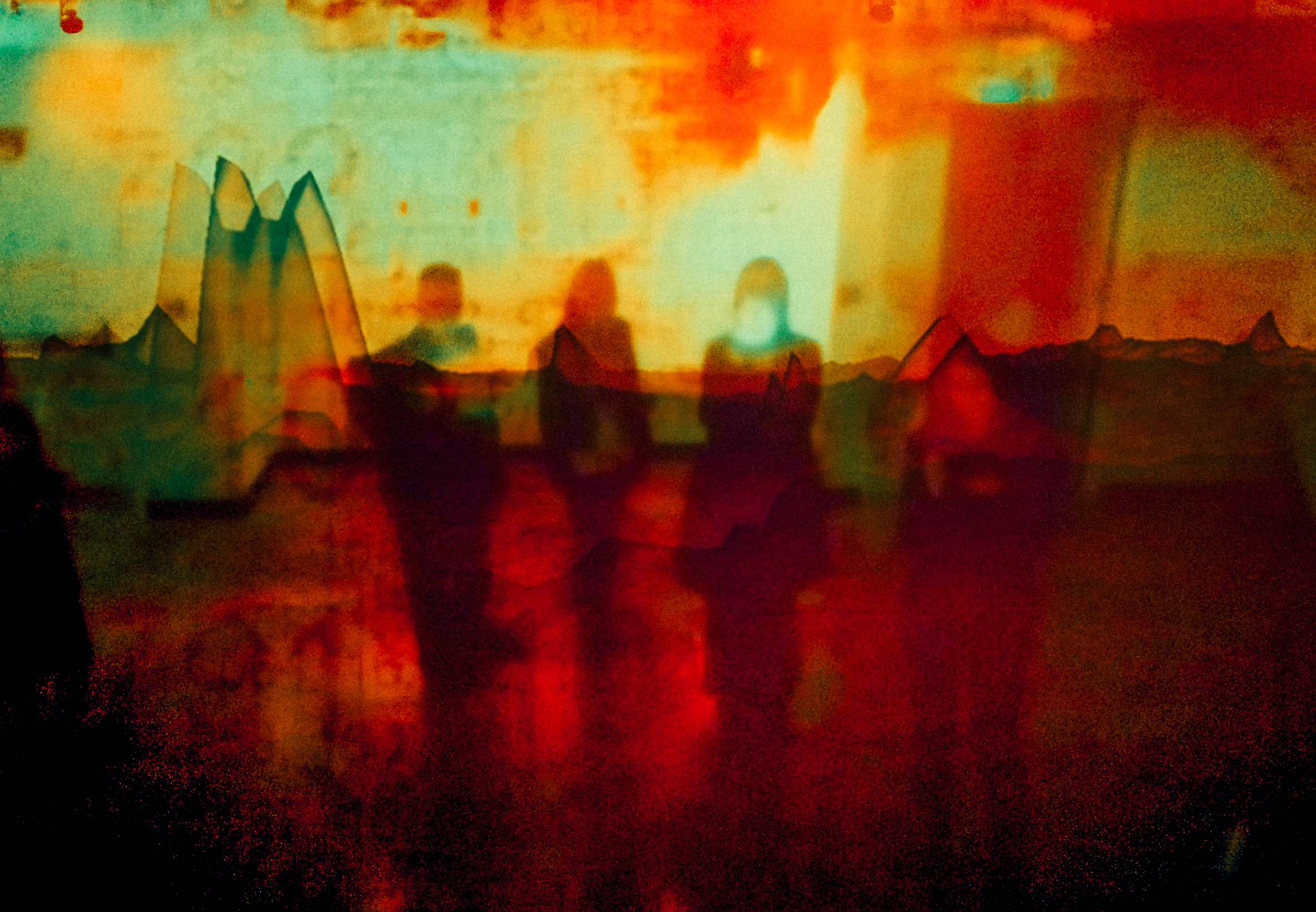
Exposure is an exhibition of work by Mike Phillips, Professor of Interdisciplinary Arts, School of Art & Media at Plymouth University. Mike Phillips is director of i-DAT, a Principal Supervisor for the Planetary Collegium and a supervisor of the Transtechnology Research Groups. His R&D orbits digital architectures and transmedia publishing, and is manifest in a series of ‘Operating Systems’ to dynamically manifest ‘data’ as experience in order to enhance perspectives on a complex world. The year that Eastman Kodak filed for bankruptcy protection was the same year Fujifilm moved from film production to beauty products1. This did not just mark a technological shift from film grain to nanoparticles but also a massive cultural shift - a shift from capturing the face on film to the embedding of ‘film’ in the face. The thing that once froze the face in an eternal youthful smile is now the anti-aging nanoparticle that preserves the face we wear. Barthes described the face on film as representing “a kind of absolute state of the flesh, which could be neither reached nor renounced”2. Now this absolute state is closer to hand and we will walk around wearing our old photo albums as our face, peeling away the frames like layers of dead skin. Our essence, like Garbo’s, will not degrade or deteriorate. ‘Viewed as a transition’ Exposure explores the deterioration of the flesh through the temporality of the Atomic Force Microscope (AFM). From the 60th of a second exposure of the Kodak Brownie camera to the 20-minute scan of the AFM - the closer the subject the longer the ‘exposure’. Incorporating data from an AFM scan of a basal cell carcinoma Exposure explores the convergence of ideologies constructed around imaging technologies. Through a subtle interaction the viewer conjures up a dynamic data/image of a skin cancer - over exposed to the sun - or the intense light of the camera flashgun.
Lecture @ 2pm
Exhibition Openings: 5-7pm
Location: Lecture @ UCLA Broad Art Center, room 5240, Exhibition @ CNSI Gallery
Dark Skies is a work by Patricia Olynyk in Collaboration with Axi:Ome and Christopher Ottinger.
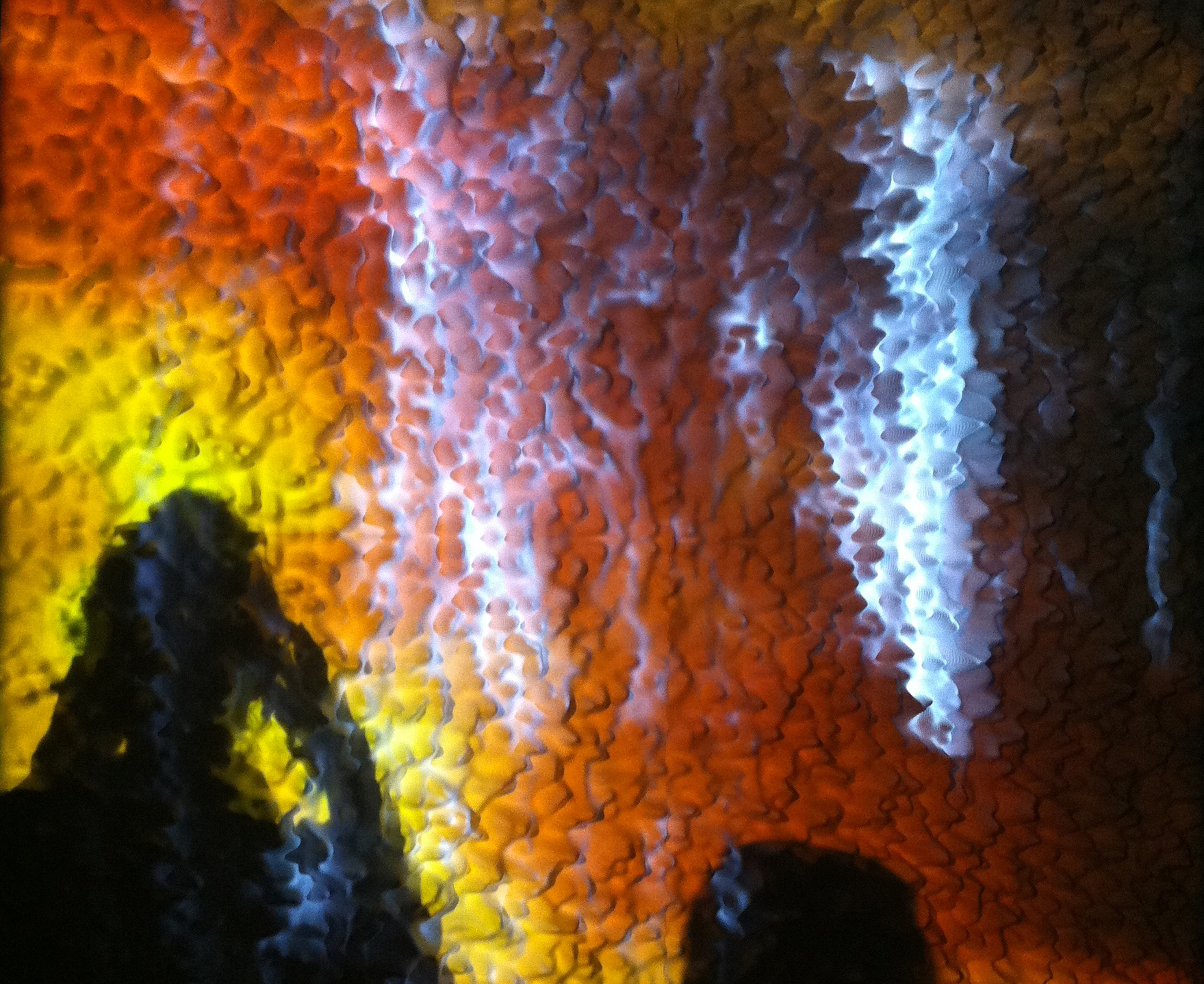
Dark Skies is a multi channel projection on CNC routed tiles inspired by the concept of biomimicry. The surfaces of the tiles themselves are based loosely on the shape and topography a wildmouse tastebud. The installation also includes an evocative soundscape, drawn primarily from field recordings captured at twilight in the Rocky Mountains during high summer. "Dark Skies" is an astronomical reference, referring to remote places free of hazy city light that allow for an extended view into deep space and time. This insight offers not only a unique perceptual and psychological experience but the promise of new discovery.
Patricia Olynyk is an artist whose prints and installations frequently employ microscopy and biomedical imaging technologies to explore the intersections between art and the life sciences. Currently she is Chair of the Leonardo Education and Art Forum (LEAF). Exhibition opening to follow the lecture.
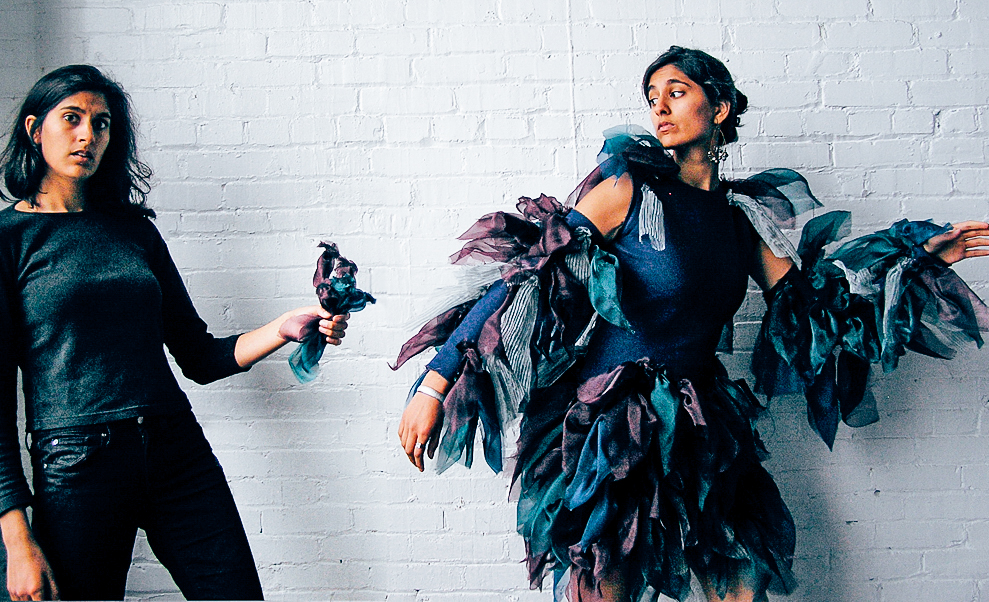
Amisha Gadani is a Los Angeles artist interested in curious creatures and their unique adaptations. She is an artist in resident at the Alfaro Lab and the Center for Society and Genetics at UCLA.
Time:
Lecture @ 2pm
Location: UCLA Broad Art Center, room 5240
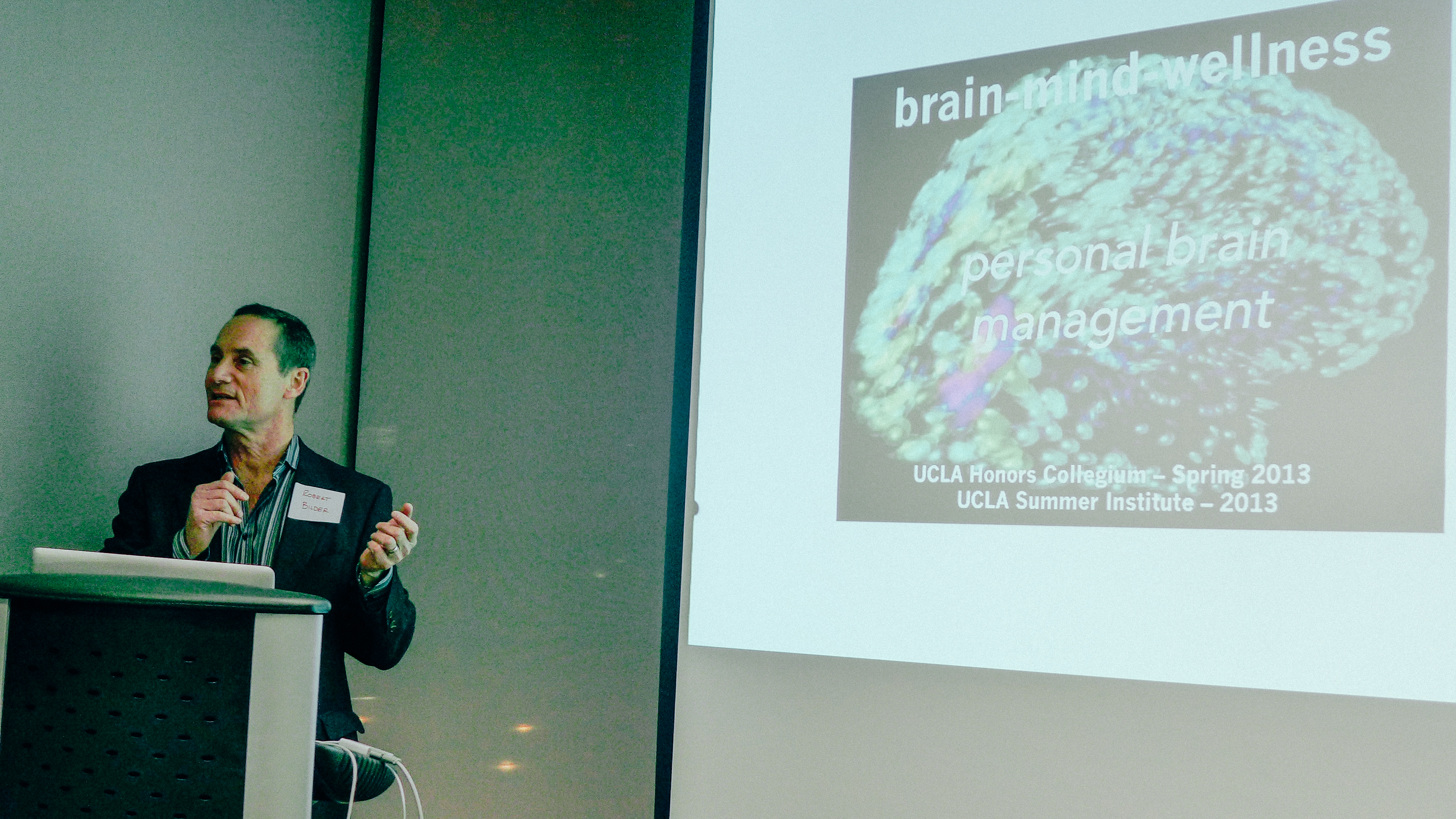
Robert Bilder Lecture (hosted by Prof. Barbara Drucker, Dept. of Art)
Dr. Bilder is a Clinical Neuropsychologist who has been actively engaged for over 20 years in research on the neuroanatomic and neuropsychological bases of major mental illnesses. Dr. Bilder’s current research focuses on transdisciplinary and translational research. Among other prominent positions, he directs the Tennenbaum Center for the Biology of Creativity.
Takashi Ikegami is an associate professor in the Department of General Systems Sciences at the University of Tokyo. His works encompasses both the arts and sciences and deal with complex systems and artificial life. He comes to UCLA to start work on a NSF grant with Professor Charles Taylor and Victoria Vesna. Together they are developing the “Acoustic Sensor Arrays for Understanding Bird Communication”
Mizuki Oka
Exploring Default Mode and Information Flow on the Web
Using the unique ideas of the recent discovery in brain science of the
default mode, Oka studies the autonomy and information flow in a Web
system. In this talk, Oka discusses her study on the weak fluctuation
not driven by social context as a default mode of the Web derived from
brain science.
Time:
Lecture @ 2pm
Location: UCLA Broad Art Center, room 5240
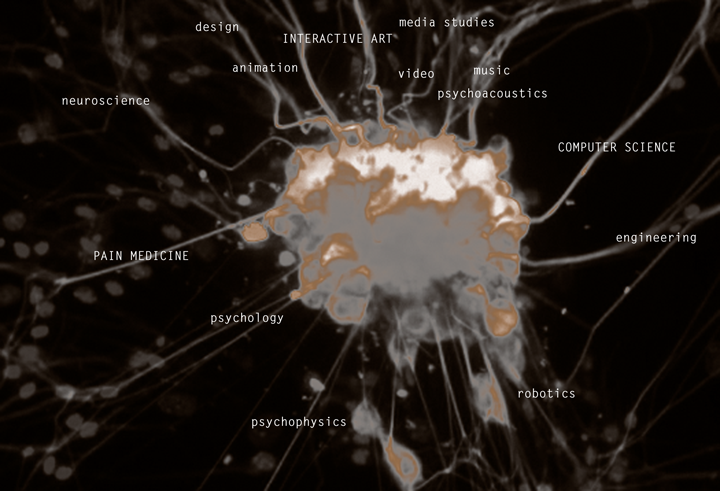
Spring 2011 Art|Sci Artist in Residence Dr. Diane Gromala spent her time at UCLA researching the expression of pain at UCLA’s John C. Liebeskind History of Pain Collection in the Louise M. Darling Biomedical Library.As the Founding Director of the Transforming Pain Research Group, Gromala collaborates with prominent pain physicians, a neuroscientist, a psychophysicist, artists and animators, computer scientists and engineers and interaction and sound designers.
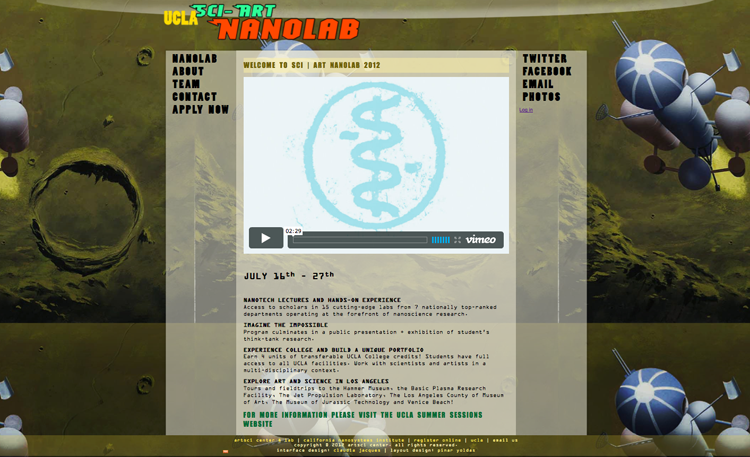
The Sci | Art NanoLab is a highly competitive summer program for high school juniors and seniors interested in collaborating with diverse and notable minds to challenge traditional, polarized perspectives of the arts and sciences. Throughout the 2-week intensive program, students will make connections between cutting edge scientific research, popular culture and contemporary arts. Lab visits, workshops, hands-on experiments, and meetings with world renowned scientists will be balanced with visits to museums, daily movie screenings and meetings with famous contemporary artists who collaborate with scientists.
The Wild West of Chronic Pain:
Collaborations among Artists, Scientists and Health Care Experts
Why is a media technology -- immersive VR -- known as a "non-pharmacological analgesic"?
Can a robot reduce anxiety?
How might novel forms of social media combat the social isolation experienced by seniors who have chronic pain?
What do Sufi practices and phosphorescent creatures have to do with pain?
Members of the Transforming Pain Research Group comprise artists, musicians, computer scientists, engineers, designers, psychophysicists; and pain physicians. All are exploring the ways that new technologies may help the 1 in 5 people who suffer from chronic pain.
Referred to as the silent epidemic, this relatively new disease has no known cause and no cure. While health care researchers explore its etiology, experts from diverse disciplines are working on ways to help with managing chronic pain. See what a group of innovative researchers north of the border are doing.
November 30th: . Guided Tours: Noon to 5pm
ArtSci Gallery, CNSI Bldg., Room 5419 . Reception: 5:30-7:30pm
CNSI Lobby
“Before I sink
Into the big sleep
I want to hear
I want to hear
The scream of the butterfly”
(Jim Morrison, “When the Music is Over”, 1967)
Once an artist takes on the challenge of making the invisible visible, or the inaudible audible, s/he is almost immediately thrown into the realm of energy at the edge of art and science. The established art world based on visual culture finds it difficult to place this kind of work. The scientific community, used to working in this realm in a reductionist way, finds it hard to comprehend. Yet the public seems to be drawn to artwork residing “in between”, and there seems to be a universal need for a connection to the spiritual realm beyond what established religions offer. As many speculative ideas in the West circulate around ideas of energetic approach to matter in general, particularly the body and mind, alternative medicine and other Eastern philosophies are thriving. Nanotechnology mixing with the quantum fields, inexplicable to the rational reductionist minds, opens up new territories of vibration matters that brings us back to poetic expressions.
The Ancient Greek word for "butterfly" is ψυχή (psȳchē), primarily means “soul” and/or “mind” and the sensation of feeling “butterflies in the stomach” is most often experienced prior to important events, related to nervousness and can be experienced in situations of impending danger. It is possible that the condition, frequently felt by an oncoming new experience or relationship, is caused by a surge of adrenaline. One could look at the current condition of humanity as a collective state of nervousness, especially in relation to the current economic / ecological crisis that is global. The “butterfly effect” has been very much in the public imagination in the last two decades with numerous movies, Sci-Fi novels and even games, center plots around the idea that one butterfly could have a far-reaching ripple effect in the subsequent historic events.
……
Victoria Vesna is a media artist, Professor at the Department of Design | Media Arts at the UCLA School of the Arts and director of the UCLA Art|Sci center. Currently she is Visiting Professor at Art, Media + Technology, Parsons the New School for Design in New York and at the School of Creative Media in Hong Kong. Her work can be defined as experimental creative research that resides between disciplines and technologies. She explores how communication technologies affect collective behavior and how perceptions of identity shift in relation to scientific innovation. Her most recent experiential installations -- Blue Morph, Mood Swings and Water Bowls, all aim to raise consciousness around the issues of our relationship to natural systems. Other notable works are Bodies INCorporated, Datamining Bodies, n0time and Cellular Trans_Actions. She has long-term collaborations with a nanoscientist, a neuroscientist and Buddhist monks.
Victoria has exhibited her work in 20+ solo exhibitions, 70+ group shows, published 20+ papers and gave a 100+ invited talks in the last decade. She is recipient of many grants, commissions and awards, including the Shanghai International Art Science exhibition award for best art work in 2008, the Oscar Signorini award for best net artwork in 1998 and the Cine Golden Eagle for best scientific documentary in 1986. Vesna's work has received notice in numerous publications such as Art in America, Nature, National Geographic, the Los Angeles Times, Spiegel (Germany), The Irish Times (Ireland), Tema Celeste (Italy), and Veredas (Brazil) and appears in a number of book chapters on media arts. She holds a PhD from the University of Wales and is the North American editor of AI & Society journal and author of Database Aesthetics: Art in the Age of Information Overflow edited volume (Minnesota Press, 2007), and recently published Context Providers: Conditions of Meaning in Media Arts, co-edited with Margot Lovejoy and Christiane Paul (Intellect, 2011).
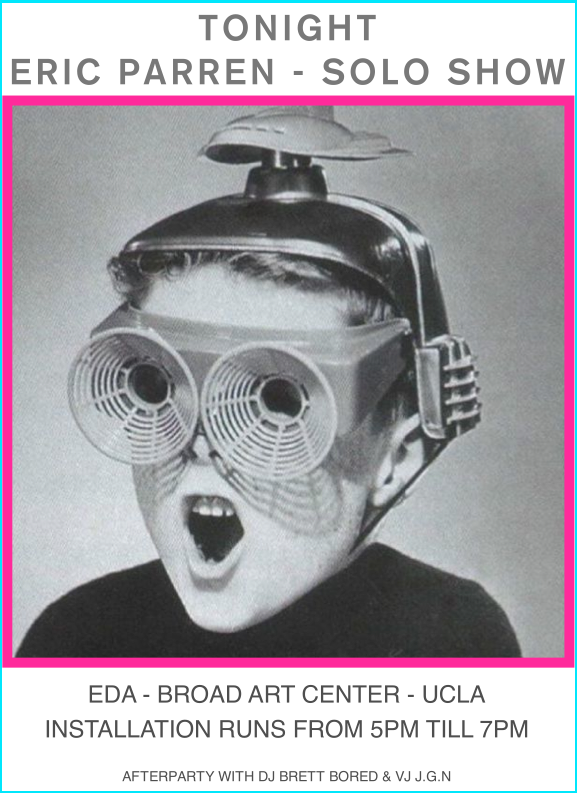
Eric Parren (1983, NL/US) is a transdisciplinary artist who lives and works in Los Angeles. He studied at the Interfaculty ArtScience of the Royal Conservatory and the Royal Academy of Art in The Hague where he received his BFA in 2009. Currently he is pursuing an MFA at the Design | Media Arts department of the University of California Los Angeles. His main focus is on live audiovisuals, generative art, artificial intelligence, bio-inspired art and human computer interaction. A special field of interest is evolutionary systems and their creative possibilities. He is part of the art collective Macular and he is the founder and co-host of the La Force Sauvage internet radio-show.