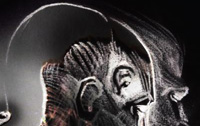
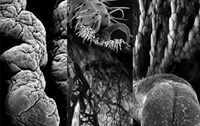
Patricia Olynyk's work investigates the tenuous relationships between art, culture, science, and the environment. Often using microscopy and biomedical imaging technologies, her work calls on viewers to expand their awareness of the worlds they inhabit - whether those worlds are their own bodies or the spaces that surround them.
An afternoon of innovative work showcasing art|science collaborations at UCLA, presented to the International Fulbright Science & Technology Conference scholars.
Introduction by: Victoria Vesna, artist | James Gimzewski, scientist | Paul Weiss, CNSI Director
Featuring presentations of Art|Sci work by: Mattia Casalegno, Romie Littrell, Silvia Rigon, Johanna Reed, Jiacong Yan, and Pinar Yoldas
3 – 5 pm Welcoming
International Fulbright Science & Technology conference attendees
5 – 7 pm Social mixer with molecular cocktails by Johanna Reed and Jiacong Yan, music by Odo
Co-sponsored by The Center for Society and Genetics
Victoria Vesna is a media artist and Professor at the UCLA Department of Design | Media Arts and Director of the Art|Sci center at the School of the Arts and California Nanosystems Institute (CNSI). She is currently a Visiting Professor and Director of Research at Parsons Art, Media + Technology, the New School for Design in New York and a senior researcher at IMéRA – Institut Méditerranéen de Recherches Avancées in Marseille, France and Artist in Residence at the Institute of Advanced Studies, University of Bristol. Her work can be defined as experimental creative research that resides between disciplines and technologies. With her installations she explores how communication technologies affect collective behavior and how perceptions of identity shift in relation to scientific innovation. Victoria has exhibited her work in over twenty solo exhibitions, more than seventy group shows, has been published in excess of twenty papers and gave 100+ invited talks in the last decade. She is the North American editor of AI & Society and in 2007 published an edited volume, Database Aesthetics: Art in the Age of Information Overflow, Minnesota Press. In Press is Context Providers: Conditions of Meaning in Media Arts. Edited with Christiane Paul and Margot Lovejoy. Intellect Press, 2011.
James Gimzewski
Science Director, Art|Sci Center, UCLA
Dr. Gimzewski is a professor of Chemistry at the University of California, Los Angeles and member of the California NanoSystems Institute. Prior 2001, he was a group leader at IBM Zurich Research Laboratory in nanoscale science and technology for more than 18 years. He pioneered research on mechano-electrical contacts imaging with single atoms and molecules using scanning tunneling microscopy (STM. His accomplishments include the STM-tip fabrication of molecular superstructures, the discovery of single molecule rotors and development of micro-nanomechanical sensors to convert biochemical recognition into Nanomechanics. His current interests are in the nanomechanics and elasticity of cells and bacteria in collaboration with the UCLA Medical and Dental Schools. His projects range from miniature nuclear fusion devices using pyroelectric crystals to single molecule DNA profiling. He is involved with Victoria Vesna in many art-science installations exhibited in museums worldwide. As scientific-director of the UCLA Art|Sci Center, Dr. Gimzewski promulgates the fusion of artistic creation and scientific innovation.
Mattia Casalegno
Artist
Department of Design Media Arts, Art|Sci Center, UCLA
He’s a multidsciplinary artist born in Naples, Italy, and currently based in Los Angeles, CA. He often collaborates with designers, architects, neurologists, and musicians producing works that span architectural video-installations, immersive environments, live media performances and interactive systems. His works and performances have been shown in events such as RomaEuropa Festival, Netmage and Sant’Arcangelo dei Teatri in Italy, Mutek in Canada, Optronica in UK, OFFF in Spain, Cimatics Belgium, AVIT in Germany.
mattiacasalegno.net
Romie Littrell
Scientist
Department of Biomedical Engineering, Art|Sci Center, UCLA Romie Littrell is a graduate student in the Biomedical Engineering Dept. at UCLA. He received his BA in Molecular and Cell Biology in 2003 from UC Berkeley. Since then he has engaged in a wide array of biological research including maize genetics, cornea tissue engineering, microfluidic bioreactors, and cell-chip interfaces. His current research focuses on creating hybrid electronic/microfluidic tools for abstracting biological techniques to facilitate education and empower those in unrelated fields to perform advanced biology. Romie is also very interested in synthetic biology, is a member of DIY bio, and was a grad advisor to the 2007 MIT iGEM team. He currently collaborates with UCLA's Department of Design Media Arts and MIT's Media Lab for the former.
Silvia Rigon
Artist
Alumni, Department of Design Media Arts, Art|Sci Center, UCLA, Disney
Silvia Rigon is an Italian visual artist and designer. She has a background in Painting from the Venezia Academy of Fine Arts, and an MFA from the Department of Design Media Arts at UCLA. Silvia’s artistic investigation in the field of digital media concerns sensorial design in the context of an interactive experience of art. The content of her pieces often refers to the notion of “monstrosity,” especially manifested in historical iconography and myths, as a way of unveiling the ambivalence and paradoxes underling our perception of the time in which we live.
silviarigon.com
Johanna Reed
Artist
Alumni, Department of Design Media Arts, Art|Sci Center, UCLA
Johanna Reed is an artist in Los Angeles. She’s written plays, made a wearable head extension to test the hypothesis “would you think bigger thoughts if you had a bigger head?”, and started work on a food opera.
johannareed.net
Jiacong Yan
Artist
Alumni, Department of Design Media Arts, Art|Sci Center, UCLA
Jay was born. Thank god.
jay-yan.com
Pinar Yoldas
Artist
Duke University
Alumni, Department of Design Media Arts, Art|Sci Center, UCLA Pinar Yoldas is an LA-based interface designer, artist and educator. She received her BArch from Middle East Technical University with high honors, her MA in Visual Communication Design from Istanbul Bilgi University, her MS in information technologies from Istanbul Bilgi University and (finally) her MFA from UCLA's Design Media Arts department where she was the recipient of Eugene Wurzel Memorial Scholarship and Clifton Webb Scholarship from the School of the Arts and Architecture at UCLA. So far, Pinar has exhibited in Los Angeles, Istanbul, Frankfurt and Bologna. Her work is a reflection of her interests in design, architecture, neuroscience, evolution, gender studies and science fiction. Pinar is currently a visiting artist at Duke University where she teaches studio classes and collaborates with Dr. Kevin LaBar's lab on neuroscience of emotions.
Location: CNSI Gallery on the 5th Floor Beginning June 28, 2010 Gallery Hours: Monday-Friday, 10 am - 4 pm
social sqncr is an interactive audio-visual installation that aims to make people more aware of the act of creating their public identity.
To create their ‘identity’, participants use their bodies to physically interact with a pseudo-musical instrument projected in a physical space to create virtual musical creatures based on their movements. The instrument consists of eight zones that participants interact with which influence the shape, movement, and aural properties of the resulting entity.
Once complete, the system captures an image of the participant to attach to the creature which is then set free into an eco-system inhabited by similar entities. The entities react to one another, much like human beings in a social network. Participants can cause environmental disturbances by physically interacting with the projection.
The physical movements required of participants ensures a high level of investment in the process, causing a heightened awareness of their creation, and thus themselves. Watching their entity interact with other entities is a reflection of their own interaction in their social networks.
Bio:
Bruce Drummond and Nick Hardeman are both recent graduates from the MFA Design and Technology program at Parsons, in New York. They experiment with new technologies to produce immersive, interactive audio visual experiences.
California NanoSystems Institute (CNSI)
Art | Sci gallery
570 Westwood Plaza (5th floor)
Students from Professor Victoria Vesna’s 2010 graduate seminars Data + Flesh, Department of Design | Media Arts, UCLA + Hybrid Worlds: Nano_Biotech + Art Parsons The New School for Design in New York and UCLA Honors class Biotech + Art exhibit their concepts / proposals / presentations of objects, performances / art installations -- all responding to how we are changing our bodies, the food we consume,the animals we breed & the environment we inhabit.
co-sponsored by UCLA Center for Society and Genetics
supported by Leonardo ISAST + UCIRA + Parsons AMT
May 14 - June 7, 2010.Open Monday-Friday, 10 a.m.- 4 p.m.
Parking is $10 all day, and is available near CNSI in structure 9, adjacent to the building. For more information, call 1.310.794.2118.
Students from Professor Victoria Vesna’s 2010 graduate seminars Data + Flesh, Department of Design | Media Arts, UCLA + Hybrid Worlds: Nano_Biotech + Art Parsons The New School for Design in New York and UCLA Honors class Biotech + Art exhibit their concepts / proposals / presentations of objects, performances / art installations -- all responding to how we are changing our bodies, the food we consume, the animals we breed & the environment we inhabit.
Parsons seminar co-taught by neuroscientist Siddharth Ramakrishnan
co-sponsored by UCLA Center for Society and Genetics
supported by Leonardo ISAST + UCIRA + Parsons AMT
May 14 - June 7, 2010.Open Monday-Friday, 10 a.m.- 4 p.m.
Parking is $10 all day, and is available near CNSI in structure 9, adjacent to the building. For more information, call 1.310.794.2118.
A symposium on how conceptions of the skeleton have evolved alongside the increasing ability of science to represent the body. Medicine, critical theory, anthropology, and art history will be represented.
Co-sponsored by the Ph.D. Program in Art History
Friday, April 30, 1:00 PM
Rooms 9206 / 9207
No reservations. First come, first seated
Social ArtSci Networked Discourse (SAND) is a new paradigm of teaching as a social network and discourse to address issues that require multi-faceted considerations and point of view. No one can claim authority alone but Professors can design a conceptual platform and engage students who teach what they learn. They become part of an international social network of professional artists and scientists who engage in research that addresses issues raised in class. Language barriers are crossed by having international students who are bi-lingual act as discourse leaders / teachers while bringing back to class different points of view. Time zone and schedule problems are addressed by having local group dialogues recorded and added to the resource.
Double Dutch is a show of the Netherlands based artists Casper Schipper and Antal Ruhl. As both students Design | Media Arts at UCLA and Media Technology at Leiden University, their work uses different media to express topics regarding (mostly) culture and nature, influenced by both science and art.
The show will be one night only, on Thursday April 1st at 5pm. Broad Arts center, EDA gallery.
Guest: Leas Maria
Collaborators: Miu Ling Lam, Romie Littrell, Blanka Buic, Pinar Yoldas
Special thanks to Susan Hopmans and the David Bermant Foundation for their continuous support.
ABOUT
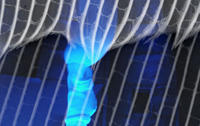
Nanotechnology is changing our perception of life and this is symbolic in the Blue Morpho butterfly with the optics involved -- that beautiful blue color is not pigment at all but patterns and structure which is what nano-photonics is centered on studying. The optics are no doubt fascinating but the real surprise is in the discovery of the way cellular change takes place in a butterfly. Sounds of metamorphosis are not gradual or even that pleasant as we would imagine it. Rather the cellular transformation happens in sudden surges that are broken up with stillness and silence. The audience is invited to immerse themselves in the sounds of metamorphosis and be the performer in the piece.
Organized by Machiko Kusahara, Art|Sci Visiting Research Scholar and Waseda University, Japan
Sponsored by CREST program of Japan Science and Technology Agency, UCLA Art|Sci Center, and the UCLA Department of Design|Media Arts.
Thu, Feb. 18, Broad Art Center EDA, room 1250
5:30 - 7:00 PM Keynote speaker and lectures, Broad Art Center, EDA, Room 1250
7:00 - 8:00 PM Exhibition Opening Reception, Broad Art Center, 2nd floor patio
Symposium opening with Maywa Denki presentation by Novmichi Tosa
Friday, Feb. 19, 10 am-5 pm C(N)SI Auditorium and Art|Sci gallery
Lectures on Art, Science, and Technology. A special presentation by Novmichi Tosa, followed by afternoon lectures on Device Art, and a panel discussion.
Symposium: Device Art explores new ways of bridging art, design, technology, science and entertainment by using both latest innovations and everyday technology. The two day symposium will include: lectures by academia from Japan and UCLA; performances by artists Novmichi Tosa, Kazuhiko Hachiya, and others; and an exhibition of intriguing gadgets that exemplify Device Art. Exhibitions at EDA Bermant Gallery runs February 18 - February 24, 2010 and the student exhibition in Art|Sci gallery runs through February 18 - March 4, 2010. Hours of exhibition to be announced.
All day parking is available in Lot 3 for the Broad Art Center and Lot 9 for C(N)SI and is $10 per day.
Exhibition at EDA runs Feb. 18-24; Art|Sci gallery Feb 19-March 4
Friday 4-8pm: Symposium
Saturday 10am-3pm: Workshop and Exhibition
a symposium exploring new forms of biological and engineering research beyond the university and the corporation and an exhibition and bio-faire for exploring new forms of participation, open science and do it yourself biology.
With:
Gaymon Bennet (SynBERC and Ars-Synthetica.net, Berkley,)
Jason Bobe (DIYBio.org and The Personal Genome Project, Cambridge, MA)
Roger Brent (Fred Hutchison Cancer Center, Seattle)
Phil Lukeman (Cal Poly Pomona)
Hugh Rienhoff (MyDaughtersDNA.org, Berkeley)
Meredith Paterson (Hacker, Belgium)
Victoria Vesna (UCLA Art|Science Center, UCLA Design Media Arts, Los Angeles)
Moderated by:
Christopher Kelty (UCLA Center for Society and Genetics, Los Angeles)
A symposium exploring new forms of public participation in biological research, raising questions and cultivating ideas about how life could and should be studied. Panelists will address issues including do-it-yourself biology, open source science, at home medical genetics, bio-art, and novel ethical engagements with science at the cutting edge. Event schedule includes: Friday, a panelist discussion with artists, scientists and normal people; Saturday, workshops and an open-house exhibition throughout.
Today the life sciences are blooming with possibility. The Human Genome Project is at an end, but the answers it promised remain elusive. Older models of gene action and genetic determinism are crumbling, even as huge pharmaceutical corporations and federally funded university laboratories—Big Bio—continue to drive the research agenda. But just past the frontiers of law and order, a handful of outsiders are trying to remake biology in radical new ways. Synthethetic Biology, DIY Biology, recreational genetics, nanobiotechnology, open source science, patient-driven clinical research, bio-art all in their own ways are challenging Big Bio, and inviting you, the public, to participate.
But can “outlaw biology” really have an effect? What can a band of do-it-yourself biologists teaching themselves to do gel electrophoresis at home really accomplish? Can synthetic and nano-bio engineering cure malaria, as they claim, or just make yogurt glow? Who is “the public” and is it really involved in a meaningful way? What’s good—or bad—about customizing genetic research to explore forgotten diseases
or rare disorders? Can the model that made open source software a success also work in biology? Can artists teach biologists a few things about life, or biologists teach artists something about making? When biology is outlawed, will only outlaws do biology?
Citizen Science | DIY Biology | Nano Hacking | At-Home Clinical Research | Recreational Genetics | Synthetic Biology | Open Source Science | Ars Synthetica | Genetic Art


 3 – 5 pm Welcoming