Data

Image: 
Exhibitors / Artists: 

Aisen Caro Chacin, Joel Ong and Art|Sci Collective

06 NOVEMBER 2014
CNSI ART|SCI GALLERY

Aisen Caro Chacin, Joel Ong and the Art|Sci Collective joined the multi-year collaboration of Professor Victoria Vesna and evolutionary biologist Dr. Charles Taylor in this sound and art exhibition based on the NSF-sponsored research on Mapping Acoustic Sensor Array of Bird Communication Networks.

Secret Life of Birds built off of this idea and aimed to re-examine the bonds between humans and birds through the perspective of the birds. This ongoing project continues to see various disciplines of art and science converging to present Taylor’s research as a work of art.

Image: 
Exhibitors / Artists: 

Fallen Fruit Collective

May 16, 2013
Art|Sci Gallery
CNSI 5th floor

Fallen Fruit presents a set of their Public Fruit Maps paired with their 2010 video, “The Loneliest Fruit in the World.” The maps are one of the collaboration’s signature projects: mapping all the fruit trees that grow in or over public space in neighborhoods around the world to which they are invited. The maps are hand-drawn and distributed free of copyright; they serve as guides for foraging but more importantly as visionary representations of what we hope to see: alternative urban spaces that engender new forms of sharing and thereby create new public experiences. “The Loneliest Fruit in the World” addresses a different kind of public fruit, berries that grow wild in the Arctic. The lingonberry, the salmonberry and the blueberry grow without any human involvement, and for a few short weeks become the site of intense activity as people flock to pick them on all public land. Shot in a residency in Tromsø, Norway, 200 miles above the Arctic Circle, the video follows a group of Norwegians through a beautiful, spare landscape; while picking, they negotiate the relation between solitude, gleaning and company.

ARTIST BIO: Fallen Fruit is a long-term art collaboration that began by mapping fruit trees growing on or over public property in Los Angeles. The collaboration has expanded to include serialized public projects, site-specific installations and happenings in various cities around the world. By always working with fruit as a material or media, the catalogue of projects and works reimagine public interactions with the margins of urban space, systems of community and narrative real-time experience. From participatory performances such as Public Fruit Jams and Fruit Meditations, to ongoing indexical work such as Public Fruit Maps and curated exhibitions that reorganize the social and historical complexities of museums and archives by re-installing their collections through syntactical relationships of fruit as subject, the three artists of Fallen Fruit — David Burns, Matias Viegener, and Austin Young — deploy fruit as a lens through which to see the world.

Image: 

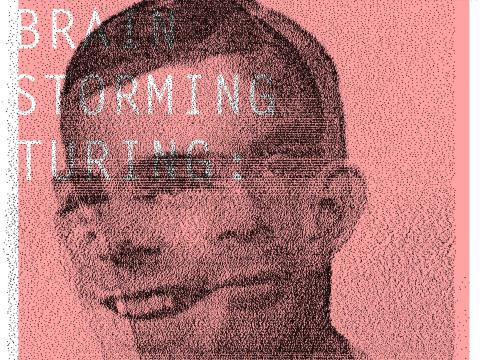
Brainstorming Turing: Celebrating Alan Turing + 25 Years of AI and Society Journal

100 years have passed since Alan Turing was born and we celebrate this historically important individual together with many organizations around the world. We look to show his eccentric creativity in addition to reminding all of the huge contribution he made to computation and artificial intelligence. Short talks by computer / neuro / nano scientists and humanists are accompanied by artists inspired by Turing’s legacy and persona. Additionally, students from UCLA will participate with their ideas of how Turing informs and inspires their work and lives in this time when social networking, robotics and automatic brains are part of daily life.

2012 also marks 25 years since the establishment of AI & Society journal that owes its formation to Turing’s legacy. The Art | Sci center is partnering with this interdisciplinary publication to honor Turing and all those who have contributed over the years. A special issue based on the symposium is planned.


The entire event will be streaming live online at http://ctrl.cnsi.ucla.edu/streaming/art-sci/brainstorming-turing


SYMPOSIUM SCHEDULE
MAY 25

12:00

Welcome
Victoria Vesna

Plenary Keynote
Leonard Kleinrock

Keynote
Karamjit Gill:
“Beauty of Turing”

Gabriel Greenberg:
“A New Kind of Machine”

Takashi Ikegami:
“Shape-shape Computation”

13:00

Mark Cohen:
”This Does Not Compute”


Dean Buonomano:
“What the Turing test reveals about the brain’s bugs and features”


Ramesh Srinivasan

15:00

Charles Taylor introduces Edward Stabler:
"Reasons for the Turing test"

Jon Beaupre
"Some Speculations on the Effects of Machine Language on
News Delivery Credibility”

16:00

Yuval Marton
“Gaylons and Gay Grammar: A few linguistic and futuristic musings
in honor of Alan Turing”

Georgina Voss

Siddharth Ramakrishnan
“Morphogenesis, Morphology and Men – Pattern Formation from Embryo to Mind”

Zach Blas + Micha Cardenas:
”Imaginary Computational Systems”

Erkki Huhtamo
“Alien Intelligence”

18:00

Exhibition Opening


FOR MORE INFORMATION PLEASE VISIT : 

http://turing.artscicenter.com/

Time:
12pm-7pm

Location: California NanoSystems Institute @ UCLA


Image: 

Opening March 7
Lecture @ 2pm
Exhibition Openings: 5-7pm
Location: Lecture @ UCLA Broad Art Center, room 5240, Exhibition @ CNSI Gallery

Exposure is an exhibition of work by Mike Phillips, Professor of Interdisciplinary Arts, School of Art & Media at Plymouth University. Mike Phillips is director of i-DAT, a Principal Supervisor for the Planetary Collegium and a supervisor of the Transtechnology Research Groups. His R&D orbits digital architectures and transmedia publishing, and is manifest in a series of ‘Operating Systems’ to dynamically manifest ‘data’ as experience in order to enhance perspectives on a complex world. The year that Eastman Kodak filed for bankruptcy protection was the same year Fujifilm moved from film production to beauty products1. This did not just mark a technological shift from film grain to nanoparticles but also a massive cultural shift - a shift from capturing the face on film to the embedding of ‘film’ in the face. The thing that once froze the face in an eternal youthful smile is now the anti-aging nanoparticle that preserves the face we wear. Barthes described the face on film as representing “a kind of absolute state of the flesh, which could be neither reached nor renounced”2. Now this absolute state is closer to hand and we will walk around wearing our old photo albums as our face, peeling away the frames like layers of dead skin. Our essence, like Garbo’s, will not degrade or deteriorate. ‘Viewed as a transition’ Exposure explores the deterioration of the flesh through the temporality of the Atomic Force Microscope (AFM). From the 60th of a second exposure of the Kodak Brownie camera to the 20-minute scan of the AFM - the closer the subject the longer the ‘exposure’. Incorporating data from an AFM scan of a basal cell carcinoma Exposure explores the convergence of ideologies constructed around imaging technologies. Through a subtle interaction the viewer conjures up a dynamic data/image of a skin cancer - over exposed to the sun - or the intense light of the camera flashgun.

Theodor Holm Nelson PhD (http://ted.hyperland.com<http://ted.hyperland.com/>)

Project Xanadu and The Internet Archive


This Thursday, Nov. 10, 2011, 3:00-5:00 p.m.

Charles E. Young Research Library (YRL) Main Conference Room (http://www.library.ucla.edu/pdf/libmap_091710.pdf)

Co-sponsored by: UCLA Department of Information Studies, Colloquium Series (http://is.gseis.ucla.edu<http://is.gseis.ucla.edu/>)

UCLA Library (http://www.library.ucla.edu<http://www.library.ucla.edu/>)

The computer world pretends to be finished, but never will be.  In fact it simulates the past: computers for secretaries, as designed by Xerox in the 1970s, have become our working world. Today's "computer documents" (.doc and .pdf) simulate paper and the fancy printing of long ago. The Web added trivial one-way jumps, allowing pogo-stick travel between pages.  But what of deeper connection?


We need deep, live documents of a very different kind for the interactive screen, as foreseen by Bush and Engelbart and others—for annotation and detailed discussion and scholarship, for organizing and decision-making, for lawmaking and litigation, and for entirely new forms of writing. Such profusely connected, living documents are still possible, but require a wholly different infrastructure.  We will show some of these alternatives.

Ted Nelson is an idealistic troublemaker who coined the word 'hypertext' in the sixties, and continues to fight for a completely different computer world.


~~~

A reception and book signing will follow the colloquium.  Attendees are encouraged to bring their own copies to be signed.  Ted Nelson’s new book Possiplex: An Autobiography of Ted Nelson and recent bookGeeks Bearing Gifts are available for purchase through lulu.com<http://lulu.com/> (links provided below).  A few copies will also be available for purchase at the event.


Possiplex: An Autobiography of Ted Nelson (http://bit.ly/pNLV3e)