Symposium

Image: 
Date for Content + Calendar: 
Friday, 15 May 2026 - 10:30am to Saturday, 16 May 2026 - 6:00pm

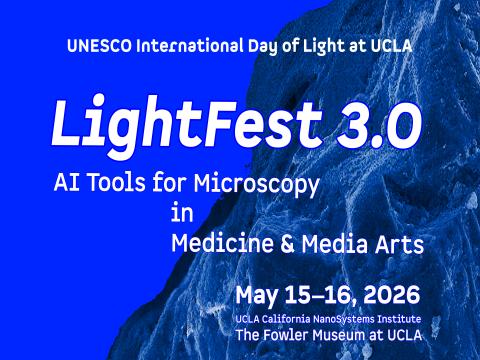
UNESCO International Day of Light at UCLA
LightFest 3.0: AI Tools for Microscopy in Medicine and Media Arts

May 15–16, 2026
UCLA California NanoSystems Institute (CNSI)
The Fowler Museum at UCLA

Visit the Medicine Buddha Mandala website for the full schedule and registration link

Presented by the UCLA Art|Sci Center in collaboration with the Advanced Light Microscopy & Spectroscopy (ALMS) Lab at the California NanoSystems Institute (CNSI) and the Smart Image Content Research Center at Chung-Ang University, South Korea.

LightFest 3.0 brings together artists, scientists, medical researchers, and cultural practitioners to explore light across scales—from AI microscopy and spectroscopy to media arts, sustainability, and contemplative cultural practices. Organized in conjunction with UNESCO International Day of Light, the two-day symposium examines how imaging technologies are transforming medicine, scientific research, and creative expression.

The 2026 UNESCO theme of Light for a Sustainable Future, frames the symposium’s focus on the relationship between light, health, environmental awareness, and interdisciplinary collaboration. Across scientific imaging, AI research, medicine, and media arts, the program asks how technologies of light can contribute to more sustainable and interconnected futures.

Held each May in honor of the first successful laser demonstration on May 16, 1960, in Malibu, California, the program also highlights emerging collaborations between UCLA CNSI, Leica Microsystems, the UCLA Art|Sci Center, and Chung-Ang University’s Smart Image Content Research Center, Yangchenma Arts, and the Gaden Shartse Monastic University, connecting AI research, scientific imaging, and media arts through interdisciplinary exchange.

Image: 
Date for Content + Calendar: 
Saturday, 15 March 2025 - 8:00pm
Exhibitors / Artists: 

Celia Hollander + Jenna Caravello, Ivana Dama, Iman Person, Paige Emery

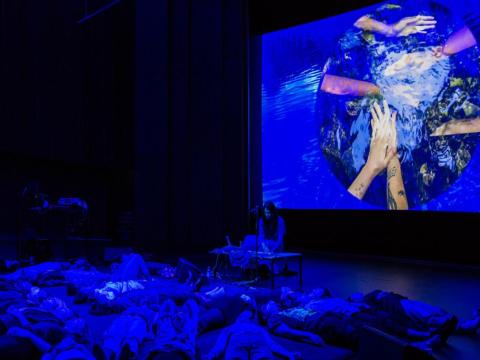
Sound & Science: From Signal to Noise is a curated showcase of sound art performances inspired and informed by scientific fields such as physics, biology, and botany, exploring the vast landscape of auditory and visual experiences. Featuring local LA-based and emerging experimental sonic artists working in ‘eco-acoustics,’ this concert presents sound as a post-object art form.

The performances are intrinsically connected to the artists’ activist work, addressing ecological, social, and ancestral issues. Immerse yourself in a unique auditory landscape complemented by live visual elements.

Artists
Celia Hollander + Jenna Caravello
Ivana Dama
Iman Person
Paige Emery

>> Tickets: https://cap.ucla.edu/event/sound-and-science

Location: Nimoy Theater
For hours and details click here: https://soundofatmosphere.com/location/nimoy-theater/

>> Concert Date:
8:00pm, Mar 15, 2025

Image: 
Date for Content + Calendar: 
Wednesday, 15 May 2024 - 10:00am
Exhibitors / Artists: 

Various contributors

Join us for the second annual Lightfest! Advanced Light Microscopy Symposium at CNSI. A celebration of UNESCO’s International Day of Light, this event will be held from May 15 – 17, in honor of Theodore Maiman, who fired the first laser right here in southern California on May 16th, 1960.

This symposium will feature invited talks from a selection of light microscopy users, poster presentations and awards, an image contest, and vendor booths. This event is free and open to anyone, we hope to see you there!

Lightfest attendees can register here: https://formfacade.com/public/111737165731248679447/all/form/1FAIpQLSeUa...

FULL SCHEDULE: https://cnsi.ucla.edu/lightfest-2024/schedule/

About the keynote speaker:

Opening Keynote: Adding Dimensions to Intravital Imaging to Better Eavesdrop on Biology
Scott E. Fraser, PhD
University of Southern California
Wednesday, May 15, 2024

Imaging of living specimens can animate the wealth of high-throughput molecular data to better understand complex events ranging from embryonic development to disease processes. We are advancing this approach despite the unavoidable tradeoffs – between spatial & temporal resolution, field of view, limited photon budget – by constructing faster and more efficient light sheet and laser-scanning microscopes that maintain subcellular resolution.

Our two-photon light-sheet microscope combines the deep penetration of two-photon microscopy and the speed of light sheet microscopy to generate images with more than 10x improved imaging speed & sensitivity. Better engineering of the detection objective’s point-spread-function improves this another 3-fold. Two-photon excitation light is far less scattered, permitting subcellular resolution to be maintained better than conventional light sheet microscopes, resulting in 4D (3D over time) cell and molecular imaging with sufficient speed and resolution to unambiguous trace cell lineages, movements and signals in intact systems.

To increase the 5th Dimension (# of simultaneous labels), we are refining new multispectral image analysis tools that exceed the performance of our previous work on Linear Unmixing by orders of magnitude in speed, error propagation and accuracy. Novel denoising strategies using machine learning permit imaging at far lower light levels, yielding rapid and unambiguous analyses without perturbing even fragile multiplex-labeled specimens.

Parallel refinements in label-free approaches extend imaging to patient-derived tissues and even human subjects. The low concentrations of these intrinsic labels required us to refine fluorescence lifetime imaging (FLIM), and combine it with multispectral and advanced denoising tools, to perform intravital imaging in such challenging settings.

Combined, these imaging and analysis tools offer the multi-dimensional imaging required to follow key events in intact systems as they take place, and allow us to use noise and variance as experimental tools rather than experimental limitations.

Schedule:
Day 1 – Wednesday May 15 – CNSI Alfred E Mann Auditorium & Lobby
1:30pm – 2:00pm Participant Registration & Check-In
2:00pm – 3:00pm Welcome & Introduction to UNESCO’s International Day of Light
3:00pm – 4:00pm Session 1: Art in Science – Session Chair Victoria Vesna (UCLA)
Daniel G. Jay (Tufts) | Chromophore assisted light inactivation, fluorescence & electrophoresis art
Walter Gekelman (UCLA) | Using lasers to map the motion of ions in a plasma physics experiment
4:00pm – 5:00pm Session 2: Keynote – Session Chair Laurent Bentolila (UCLA)
Scott E. Fraser, Ph.D. – Provost Professor, Director of Science Initiatives, USC
Adding dimensions to intravital imaging to better eavesdrop on biology
5:00pm – 5:30pm Interactive Fiat Lux installation by the Art|Sci Collective
5:30pm – 7:00pm Networking reception

Day 2 – Thursday May 16 – CNSI Alfred E Mann Family Foundation Auditorium and Lobby
9:00am – 9:30am Light breakfast and vendor showcase
9:30am – 10:45am Session 3: Navigating Neuroscience in 3D – Session Chair Esteban Fernandez (CHLA)
Ivan Lopez (UCLA) | Laser confocal imaging of sensory neurons of the human internal ear
Ranmal Samarasinghe (UCLA) | Modeling and Imaging Neural Networks using Human Brain Assembloids
Peyman Goldshani (UCLA) | New generation 1P & 2P miniaturized microscopes for in-vivo imaging during free behavior
10:45am – 11:00am Coffee break and vendor showcase
11:00am – 12:15pm Session 4: Multiphoton in the Musculoskeletal System – Session Chair Blaise Ndjamen (UCSF)
Jimmy Hu (UCLA) | Multiphoton of living craniofacial stem cells
Kristen Reider (UCLA) | Correlated two photon and atomic force microscopy for characterizing surgically extracted tissues
Tad Kremen (UCLA) | Soft tissue-to-bone healing: Defining the problem and potential solutions
12:15pm – 1:15pm Lunch break and vendor showcase
1:15pm – 2:30pm Session 5: Multimodal and Multiplexed Imaging – Session Chair Brian Jeong (UCLA)
Janielle Cuala (USC) | Multimodal imaging reveals changes in beta cell metabolism and heterogeneity over the course of pregnancy
Lior Kashani Ligumsky (UCLA) | Stop blaming the placenta: Label-free multiphoton microscopy reveals previous cesarean scars are a defining pathology of the Placenta Accreta Spectrum (PAS)
Niles A. Pierce (Caltech) | HCR imaging: multiplexed, quantitative, sensitive, versatile, robust
2:30pm – 2:45pm Coffee break and vendor showcase
2:45pm – 4:00pm Session 6: Beyond the Visible Spectrum – Session Chair Haley Marks (UCLA)
Justin Caram (UCLA) | Seeing the shortwave infrared with novel materials, detectors and interferometric methods
Ellen Sletten (UCLA) | Multiplexed in vivo imaging with near and shortwave infrared polymethine
fluorophores
Eric Potma (UCI) | Nonlinear optical imaging with mid-infrared light
4:00pm – 5:00pm Vendor showcase/poster session
5:00pm – 6:15pm Session 7: Cutting Edge Microscopy Modalities – Session Chair Laurent Bentolila (UCLA)
Enbo Zhu (UCLA) | Multi-View light-sheet imaging system with comprehensive tissue clearing compatibility and large field of view
Liang Gao (UCLA) | Breaking the speed barrier: high-speed light-field microscopy for kilohertz to terahertz 3D imaging
Aydogan Ozcan (UCLA) | Virtual Staining of Label-free Tissue Using Deep Learning
6:15pm – 7:30pm Networking Reception

Day 3 – Friday May 17 – CNSI 3rd Floor Executive Conference Rooms – Brunch & Learn – 10:00 am Vendor Slam Talks (3rd Floor Executive Conference Room)
10:00 am – 2:00 pm Vendor Demo Fair (Labs/Booths)
10:00 am – 2:00 pm
10:30 am – Evan Darling (ONI) | Blinky Blink Blink: A Short Introduction to STORM Super-Resolution
11:00 am – Jan Otto Wirth (Abberior) | MINFLUX tracking of kinesin-1 at the nanometer and millisecond scale
11:30 am – Chris Tsang (LifeCanvas Technologies) | What insights are possible if you could image in 3D
12:00 pm – Gert Vreede (Zeiss) | Lightsheet at Lightfest: Versatile 3D imaging from micro- to mesoscale
12:30 pm – Kevin Mann (Bruker) | Illuminating the Brain:
Mapping and Manipulating Neural activity in 3D
1:00 pm – Fred Sala (Leica Microsystems) | Stellaris FLIM: Rainbow of possibilities
Room 6350 | Andor (Benchtop Confocal BC43)
Lobby | LifeCanvas (SmartBatch Automated Tissue Clearing)
Lobby | Ibidi (perfusion & incubation systems)
Room 2152 | Abberior (MINFLUX & STEDyCon)
2:00 pm Closing Remarks & Awards Ceremony (Auditorium)

More info: https://cnsi.ucla.edu/event/lightfest-advanced-light-microscopy-symposiu...

Image: 
Date for Content + Calendar: 
Saturday, 14 September 2024 - 2:00pm
Exhibitors / Artists: 

Sholeh Asgary | Patricia Cadavid | Bill Fontana | Katie Grinnan | Yolande Harris | Rachel Mayeri | Christina McPhee | Anna Nacher | Joel Ong | Iman Person | Robertina Sebjanic | Amber Stucke | Nina Waisman

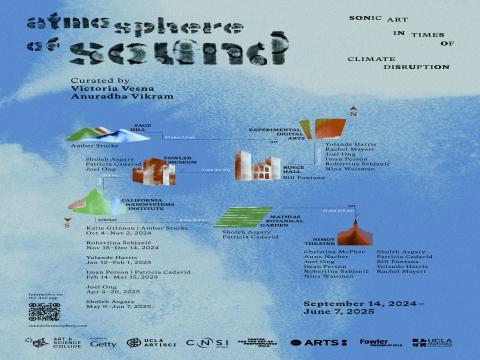
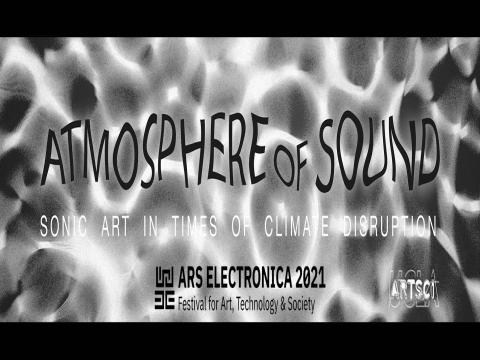
UCLA Art|Sci Center Presents Atmosphere of Sound: Sonic Art in Times of Climate Disruption | Part of Getty’s PST ART: Art & Science Collide initiative, related programs and exhibitions will run Sept 14, 2024, through June 7, 2025, launching with 'Silent Echoes: Notre-Dame and the Dachstein Glacier,' a sound exhibition by Bill Fontana–read more: http://artsci.ucla.edu/node/1745

Immersive, interactive installations, artist lectures, walkthroughs, and live performances and videos by 13 artists—including Bill Fontana’s site-specific installation Silent Echoes: Notre-Dame and the Dachstein Glacier; Katie Grinnan’s sound sculptures The Sensitives; Anna Nacher’s soundwalks; and performances by artists such as Patricia Cadavid, Amber Stucke, and Sholeh Asgary—will activate the UCLA campus to engage audiences in deep reflection on the climate crisis. Organized by co-curators Victoria Vesna, Art|Sci Center Director, and Anuradha Vikram, Atmosphere of Sound: Sonic Art in Times of Climate Disruption includes seven sequential exhibitions presented between September 14, 2024, and June 7, 2025, as part of Getty’s PST ART: Art & Science Collide.

The exhibition and related public programs will be held in multiple campus venues, including the Art|Sci Gallery in the California NanoSystems Institute (CNSI) building on UCLA’s South Campus; the EDA in the Broad Art Center on North Campus; Sage Hill Native Plants & Wildlife Habitat; the Mildred E. Mathias Botanical Garden; Royce Hall; and the UCLA Nimoy Theater operated by UCLA’s Center for the Art of Performance.

Atmosphere of Sound: Sonic Art in Times of Climate Disruption builds from four years of research by eight artists-in-residence at the UCLA Art|Sci Center: Sholeh Asgary, Patricia Cadavid, Bill Fontana, Yolande Harris, Anna Nacher, Joel Ong, Iman Person, and Robertina Šebjanič. Their projects will be joined by installations and performances by local artists Katie Grinnan, Rachel Mayeri, Christina McPhee, Amber Stucke, and Nina Waisman.

“Our goal is to highlight artists and scientists who have developed long-term collaborative relationships with one another,” says co-curator Victoria Vesna. “In this exhibition, we use sound to join the disciplines of art and science and to foster a deeper understanding of our many interconnected environments and cultures.”

PST ART, formerly Pacific Standard Time, is the largest art event in the United States. This year’s iteration will engage audiences throughout Southern California in the theme Art & Science Collide. With the support of nearly $20 million in grants from Getty, dozens of cultural, scientific, and community organizations will present more than 80 exhibitions and a wide spectrum of programs, traversing such topics as climate change, Indigenous knowledge, artificial intelligence, the burgeoning field of eco-acoustic art, and more.

Through Atmosphere of Sound, participating artists and scientists propose to engage human bodies through vibration and exploratory learning as a means of achieving deeper empathy with the environment and with other species.

“Our approach to this project is informed by the work of feminist scientific philosophers including Jane Bennett and Donna Haraway,” Vesna said. “We seek to connect artists and art lovers, scientists, students, performing arts patrons and local families with concepts of vibrant matter and intercellular communication on a global scale.”

Atmosphere of Sound kicks off with Bill Fontana’s outdoor sound sculpture, Silent Echoes: Notre-Dame and the Dachstein Glacier, which will be amplified from UCLA’s Royce Hall from September 14 to October 5, 2024. This work threads audio feeds from Notre-Dame’s dormant bells and the Dachstein Cave in Austria, layering these soundscapes into a poetic statement on climate disruption and the fragility of human culture. Fontana is an American composer and media artist who has developed an international reputation for his pioneering experiments in sound.

Following Fontana’s exhibition are six sequential exhibitions in the Art|Sci Center’s gallery, located on the fifth floor of UCLA’s CNSI building.

October 4 to November 2, 2024: Katie Grinnan’s The Sensitives and Amber Stucke’s Talking to Plants
November 15 to December 14, 2024: Robertina Šebjanič’s CO_SONIC 1884 km2
January 10 to February 1, 2025: Yolande Harris’s How You Shimmer: Sound Portal for Whale Bubbles
February 14 to March 15, 2025: Iman Person’s Memory Garden and Patricia Cadavid’s Kanchay_Yupana// and Electronic_Khipu
April 4 to April 26, 2025: Joel Ong’s In Silence . . .
May 9 to June 7, 2025: Sholeh Asgary’s Qanat, Ghatel, and Sholeh Asgary + the Ad Hoc Collective for Improvising Mourning Technologies for Future Griefs

All exhibitions are viewable by appointment between 2-5pm on Thursdays and Fridays and 12-3pm on Saturdays. Entry is free to the public.

Visitors are encouraged to visit the Atmosphere of Sound website and download the project app to assist in navigating between venues. The app includes wayfinding tools with parking and metro information; meditative soundwalks recorded by Atmosphere of Sound artist Anna Nacher; access to the Atmosphere of Sound radio station, which will stream sonic artworks and interviews with artists and scientists; and detailed exhibition and program information.

“Atmosphere of Sound provokes the central question: ‘If the scale and complexity of climate change exceeds the limits of human perception, how can artists represent it?” said co-curator Anuradha Vikram. “The project examines how sound-based artists, responding to the climate crisis, have found a unique point of entry to this representational challenge. Sound art, as a medium, evades and challenges the certainty often associated with the sense of sight. The inherent ambiguities of sound can help audiences understand the rapidly shifting state of the climate and its effects on the physical world.”

The Atmosphere of Sound: Sonic Art in Times of Climate Disruption exhibition and program of artist lectures, symposia, and performances, as well as a 250-page full color publication featuring seven original essays (est. print date September 2024), has been generously supported by the Getty PST ART initiative.

About PST ART: Southern California’s landmark arts event, PST ART, returns in September 2024, presenting more than 70 exhibitions from organizations across the region exploring the intersections of art and science, both past and present. PST ART is presented by Getty. For more information about PST ART: Art & Science Collide, please visit pst.art.

About UCLA and PST ART: With seven granted projects, UCLA’s expansive presence in this year’s PST Art demonstrates the university’s unique strengths as a research institution and the far-reaching impact of its research and creative endeavors. UCLA's involvement underscores its commitment to fostering artistic innovation and interdisciplinary collaboration, showcasing what is possible when the worlds of art and science combine. Other UCLA-affiliated projects include exhibitions and events at the Fowler Museum, the Hammer Museum at UCLA, a film series from UCLA’s Film & Television Archive; a downtown arts exhibition commissioned and curated by UCLA Arts Conditional Studio and a live dance/multimedia event presented by UCLA’s Center for the Art of Performance (CAP UCLA).

CLICK HERE TO LEARN MORE:
https://soundofatmosphere.com

Image: 
Date for Content + Calendar: 
Thursday, 10 November 2022 -
1:00pm to 4:00pm
Exhibitors / Artists: 

ArtSci collective

Image: 
Date for Content + Calendar: 
Friday, 23 September 2022 - 9:30am
Exhibitors / Artists: 

Organized by Warren Neidich in collaboration with UCLA Art Sci center, The Getty Research Center, The Saas-Fee Summer Institute of Art and the Museum of Neon Art.

Friday, September 23, 2022, 9:30 a.m. to 6:30 p.m.
UCLA California NanoSystems Institute (CNSI)  
Presentation Space, 5th floor  

570 Westwood Plaza 
Building 114 
Los Angeles, California 
 
HYBRID Symposium ON SITE AT UCLA CNSI or ON ZOOM:
https://ucla.zoom.us/j/99062268818

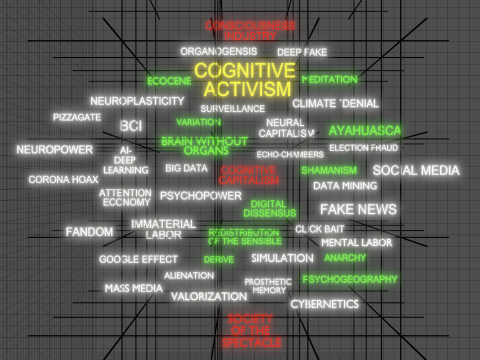
This conference endeavors to describe the role of art and artists in cognitive capitalism in which
the brain and mind are the new factories of the 21 st century. We are no longer only proletariats
working on assembly lines to create objects but cognitariats or mental labors working on screens
to produce Big Data which is sold to policing, governmental and cooperate entities. This has led
such authors as Byung-Chul Han, in his book Psycho-politics: Neoliberalism and New
Technologies of Power, to understand that in our moment biopower, Foucault’s power over life
as a form of the granular management of life, has transitioned to psychopower or psychopolitics
in which the mental laborers or cognitariats gladly give up their freedoms without direct coercion
to labor incessantly and overtime to interact with digitality. His new term for this is “smart
power”. But we are now on the doorstep of another transition almost or maybe as important as
that which transformed the agricultural/manufacturing economies into knowledge and
information economies. It is referred to as a neural based economy in which the material brain
and its neuroplasticity have become the focus of capitalistic commodification directly and
indirectly. Directly through technologies like brain computer interfaces, nootropics and cortical
implants and indirectly with Big Data, neuroeconomics and neural consumerism. In this neural
economy, psychopower has further transitioned to neural power where the material brain is put
to work. In psychopower and neuropower the body’s importance is reduced and subsumed by the
brain and mind. The brain, as understood here, is not restricted to the bony carapace of the skull
as cognitivists would have us believe but is a situated complex that extends into the socio-
political-cultural-ecological milieu with which it coevolves. Changes in the external milieu are
mirrored in the architectural composition of the brain through a process that Bernard Stiegler,
later in his life, referred to as exosomatic organogenesis, in which technical rather than genetic
evolution is at the core of the liberation and perfection of organ systems, especially the brain.
This brain-model is a diverse, variable, rhizomatic, intensive, becoming entity in constant
transformation. Consciousness is no longer understood as something restricted to and most
elegantly formed in humankind but rather is traced into the deep history of inorganic matter and
shared with plants and animals in non-hierarchical alignments.  
This is the starting point for this symposium in which artists, architects, art historians, and
philosophers using their own practices, materials, histories, and apparatuses unveil the mysteries
of this becoming brain model.  In fact, the power of art is its special alliance with the sensory,
perceptual, and cognitive as a source of emancipation, magic, and diversity in contradistinction
to cognitive neuroscientific models of aesthetics in which it becomes a map or model of data
points subject to forms of institutionalization, normalization, and demystification. This is where
the idea cognitive activism becomes evident as a reaction and form of dissensus against these
conservatisms.   Key to this conference is Catherine Malabou’s entreaty that the brain is our
work, and we have the capacity to make our own brains if we have the fortitude to do so. In this
vein we also will engage with Victoria Pitts- Taylor in her book The Brain’s Body understands,
“the plastic, social brain also reveals neurobiology to be political-that is, capable of change and
transformation and open to social structures and their contestation.” 

WATCH THE RECORDINGS: https://vimeo.com/user/1782510/folder/13004442

Faculty
David William Bates, Arne DeBoever, Jordan Crandall Anders Dunker, Igor Galligo, Katie
Grinnan, Karen Lofgren, David Rosenboom, Victoria Vesna, Anuradha Vikram, Pinar
Yoldas, Warren Neidich.

Image: 
Date for Content + Calendar: 
Wednesday, 8 September 2021 (All day)
Exhibitors / Artists: 

Kaitlin Bryson, Saša Spačal, Yolande Harris, Victoria Vesna, James Gimzewski, Carlo Ventura, Charles Taylor, Art Sci Now Collective


Sound of Atmosphere website with detailed schedule.

Garden Page at the Ars Electronica website.


Day 1, September 8

BREATHE TO FLOW
Anna Nacher

Day 2, September 9

THAT UNSEEN VIBRANCE
Yolande Harris

Day 3, September 10

VARIATIONS ON AEOLIAN DYNAMICS: For Contained Winds
Joel Ong

Day 4, September 11

SOUNDING MYCELIAL NETWORKS: MycoMythologies Storytelling Circle
Kaitlin Bryson, Saša Spačal

Day 5, September 12

VIBRATIONS MATTER: Art & Science of Deep Listening
Victoria Vesna, James Gimzewski, Carlo Ventura, Charles Taylor, Art Sci Now Collective

Image: 
Date for Content + Calendar: 
Thursday, 11 March 2021 - 2:00pm
Exhibitors / Artists: 

Jen Arch, Erkki Huhtamo, Christine Johnson, Christina Ramos

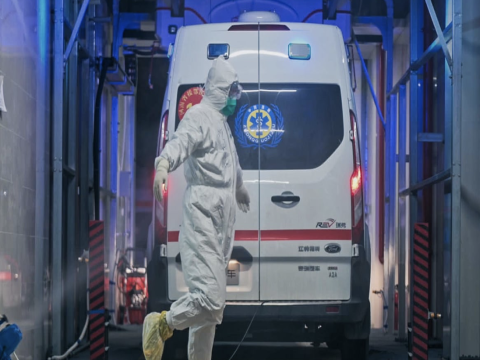
A collaboration between UCLA's Art|Sci Center and Washington University’s Center for the Humanities and Medical Humanities program, Screening Contagion invites you to a series of panel discussions on four films, with faculty drawn from a variety of disciplines. This week's panel will explore a classic of world cinema: Ingmar Bergman, The Seventh Seal (1957). How does our own pandemic moment inform how we view these films?

Newsletter link:
https://mailchi.mp/ucla/ucla-lunch-labs-artsci-2551867?e=[UNIQID]

Image: 
Exhibitors / Artists: 

Victoria Vesna

Raw Science Film Festival live events are postponed until later in 2020. The festival team considers it a challenge to bring science-based technical solutions and communication strategies to ensure a safe event where filmmakers can be honored, live.

Raw Science Film Festival (RSFF) is an annual event that takes place in Los Angeles, California and brings together people across science, technology, entertainment and media to showcase best in class film from around the world. The event was initially made possible through the support of the National Academy of Sciences and The Science and Entertainment Exchange.

The festival was created by Raw Science Inc. founder Keri Kukral thanks to the inspiration of producer Mitchell Block. The mission of RSFF is to humanize science and bring fact-based experts to the forefront of popular culture by celebrating the best science storytelling in the world. The goal is to create a world class film festival for science media on par with Cannes or Sundance Film Festival, and to extend it globally.

RSFF2020 is the 6th annual event and RSFF is collaborating with Gensler and Art|Sci Center and Natural History Museum Vienna are redesign the red carpet, defining a newly accessible and focused Hollywood experience. [Alien] StarDust is the featured, interactive red-carpet exhibit and based on extraterrestrial and anthropogenic dust which falls across the Earth with no boundaries. The art exhibit was developed at the invitation of Dr. Christian Koeberl, geologist and director of Natural History Museum Vienna, home of the one of the largest meteorite collections in the world.

Image: 
Date for Content + Calendar: 
Friday, 18 October 2019 - 8:00am to Saturday, 19 October 2019 - 6:00pm
Exhibitors / Artists: 

Noel G. Boyle, Massimo Ciavolella, Morteza Gharib, Francis Wells +

Leonardo da Vinci, Inventing the Future: Flight, Automata, Art, Anatomy, Biomorphism brings scholars, doctors, scientists, and artists together to discuss and view Leonardo’s influential work and legacy. His desire for new knowledge and understanding are examples of true interdisciplinary thinking, and this conference invites us all to consider approaching the future with expanded, Leonardo visions of what is possible.

Organized by: Noel G. Boyle, Professor of Medicine/Cardiology, UCLA; Massimo Ciavolella, Professor of Italian and Comparative Literature, UCLA; Morteza Gharib, Professor of Aeronautics and bioinspired Engineering, Caltech; Francis Wells, Cardiac Surgeon, Royal Papworth Hospital, and Cambridge University, UK

https://cmrs.ucla.edu/conference/leonardo/

Pages