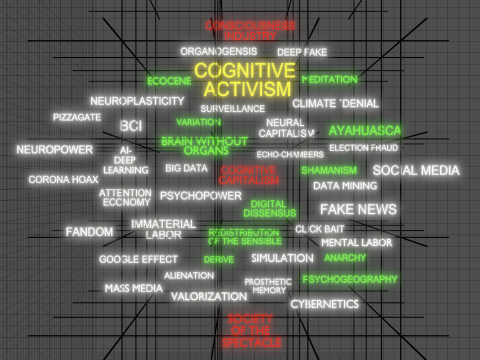
Organized by Warren Neidich in collaboration with UCLA Art Sci center, The Getty Research Center, The Saas-Fee Summer Institute of Art and the Museum of Neon Art.
Friday, September 23, 2022, 9:30 a.m. to 6:30 p.m.
UCLA California NanoSystems Institute (CNSI)
Presentation Space, 5th floor
570 Westwood Plaza
Building 114
Los Angeles, California
This conference endeavors to describe the role of art and artists in cognitive capitalism in which
the brain and mind are the new factories of the 21 st century. We are no longer only proletariats
working on assembly lines to create objects but cognitariats or mental labors working on screens
to produce Big Data which is sold to policing, governmental and cooperate entities. This has led
such authors as Byung-Chul Han, in his book Psycho-politics: Neoliberalism and New
Technologies of Power, to understand that in our moment biopower, Foucault’s power over life
as a form of the granular management of life, has transitioned to psychopower or psychopolitics
in which the mental laborers or cognitariats gladly give up their freedoms without direct coercion
to labor incessantly and overtime to interact with digitality. His new term for this is “smart
power”. But we are now on the doorstep of another transition almost or maybe as important as
that which transformed the agricultural/manufacturing economies into knowledge and
information economies. It is referred to as a neural based economy in which the material brain
and its neuroplasticity have become the focus of capitalistic commodification directly and
indirectly. Directly through technologies like brain computer interfaces, nootropics and cortical
implants and indirectly with Big Data, neuroeconomics and neural consumerism. In this neural
economy, psychopower has further transitioned to neural power where the material brain is put
to work. In psychopower and neuropower the body’s importance is reduced and subsumed by the
brain and mind. The brain, as understood here, is not restricted to the bony carapace of the skull
as cognitivists would have us believe but is a situated complex that extends into the socio-
political-cultural-ecological milieu with which it coevolves. Changes in the external milieu are
mirrored in the architectural composition of the brain through a process that Bernard Stiegler,
later in his life, referred to as exosomatic organogenesis, in which technical rather than genetic
evolution is at the core of the liberation and perfection of organ systems, especially the brain.
This brain-model is a diverse, variable, rhizomatic, intensive, becoming entity in constant
transformation. Consciousness is no longer understood as something restricted to and most
elegantly formed in humankind but rather is traced into the deep history of inorganic matter and
shared with plants and animals in non-hierarchical alignments.
This is the starting point for this symposium in which artists, architects, art historians, and
philosophers using their own practices, materials, histories, and apparatuses unveil the mysteries
of this becoming brain model. In fact, the power of art is its special alliance with the sensory,
perceptual, and cognitive as a source of emancipation, magic, and diversity in contradistinction
to cognitive neuroscientific models of aesthetics in which it becomes a map or model of data
points subject to forms of institutionalization, normalization, and demystification. This is where
the idea cognitive activism becomes evident as a reaction and form of dissensus against these
conservatisms. Key to this conference is Catherine Malabou’s entreaty that the brain is our
work, and we have the capacity to make our own brains if we have the fortitude to do so. In this
vein we also will engage with Victoria Pitts- Taylor in her book The Brain’s Body understands,
“the plastic, social brain also reveals neurobiology to be political-that is, capable of change and
transformation and open to social structures and their contestation.”
Faculty
David William Bates, Arne DeBoever, Jordan Crandall Anders Dunker, Igor Galligo, Katie
Grinnan, Karen Lofgren, David Rosenboom, Victoria Vesna, Anuradha Vikram, Pinar
Yoldas, Warren Neidich.
Friday, 18 October 2019 - 8:00am to Saturday, 19 October 2019 - 6:00pm
Exhibitors / Artists:
Noel G. Boyle, Massimo Ciavolella, Morteza Gharib, Francis Wells +
Leonardo da Vinci, Inventing the Future: Flight, Automata, Art, Anatomy, Biomorphism brings scholars, doctors, scientists, and artists together to discuss and view Leonardo’s influential work and legacy. His desire for new knowledge and understanding are examples of true interdisciplinary thinking, and this conference invites us all to consider approaching the future with expanded, Leonardo visions of what is possible.
Organized by: Noel G. Boyle, Professor of Medicine/Cardiology, UCLA; Massimo Ciavolella, Professor of Italian and Comparative Literature, UCLA; Morteza Gharib, Professor of Aeronautics and bioinspired Engineering, Caltech; Francis Wells, Cardiac Surgeon, Royal Papworth Hospital, and Cambridge University, UK
Thursday, 7 February 2019 - 9:00am to Saturday, 9 February 2019 - 5:00pm
Exhibitors / Artists:
Branda Miller, Pamela Z, Joselyn Hu
2019 Alliance of Women in Media Arts and Technology Conference
University of California Santa Barbara, CA USA
AWMAT 2019: Impact! How women in media arts, science and technology influence the community
Impact! explores how the creative and innovative works of women in media arts and technology influence the community. New forms of artistic representation in multimedia art are highlighted through interactive installations, virtual reality and sonic arts. Emphasis will be placed on how these new forms work in conjunction with technology to shape our culture.
Keynote Presenters:
Branda Miller – Media Artist/Educator
Pamela Z – Media Artist/Performer/Composer
Sunday, 11 November 2018 - 9:00am to Sunday, 18 November 2018 - 6:00pm
Exhibitors / Artists:
Victoria Vesna, Joel Ong, Ioannis Bardakos, Linus Lancaster, Marta de Menezes, Robertina Sebjanic ++
The third international interdisciplinary conference "Taboo - Transgression - Transcendence in Art & Science" will take place in 11-13 November 2018 in Mexico City, hosted by the Universidad Nacional Autónoma de México (UNAM) and the Centro de Cultura Digital. Including theoretical and artwork presentations TTT2018 continues to focus: a) on questions about the nature of the forbidden and about the aesthetics of liminality - as expressed in art that uses or is inspired by technology and science, b) in the opening of spaces for creative transformation in the merging of science and art. Coordinated in partnership with the program of the FACTT 2018 - Festival Art & Science Trans-disciplinary and Trans-national the conference is co-organized by the Research and Creation Group Arte+Ciencia, UNAM (Mexico), Arte Institute (USA), Cultivamos Cultura (Portugal) besides the Department of Audio and Visual Arts, Ionian University (Greece).
Art is, in so many ways, a reflection of reality, its glorification as well as its challenger, in an instinctive understanding that nothing is stable despite the effort to keep a balance between the comfort of belief and the delusion of control. Art and science interrelations are not always clear and one could have the impression that the artist seems more permeable to the influence of science than the scientist to the influence of art. Art’s playfully transgressive nature offers creative bypasses to the grammar of science and expands the dialogue with its openness to a multiplicity towards the new. Nevertheless, art – albeit its originary affinity with the taboo – is never completely liberated from moral considerations. Deeply involved into this lively discourse on the nature of the taboo, art becomes the very domain of contemporary experimentation with transgression, in order to provoke and sparkle discourse, catalyzing possible forms of transcendence.
Chair: Michael Doser + Speakers: Hiroshi Ishii + Matthew Fuller + Ulrike Felt + Eveline Wandl-Vogt + Jim Gimzewski
ERROR – The Art of Imperfection Conference
The Academy of Error sets the counterweight to Friday’s Error conference. It is a celebration of errors, mistakes, and failures. It seeks to reveal the potential that lies in committing errors, turning the unexpected experience of failing into a productive and constructive part of our processes. It shifts the reflection on the act of erring from an outward perspective to a more personal level. Professionals from different fields of science will give insight into the handling of errors in their respective disciplines.
Chair: Michael Doser (AT/CH)
Speakers: Hiroshi Ishii (JP/US), Matthew Fuller (GB), Ulrike Felt (AZ), Eveline Wandl-Vogt (AT), Jim Gimzewski (GB/US) Read More
Sunday, 30 July 2017 - 10:00am to Thursday, 3 August 2017 - 6:00pm
Exhibitors / Artists:
LEONARDO 50TH ANNIVERSARY
BIRDS OF A FEATHER
Informal presentations, discussions, and demonstrations for people who share interests, goals, technologies, environments, or backgrounds. Birds of a Feather sessions are proposed by SIGGRAPH 2017 attendees. The sessions are free of charge, related to computer graphics or interactive techniques, and non-commercial in nature. Sessions are presented in the convention center, official conference hotels, and the ACM SIGGRAPH Theater. More info soon! http://s2017.siggraph.org/birds-feather
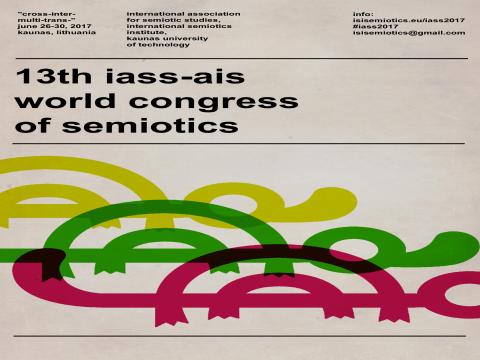
13th IASS-AIS World Congress of Semiotics
Moderated by Søren Brier and Carlos Vidales
Featuring Paul Cobley, Claudia Jacques, Zhou Liqian, Basarab Nicolescu.
VISUALIZING THE CYBERSEMIOTIC EXPERIENCE | CLAUDIA JACQUES
Advances in artificial intelligence and ubiquitous computing are expanding human-computer interaction (HCI) in everyday life turning phones, TVs, cars, etc., into computer interfaces. Such changes affect how humans perceive and interact with digital information. Cybersemiotic provides a powerful framework for comprehending and interpreting changes in human experience and consciousness wrought by the digital revolution. It achieves this by enabling an understanding of humans as complex adaptive systems; consequently, anything that involves or is involved with humans becomes an integral part of the system. Through a series of visual representations the experience of these exchanges is explored under the lens of the Cybersemiotic framework and balances human user, interface, and digital information as elements within an ever-changing system, demonstrating the manner in which a change in one element affects each and every other part of the system.
CLAUDIA JACQUES DE MORAES CARDOSO is a Brazilian-American interdisciplinary artist, designer, educator and researcher of space-time aesthetics in the user-information-interface relationship through the lens of Cybersemiotics. http://claudiajacques.com
Beginning at 5:35pm as part of the Embodiment and Evolution panel, Victoria and Takashi will lead a presentation discussing their Birdsong Diamond: Japan installation which took over the Large Space in Tsukuba this past January.