The Quantum Drawing workshop designed by Honorary Professor Paul Thomas would benefit scientists, physicists, artists and designers. The participants will explore via drawing concepts of John Bell’s 1964 provocation, to try and capture reality in the act of happening. Bell’s theorem was designed to prove or disprove the fundamental concepts of quantum mechanics. The Quantum Drawing workshop draws an analogous relationship with probability and uncertainty prevalent in science where the observer affects what is observed. The workshop questions the role of the observer influencing what is seen and experienced whilst measuring the world through drawn marks. By the act of drawing, the participants will question their roles in observing and measuring the world. Complex subjects such as delayed choice quantum erasure, probability, indeterminacy, entanglement, superposition and the classical-quantum divide will be explored through the traditional act of mark-making. When an artist makes a mark on a piece of paper through a process of summing all the probabilities of what they experience then the mark collapses the world down to a single state. Intentional repositioning and reshaping of science practices through art can promote exploration of different ways of visualising, perceiving, understanding, communicating and acting in the material world. In so doing this workshop becomes a model for facilitating transdisciplinary development of alternative domains and discourses that garner insights gained from perception, seeing with understanding.
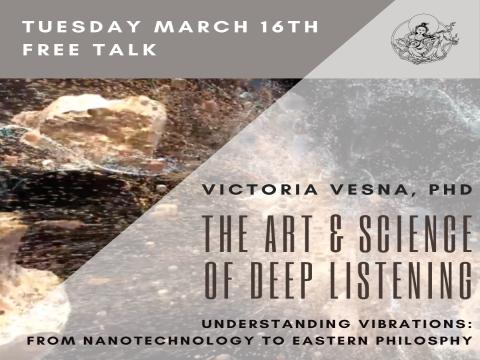
UNDERSTANDING VIBRATIONS: FROM NANOTECHNOLOGY TO EASTERN PHILOSOPHY A TALK WITH VICTORIA VESNA, PHD
In this talk, Dr. Victoria Vesna discusses vibrations from the point of view of visual and sound artists considering the scientific research into matter, brain waves, human and animal voice, environmental noise and outer space.
Quantum mechanics is based on music theory and nanotechnology is showing us the waves that underlie all matter which many Eastern philosophies have known for centuries. We need to learn to listen to the inaudible.
The way we, as humans, participate in the vibrational fields and flows of energy of the Planet Earth is embodied practice, even if the process often remains somewhat mysterious, unnoticed or unacknowledged. This workshop will explore how a human vocalization, which is nothing else than amplified and conscious breathing, can become a practice of inquiry into the planetary water cycle.
The human body is a fluid phenomenon, not only because the average amount of water in human organism ranges between 45-75%, depending on the particular organ or tissue (majority of which constitutes intracellular fluid), but also because it is incorporated into the planetary cycle, in which water constantly changes from liquid to vapor to ice, circulating around, through, and above the Earth. Through a simple act of breathing we may participate in the whole range of scales and time flows: for the terrestrial atmosphere, a given water molecule, the one we breathe in and breathe out as oxygen, might spend in the atmosphere 15,23 days on the average. What if the way we breathe and vocalize impacts the water cycles? Can we turn our bodies into water cycles measuring units and the instruments of cooperation with weather patterns? What if even the tiniest movement of the oxygen in our nostrils and lungs and even the slightest resonation of the vocal cords, chest, and abdomen can affect a rainstorm?
Meditating on such questions may provide an interesting departure point for both scientific inquiry and embodied practice of breathing and vocalizing.
Join us as we welcome in the new year with a discussion about Public Art and Atmospheric Science. Within this virtual conversation with Dr. Andrea Polli, Dr. Suzanne Paulson and Emily Womack, we will learn how these concepts converge and facilitate expanding awareness about one of our most critical diminishing resources - clean air.
Under the Hood is a video series presented by the UCLA ArtSci Center that pops open the “hood” to reveal the mechanics and mechanisms of ArtSci projects. In these short interviews, you are invited to take a deep dive into the process of how these complex artworks are created. Through a practical break-down of the technology, software, and science behind these art-science features, you will gain understanding of how art-based research is practiced and applied. Under the Hood is a series that serves as a source of inspiration and information for anyone interested in understanding the inner-workings of the multidisciplinary projects at the ArtSci Center.
Victoria Vesna’s work has long focused on immersing her audiences in installation spaces that are meant to slow down time and take us into other dimensions. This led her to work in close collaborations with musicians, sound artists, nanoscientists, biologists, neuro-scientists and buddhist monks among others. Some examples of work in the past two decades are the NanoMandala, Water Bowls, Blue Morph, Octopus Brain Storming, Bird Song Diamond and most recently the Noise Aquarium. In this new work, together with her collaborators from the UCLA Art Sci collective and Harvestworks, she takes us on a meditative journey to outer space.
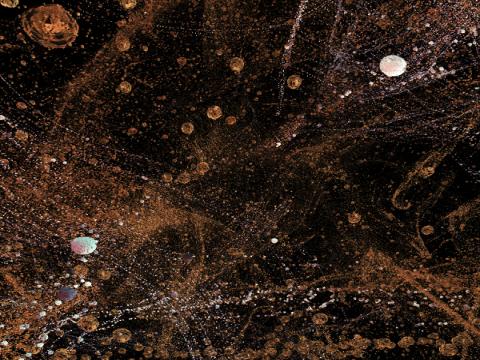
Premiering with the support of Harvestworks, this work is meant to be experienced as a guided meditation bringing to life the sensations of meteorites and micro-meteorites falling on all continents and mixing with the anthropogenic dust falling on our planet from many dimensions. Layers of sounds from inner and outer space with animations of dust and data driven by corona deaths are presented with the intent of honoring those who left their bodies without preparation and all who are suffering.
This online version was created as a meditation that is guided by the artist following the extra-terrestrial, terrestrial, and human-made dusts traveling far and wide and creating complexity that is part of an invisible reality. Most go about their daily life without being aware of ever thinking about the extraterrestrial dusts that could be on their kitchen floor, right here on earth. The alien signal is lost in the human noise and the group meditation reclaims our vision of planetary citizenship.
We are created from stardust by nuclear fusion, like our myriad siblings – animals, plants, insects, plankton, bacteria, and viruses, and we all function together in vibratory fields – bottom up just as nature and nanotechnology works. [Alien] Star Dust rains on us every day and this piece brings these particles to our attention and reminds us of our interconnected heritage in the larger cosmos. Dust knows no borders.
Linda Weintraub, Wenda Gu, Laura Parker, Jiayi Young, Iain Kerr, Vera Wittkowsky, Terence Koh.
North campus | EDA, UCLA Broad Arts
Work Out / Tune-Up / Turn On -- What’s Next? Eco Materialism & Contemporary Art –
with author Linda Weintraub
Linda Weintraub, curator, author and artist will lead a series of hands on interactive actions with visiting artists and scholars, faculty and students. The day will be divided into topics based on chapters in the book, WHAT’s NEXT? Eco Materialism & Contemporary Art (Intellect books). Audiences will actively participate.
6pm
Reception and book signing by Linda Weintraub at the Fowler museum RECEPTION RSVP!
Author and artist Linda Weintraub will lead a series of hands-on methods with visiting artists and scholars, faculty and students. In her approach, she re-establishes the physical organism as a tool for investigation and discovery, thus activating “sensory studies,” a growing field of academic inquiry, and “new materialism,” which is a current development in philosophy. The day will be divided into topics based on chapters in her recently published book, What’s Next?: eco materialism & contemporary art (Intellect Books). Together with guest participants, Weintraub invites her audience to consider the remarkable capacity of the human organism to discern, interpret, and apply evidence of the material and energetic environment.
Friday, 7 September 2018 - 5:00pm to Monday, 10 September 2018 - 6:00pm
Exhibitors / Artists:
Organizers: Dawn Faelnar + Ben Olsen
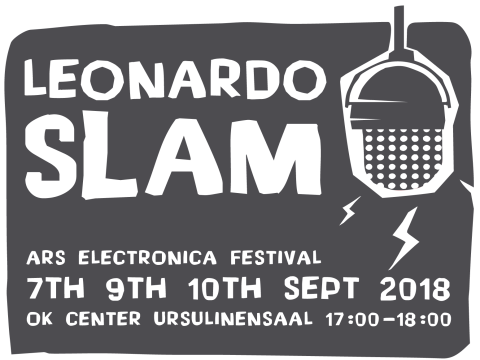
Art|Sci alumni and current grad student at Interface Cultures, Dawn Faelnar is one of the organizers of Leonardo SLAM, Sept. 7th, 9th and 10th, Ars Electronica Festival 2018, OK center Ursulinensaal, 5-6pm More info >>
The Leonardo Slam is an event for cross contamination of ideas, a short open public gathering based on the format of poetry slam, but more free-form: an individual or group may present work, words, stories, video, sound, ideas about work, work about ideas, work about work, ideas about ideas, work about nothing, ideas about music, music about performances, apples about oranges, oranges about history, history about histories, dance about architecture, et cetera.
Present or demonstrate an artwork, give a serious presentation, give a parody presentation, read a manifesto, tell an anecdote, involve the audience, improvise a song. There is no limit on the form of the presentation other than having a non negative duration and not being too long.