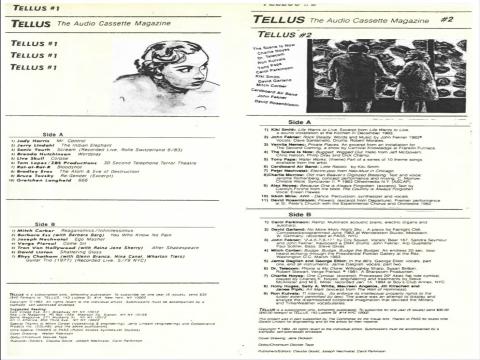
Carol Parkinson, Executive Director of Harvestworks, NY, for 37 years since 1987, has focused on the development of experimental artworks that explore sound, data, and other emerging technologies. Parkinson’s professional services include panel participation at the New York Foundation for the Arts, the New York State Council on the Arts, and the National Endowment for the Arts. Parkinson is the Executive Producer of the New York Electronic Art Festival, a series of workshops, concert performances, and exhibitions centered on art and technology. Parkinson is a founding member of TELLUS, the Audio Cassette Magazine, a cassette–based magazine of experimental music and sound art published between 1982 and 1996.
---
Shaping Experimental Arts @ Harvestworks NY 1982-2025
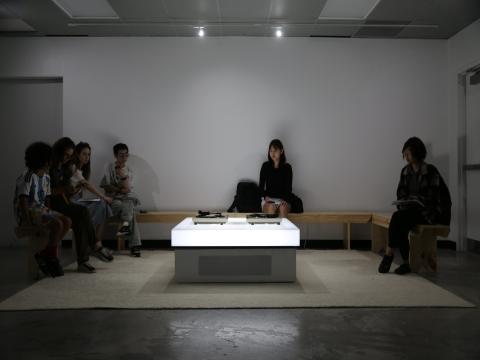
In her talk, Shaping the Experimental Media Arts in New York City, former Executive Director and current Board Member Carol Parkinson will discuss works from artists in the collection, including Blue Morph by Victoria Vesna in the New York Electronic Art Festival (2011), Alan Rath in The Interactive Show (1992), and Christian Marclay in SoundWave NYC (1987), as well as a few current exhibitions.
Dr. Paul Thomas, Honorary Professor at UNSW Art and Design and founder of the Studio for Transdisciplinary Art Research as well as the founder and series-chair of the Transdisciplinary Imaging Conference series 2010-2022. In 2000 he instigated and was the founding Director of the Biennale of Electronic Arts Perth 2002, 2004 and 2007. As an artist he is a pioneer of transdisciplinary art practice. His practice led research takes not only inspiration from nanoscience and quantum theory, but actually operates there.
---
Visualising Duration: A Quantum Perspective
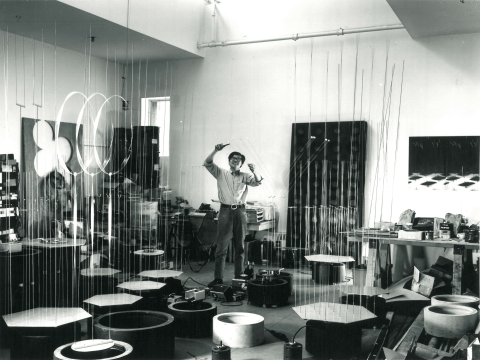
Throughout the 20th century, radical experimental artists have challenged the fundamental questions brought to the surface by quantum mechanics, highlighting the invisible forces at play. Here, the observer is integral to quantum physics, becoming part of what is observed, shaping the visualisations of the elusive quantum phenomena. Drawing examples of two artists, Thomas Wilfred, and Takis from the David Bermant Foundation, and artwork from Dr. Paul Thomas' own practice, he will discuss the concepts of duration from a quantum perspective in connection to related visualising phenomena. The artworks create visual sensations and expressions of the immense complexity of visualising the invisible, ineffable, and intangible.
Following the talk, we will be joined by special guests: Kurt Hentschläger, Andrea Rassell, and Bill Seaman
Isabel Beavers (they/she) is a transdisciplinary artist based in Los Angeles working at the intersections of new media, ecology, and collective action. Across artistic production, curatorial practice and teaching, their research challenges us to imagine adaptive climate futures–ones that rely on alternative modes of knowing as structures for living. Embodied and site-specific research are central to their practice through which they have explored Arctic sea ice melt, plant and human adaptation to wildfire in the American west, deep sea mining, the ethics of artificial intelligence, and eco-feminist re-imaginings of Western mythologies.
Beavers’ work on deep sea mining was recently included in Getty's 2024 PST Art + Science Collide as part of Transformative Currents: Art and Action in the Pacific Ocean. Beavers is the Artistic Director of Supercollider LA, and the Hixon-Riggs Early Career Fellow in STS at Harvey Mudd University. Through artistic practice, teaching, and curating, they foster communities of care and experimentation, inviting audiences to sense the unseen and imagine new eco-futures.
---
TENDER BODIES: HYBRID MEDIA + VERDANT KIN
In this presentation, Beavers discuss Nam June Paik’s Virtually Wise (1994), a work from the David Bermant Foundation Collection, and Anne Niemitz’s Kihikihi (2024), which was supported by a David Bermant Foundation grant. Drawing from these pieces, Isabel will explore how hybrid media, ecological awareness, and embodied experience can shape new frameworks for resilience and collective imagination.
Speaker: JoAnn Kuchera-Morin and Frederick Janka
Responders: Shannon Kennedy and Manjari Sharma
Our two co-presenters will be discussing four objects from the David Bermant Foundation Collection: Nam June Paik, Participation TV, 1969; Otto Piene, Light Ballet I; Marcel Duchamp, Rotorelief (optical discs) 1935-1953, edition c. 1965, and Alejandro & Moira Sina, Spinning Shaft 1978, 1983. Drawing connections between these artworks and current and upcoming artworks and projects at the Allosphere and the Museum of Contemporary Art Santa Barbara, including DJ Javier: San Milano Drive (October 2025) and Falling into the Future: Kinetic Art at the Edge of the World (October 2026)
COLOR, LIGHT, MOTION is an online series featuring media artists and scholars in dialogue about artworks from the Bermant Collection of media and kinetic arts. Each featured presenter will discuss selected artworks in history and context and in relation to their own work and connections. This series is produced in collaboration with Harvestworks NY and the David Bermant Foundation.
Speaker: Val Ravaglia will discuss works from the David Bermant Collection including: Wen-Ying Tsai, Martha Boto, and Julio Le Parc
Responders: Francesca Franco and Darko Fritz
Val Ravaglia is Curator, Displays and International Art at Tate Modern, London, and Curator of Electric Dreams: Art and Technology before the Internet. They assisted with the complete rehang of Tate Modern's Collection Displays in 2015-16 and have curated numerous collection display rooms since 2012. They co-curated the Tate Modern exhibition A Year in Art: Australia 1992 (2021-2023) and led the touring Tate exhibition The Dynamic Eye: Beyond Op and Kinetic Art. They were the Assistant Curator for the 2017 Turbine Hall Commission by SUPERFLEX and Tate Modern’s Nam June Paik retrospective. Their research interests include the intersections of art, science, and technology, as well as non-anthropocentric philosophies and the posthumanities.
Speaker: Amber Stucke Artist Talk + Reviewing Christian Marclay's works in the David Bermant Foundation Collection
Responders: Mark Patsfall and Jovi Schnell
Amber Stucke is an interdisciplinary artist based in Los Angeles, California. She identifies her work within ideas of social relationships situated between artistic research, science, and imagination.
Amber Stucke's sound installation, Talking to Plants, is featured in Atmosphere of Sound: Sonic Art in Times of Climate Disruption, co-curated by Victoria Vesna and Anuradha Vikram as part of the Getty PST ART initiative.
'In the Belly of the Beast - Southern California Art, Technology, Science and Society Nexus- A Historical Landscape'
Marko Peljhan is a distinguished artist, researcher, and professor whose work spans the fields of art, technology, and science. Born in 1969 in Slovenia, he has significantly contributed to new media art through his innovative projects and research. Peljhan co-founded the arts and technology organization Projekt Atol in 1992 and played a crucial role in establishing the Ljubljana-based new-media laboratory Ljudmila a year later.
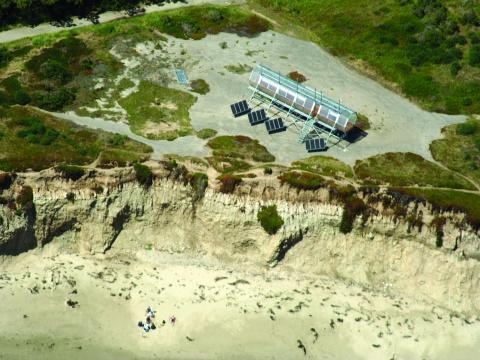
One of his most notable projects is Makrolab, an autonomous communications and research laboratory focused on weather, climate, telecommunications and migrations research, First presented at Documenta X in Kassel in 1997. Makrolab has since operated in various locations around the world, including Western Australia, Venetian Lagoon and the Scottish Highlands. Peljhan's work often addresses themes of surveillance, geopolitics, and environmental issues. Among others he co-founded the Interpolar Transnational Art Science Constellation in 2002 and in 2008 with fellow artist and colleague Matthew Biederman the Arctic Perspective Initiative. He is the recipient of many prizes for his work, including the 2001 Golden Nica Prize at Ars Electronica with Carsten Nicolai and his work has been exhibited internationally at multiple biennales (Venice, Lyon, Istanbul, Gwangju, Johannesburg, Moscow…) exhibitions and festivals, such as documenta, ISEA, Ars Electronica and museums and art institutions worldwide YCAM, ICC-NT, PS.1. MOMA, GARAGE...). In 2019 he was the representative of the Republic of Slovenia at the Venice Biennale with the work "Here we go again...SYSTEM-317".
Since 2002, Peljhan also serves as professor and director of the Systemics Lab located in the California Nano Systems Institute at UCSB, he was co-director of the UC Wide Institute for Research in the Arts from 2008-2014 and from 2017-2022 he served as Chair of the Media Arts and Technology Graduate Program at the University of California Santa Barbara. He also served as the coordinator of international cooperation for SPACE-SI Slovenian Centre for Space Sciences and Technologies and helped to conceive and launch the first Slovenian remote sensing satellite, NEMO-HD in 2020. He is also editor at large of the music label rx:tx and is known to operate in the radio spectrum as S54MX.
Ryszard W. Kluszczynski is professor of media, cultural, and art studies, Chair of the Department of New Media and Digital Culture, University of Lodz, Poland. Professor at the Academy of Fine Arts in Lodz. He investigates the issues of new media arts and cyberculture, contemporary art theory and practices, avant-gardes and transdisciplinary cultural transformations, and recent interactions between art, science, technology and politics.
Artistic Director of Art + Science Meeting Program in the Centre for Contemporary Art in Gdansk (2011-). Curator of numerous exhibitions within the Program. Co-curator of travelling international exhibition United States of Europe (2011-2013). Curator of the Second International Biennale of Contemporary Art “Mediations”, Poznan 2010. Chief Curator of Film, Video and Multimedia Arts in the Centre for Contemporary Art – Ujazdowski Castle in Warsaw (1990-2001).
Selected recent book publications:
Tsaibernetics: Transgenerational Cybernetic Art (2023);
Towards a Non-Anthropocentric Ecology. Victoria Vesna and Art in the World of Anthropocene (2020);
Beyond Borders: Processed Body – Expanded Brain – Distributed Agency (2019);
Augmenting the World. Masaki Fujihata and Hybrid Space-Time Art (2017);
Human Traits. Patrick Tresset and the Art of Creative Machines (2016);
Guy Ben-Ary: Nervoplastica. Bio-robotic Art and its Cultural Contexts (2015);
Selected recent articles and chapters:
Embodiment – Immersion – Interaction. The Art of Christa Sommerer and Laurent Mignonneau as a Living System. In Christa Sommerer & Laurent Mignonneau: The Artwork as a Living System 1992-2022. Eds. Karin Ohlenschläger, Peter Weibel, and Alfred Weidinger. The MIT Press 2023.
The History of Institutional SciArt Initiatives: An Overview of Global Tendencies. In Studiotopia. Eds. Kurt De Boodt, Emma Dumartheray, Alexia Mangelinckx, Ramona Van Gansbeke, Erich Weiss. Bozar – Centre for Fine Arts and Gluon, Brussels 2022.
The Work of Art as a Collection. Violence, Death and Loss in the Art of Luz María Sánchez. “Art Inquiry” 2021, vol. XXIII.
Praise of Darkness. Some extracts from reflections on the forms of the light presence in contemporary artistic practices. In Light as a Creative Tool. Ed. Robert Sochacki, ASP Gdańsk 2021.
Sculpting Time: The Art of Collective Memory. In Shifting Interfaces. An Anthology of Presence, Empathy, and Agency in 21st Century Media Arts. Ed. Hava Aldouby, Leuven University Press, 2020.
Visual Revolutions: From Electronic to Living Imagery, “Art Inquiry” 2020, vol. XXII.
From the Collection of Personal Memories to Collective Memory. Notes on the Archiving Trend in New Media Art. “Time of Culture” 2019, No. 2.
On the Languages of Media and Postmedia Art. In Media Education as a Challenge. Ed. Slawomir Ratajski. Academy of Fine Art and UNESCO Committee in Poland, Warsaw 2019.
Ingeborg Reichle is a Berlin-based contemporary art historian and curator at the intersection of art and technoscience. In 2004 she gained her Ph.D. from the Humboldt University Berlin with the dissertation Art in the Age of Technoscience: Genetic Engineering, Robotics, and Artificial Life in Contemporary Art (Springer 2009). In recent years she served as Professor in the Department of Media Theory at the University of Applied Arts in Vienna, Austria, and as founding chair of the Department of Cross-disciplinary Strategies (CDS), where she designed an integrated BA study program on applied studies in art, science, philosophy, and global challenges. Recent curatorial projects include the sci-art program NaturArchy at the Joint Research Centre (JRC) in Ispra, Italy, the European Commission’s science and knowledge service and the sci-art program NanoARTS by the Swiss Arts Council Pro Helvetia. In 2022 she joined the Board of Trustees of the ZKM Center for Art and Media Karlsruhe and since 2023 she serves on the Board of Trustees of Fritz and Trude Fortmann Foundation for Building Culture and Materials.
Reichle’s recent book Plastic Ocean: Art and Science Responses to Marine Pollution (De Gruyter 2021) brings together numerous international art projects related to marine plastic pollution, environmental emergencies, and climate science, and draws attention to the irreversible destruction of our marine ecosystems.
Guest Responder: María Antonia González Valerio
María Antonia González Valerio holds a PhD in Philosophy. She is a full-time professor at the Faculty of Philosophy and Literature at the National Autonomous University of Mexico (UNAM). Her academic pursuits are situated within the intersection of ontology and aesthetics, as well as the interdisciplinary realm of arts, sciences, and humanities, with a specific focus on art involving biomedia. As the director of the Seminar Arte+Ciencia, she facilitates collaborative engagements between artists, academics, and scientists, fostering interdisciplinarity that yields graduate education, specialised theoretical research, artistic creations, and exhibitions. Additionally, she is a curator and the driving force behind the artistic collective Bios ex Machina. She is the author of the books (selection): Through the Scope of Life. Art and (Bio)Technologies Philosophically Revisited (Springer, 2023), Cabe los límites: Escritos sobre filosofía natural desde la ontología estética (México: UNAM/Herder, 2016), Un tratado de ficción (México: Herder, 2010), and El arte develado (México: Herder, 2005).
COLOR, LIGHT, MOTION is an online series featuring media artists and scholars in dialogue about artworks from the Bermant Collection of media and kinetic arts. Each featured presenter will discuss selected artworks in history and context and in relation to their own work and connections. This series is sponsored by the David Bermant Foundation, partnered with Harvestworks NY and the UCLA Art Sci center.
Ivana Dama was born and raised under the socialist regime in Belgrade shortly after the end of the civil war and during the time of NATO bombing. The tension between the former Yugoslavian countries was still undoubtedly present. Even though she was only a young child when the bombing began, images and sounds of the destruction still clearly permeate her mind. The memories of living in a small shelter with the sounds and vibrations of the air raid sirens have contributed to her interest in using air and sound as a primary medium. Her work, which includes audio-video installations, robotics, web projects, and music performances, explores the deep connections between sound, memory, and human experience. Currently pursuing a graduate degree in Sculpture at Yale University, Ivana holds a previous degree in Media Arts and Digital Humanities from UCLA's School of Arts and Architecture. Her work explores the different realms of space encompassing the microscopic, architectural, and satellite scale. Through various experiments she explores how sounds behave in different environments such as vacuum, water, and outer space. Ivana has participated in over 30 group shows and had solo exhibitions in Portland and Los Angeles.