Opening Reception: Thu, January 29, 5-7pm
Exhibit Dates: January 29 - February 20
UCLA CN(S)I, ART | SCI Lab, Suite 5419
Public Secrets
There are secrets that are kept from the public and there are "public secrets," secrets that the public chooses to keep from itself-"don't ask, don't tell." The trick to the public secret is in knowing what not to know. This is the most powerful form of social knowledge. Such shared secrets sustain social and political institutions. The injustices of the war on drugs, the criminal justice system, and the Prison Industrial Complex are public secrets. Public Secrets provides an interactive interface to an audio archive of hundreds of statements made by current and former prisoners, which unmask the secret injustices of the war on drugs, the criminal justice system, and the prison industrial complex. Visitors navigate a multi-vocal narrative that links individual testimony and public evidence, social theory, and personal statements, in an effort to engage the public in a critical dialogue about crime and punishment.
Interactive, database-driven website with audio navigated with Wii controller
Blood Sugar is a "new media documentary" that examines the social and political construction of poverty, alienation, and addiction in American society through the eyes of those who live it. Blood Sugar provides an interactive interface to an audio archive of conversations with 24 current and former injection drug users recorded at the HIV Education and Prevention Program of Alameda County and in California state prisons. Since addicts must fear encounters with regimes of enforcement, they are afraid to be seen-but they do want to be heard. Theirs are the most important voices in the discourse around addiction, public health, poverty and belonging in America. Through the stories of those most affected by addiction, Blood Sugar challenges us to address question such as, what is the social and political status of the addicted? Is the addict considered fully human, diseased, possessed or wholly "other" and thus rendered ideologically appropriate to her status as less than human?
Sharon Daniel is an artist whose research involves the use and development of information and communications technologies for social inclusion. Daniel engages in the production of “new media documentaries”-building online archives and interfaces that make the stories of technologically disenfranchised communities available across social, cultural, and economic boundaries. Daniel's work has been exhibited internationally at museums and festivals including Transmediale 08, the ISEA/ZeroOne festival, the Dutch Electronic Arts Festival, Ars Electronica, the Lincoln Center Festival, the Corcoran Biennial and the University of Paris I, as well as on the Internet. Her essays have been published in books and professional journals, such as Database Aesthetics (Minnesota University Press, 2007), the Sarai Reader, and Leonardo. Daniel is a Professor of Film and Digital Media and Chair of the Digital Arts and New Media MFA program at the University of California, Santa Cruz, where she teaches classes in digital media theory and practice.
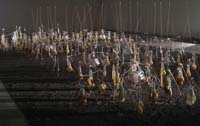
A hybrid lattice topography will be assembled at the California NanoSystems Institute, during the UCLA Art | Sci Center 2008 Symposium: Body Art Disease. The work will be composed of a lightweight sculptural field housing arrays of organic batteries. acting as a primitive 'geotextile' that might reinforce new growth. This system will support a dense series of very thin whiskers and low-power miniature lights, pulsing and vibrating in slight increments. Weak electrical charges are generated by copper and aluminum electrodes immersed in vinegar within latex bladders, working in concert with miniature microprocessors. The 'life' of the organic system will shift and erode during the symposium event. In installation workshops participants will work together in preparing the Endothelium sculpture. The work will include assembly of lightweight wood, paper and metal elements combined with miniature microprocessor and mechatronic components transported from the studio in Toronto. No prior experience is required.
Philip Beesley practices digital media art and experimental architecture in Toronto. His work in the last two decades has focused on field-oriented distributed sculpture and landscape installations.. In parallel with his sculpture practice he teaches architecture at the University of Waterloo School of Architecture in Cambridge, Ontario and is co-director of Waterloo’s Integrated Centre for Manufacturing, Visualization and Design, a facility combining high-performance computing, advanced visualization and digital fabrication. 2008-9 installations are slated for Montreal's Champ Libre, Pratt/Brooklyn, Linz Austria, CITA/Royal Academy Denmark and Surrey Gallery of Art, BC. His publications include North House (CDRN 2008), Maison Solaire (CDRN 2008), Mobile Nation (OCAD, 2007), Hylozoic Soil (Riverside, 2007), Ourtopias: Cities and the Role of Design (Riverside, 2007), Future Wood (CDRN, 2006), Responsive Architectures (Riverside, 2005), a chapter of Extreme Textiles (Smithsonian/Cooper Hewitt, 2005) and the cover feature AD Magazine Design through Making. (Wiley Academy 2005). Sculpture in upcoming publications include Interactive Art (Silver ed., Princeton, 2008), Digital Practice Now (Spiller, Wiley, 2008), Installations by Architects (Bonnemaison, Princeton, 2008), Persistent Modeling (Ayres, Architectural Design, Wiley, 2009). Beesley co-chaired the conferences Expanding Bodies: Art, Cities, Environment (ACADIA Halifax 2007), Responsive Architectures: Subtle Technologies (Toronto, 2006); Fabrication: Examining the Digital Practice of Architecture (Waterloo and Toronto, 2004), On Growth and Form: The Engineering of Nature (Cambridge, 2002). Distinctions for his work include the Prix de Rome in Architecture (Canada).
Hayley Isaacs is an associate of Philip Beesley Architect Inc. who has played key roles in conception and production of sculptures, books and buildings including Hylozoic Soil (Montreal, 2006), Ourtopias (Riverside, 2007), North House and Maison Solaire (CDRN, 2008). She holds a Master of Architecture from the University of Waterloo and her focus combines industrial design and exhibitry, graphic design and architecture.