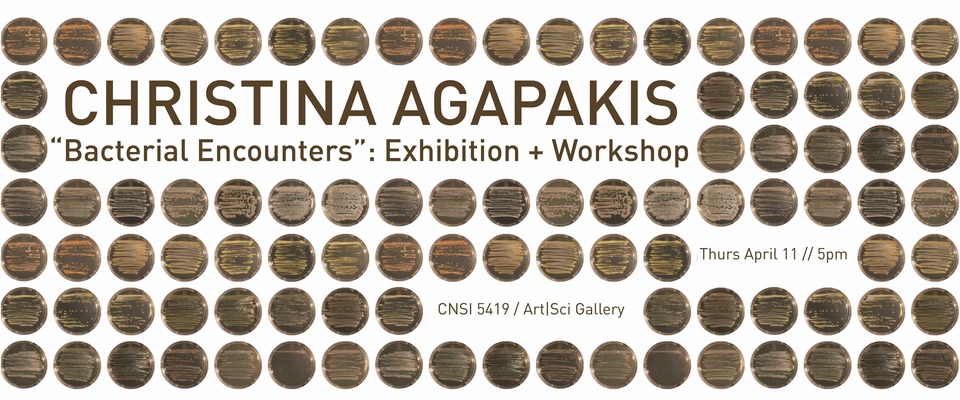
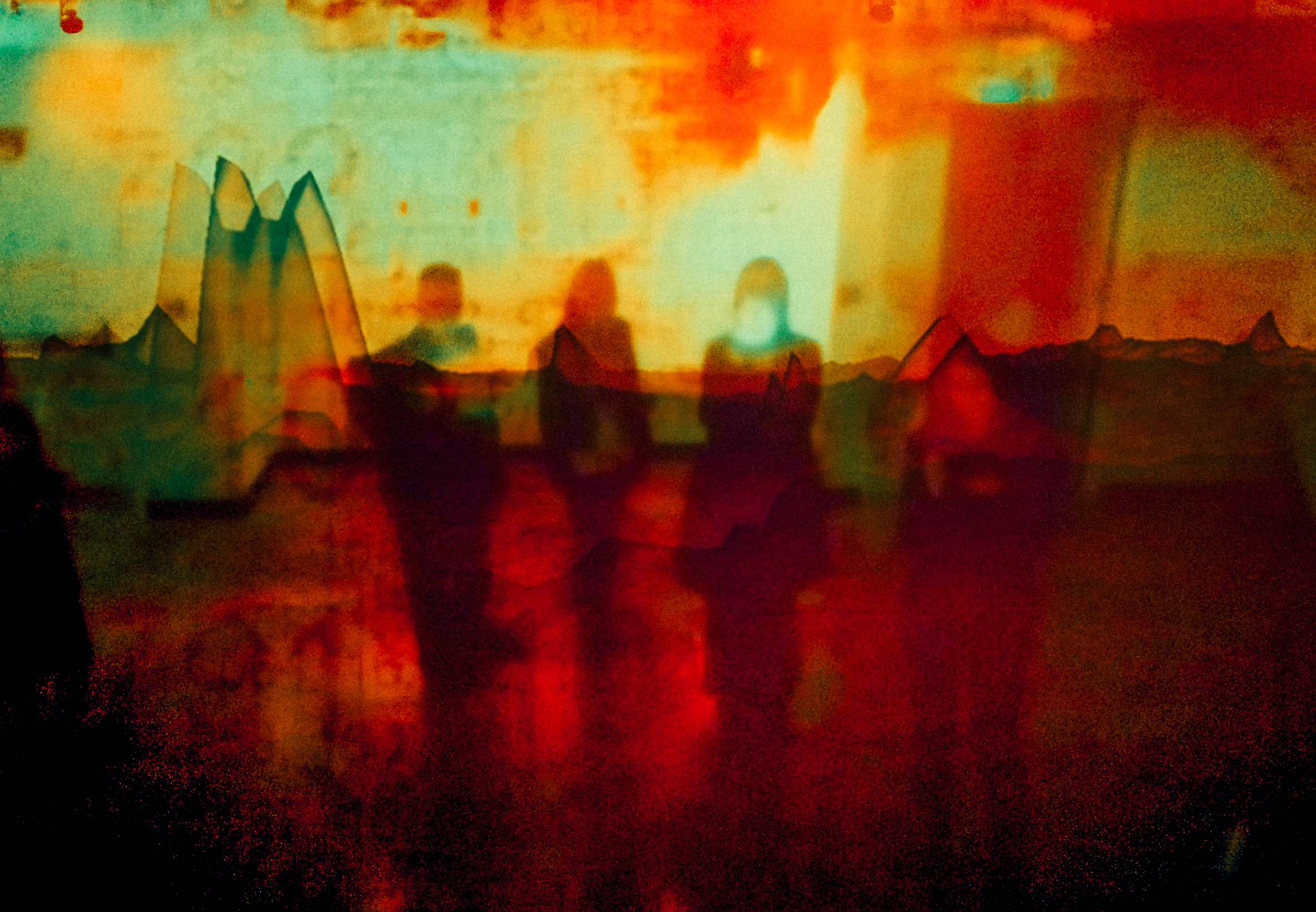
Microbes are often synonymous with rot, decay, infection, and disease. When microbes are made visible—or worse, smellable—it signals danger, a situation best avoided. But microbes are unavoidable, essential as part of the ecology of the healthy human body and the global dynamics of biogeochemical cycles. The growing realization of microbial usefulness and diversity is changing our relationship to microorganisms from one of fear, isolation, and sterilization, to a more ecological understanding of symbiotic exchange. Bacterial Encounters is an exploration of nature and culture from a microbiological perspective, capturing the microbial ecology and the living diversity thriving after the death of the Salton Sea. Through culturing such microbes, we make visible the ecologies that make up our world.
Sci|Eye Apparatus is an experimentation in images, sound, and space, as we shape them with our tools. The Apparatus takes us through different scales, states, and dimensions. The intention is to help us imagine the invisible with composed aural atmospheres.
Blanka Buic studied music and economics, takes pictures and shoots videos for a living, and started exploring scientifically-inspired perception when she joined the Art | Sci center in 2009.
Soundscapes were created by Günther Jones, inspired by both natural and man-made rhythmic sounds that have their own kind of music.
Art|Sci Gallery / CNSI 5419. Click here for a downloadable PDF map and here for an interactive campus map.
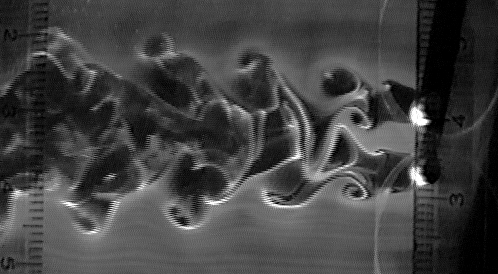
First interested in pattern formation through his experimental work on Rayleigh-Bénard convection during his PhD, Patrice le Gal was then especially interested in the formation and the interaction of Von Karman wakes and also in the instabilities of the Ekman boundary layer over rotating disks. He has published more than 70 research articles in fluid mechanics: on convective patterns, wakes, turbulence, rotating boundary layer instabilities, plankton bioluminescence and more recently on the elliptic instability. He is currently involved in experiments on stratified and rotating flows: strato-rotational instability, internal wave generation, wave breaking, vortex formation. All of these flows have applications in geo and astrophysics. Recently he developed several art-science projects in collaboration with J. Tejerina-Risso who is a video artist.
Abstract: WAVES is an Art-Science project to install videos, images and multimedia performances based on the visualization of water surface waves. We work at IRPHE (Institut de Recherche sur les Phénomènes Hors Equilibre) in Marseille for designing experiments to produce hydrodynamic waves. We aim to study the behavior of different types of waves and their evolution: generation, breaking, focussing. We present here the general property of waves to focus when properly generated or reflected. Using a parabolicaly shaped wave maker, we focus water waves in a region of the water surface classically called the Huygens Cusp in optics. At this cusp, the amplitude of the waves is increased by focusing and this leads to their breaking which is a typical property of water surface waves. We record these breakings using a fast video camera at a rate of 2000 images per second. A novel and spectacular vision of water wave breakings is obtained when playing these movies at slow speed.
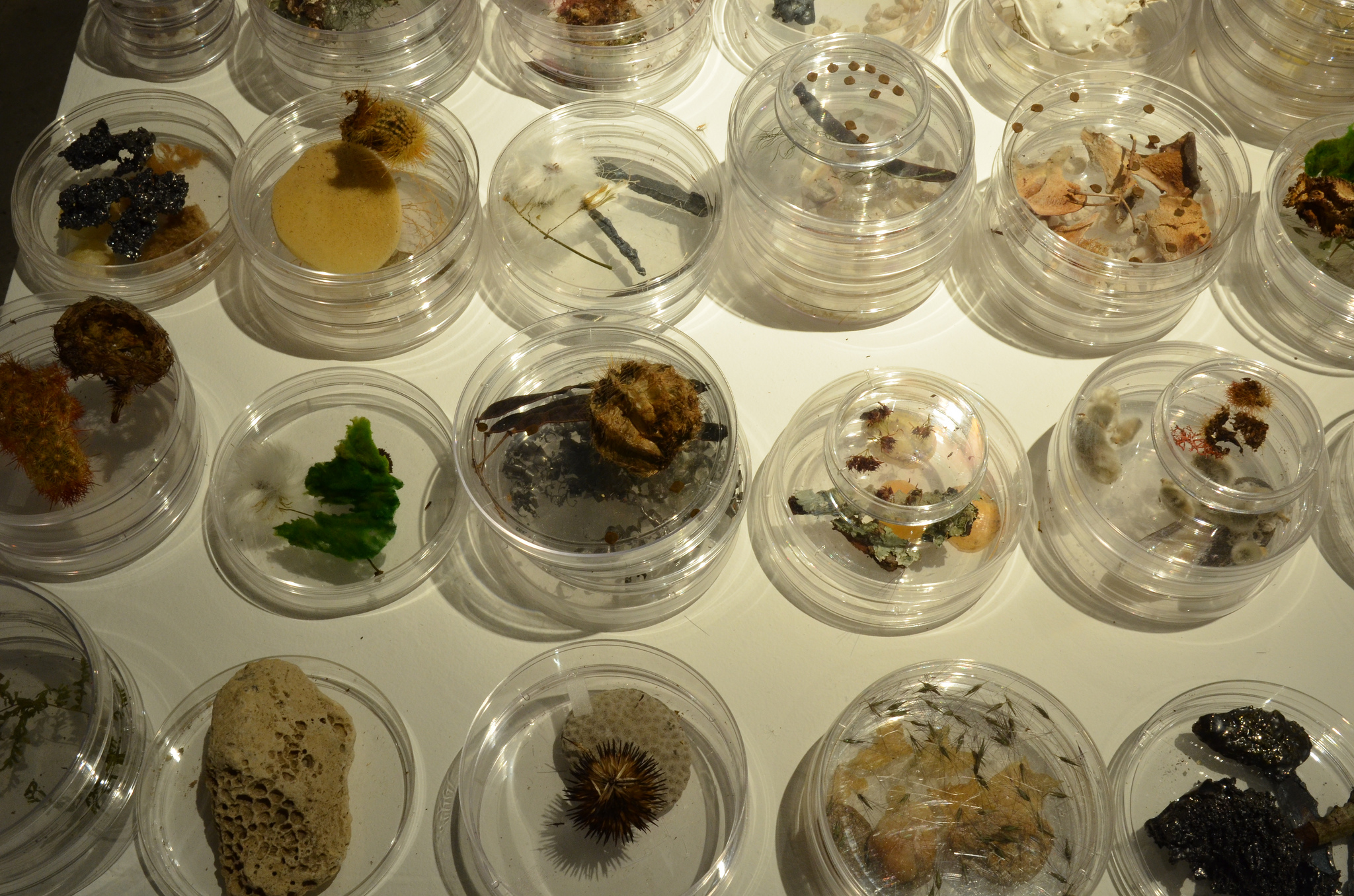
Suzanne Anker is a visual artist and theorist working at the intersection of art and the biological sciences. Her works include digital sculpture, installations and large-scale photography. Her project, Genetic Seed Bank, demonstrates the recuperative and adaptive power of nature and the potential for organic materials as a medium for artistic expression.
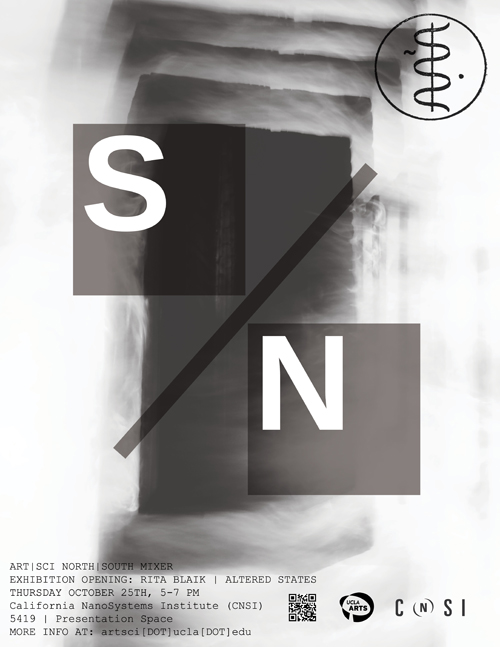
Rita Blaik, Art|Sci fellow, IGERT clean energy fellowship recipient and doctoral student in material science, presents her ephemeral photographs that cross the boundaries on materiality. The exhibition will be followed by the North | South Mixer and the introduction of the newly formed Undergraduate Art and Science Club.
Thursday, October 25, 2012. 5-7pm
Art|Sci Gallery / CNSI 5th floor Presentation Space. Click here for a downloadable PDF map and here for an interactive campus map.
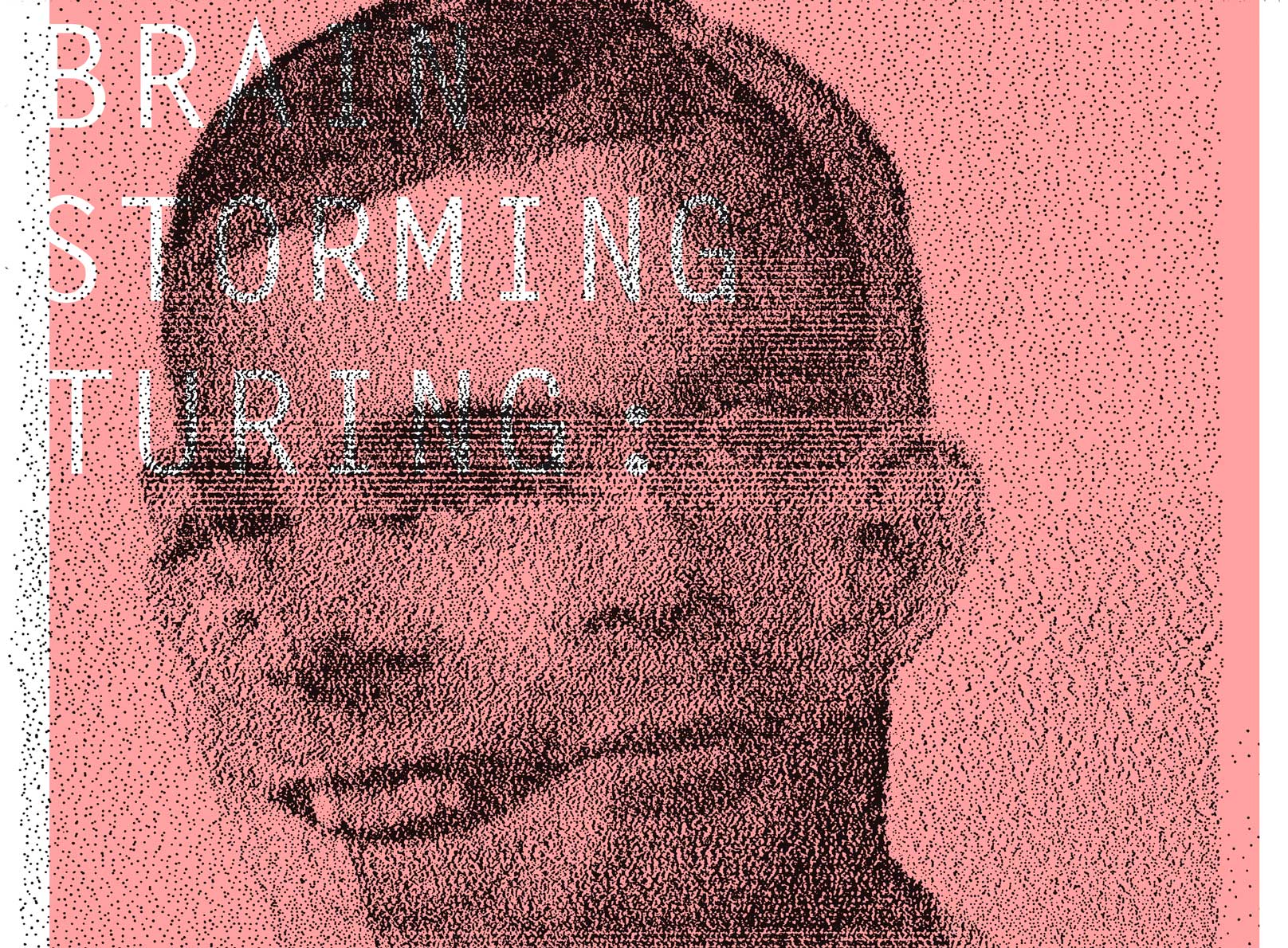
Brainstorming Turing: Celebrating Alan Turing + 25 Years of AI and Society Journal
100 years have passed since Alan Turing was born and we celebrate this historically important individual together with many organizations around the world. We look to show his eccentric creativity in addition to reminding all of the huge contribution he made to computation and artificial intelligence. Short talks by computer / neuro / nano scientists and humanists are accompanied by artists inspired by Turing’s legacy and persona. Additionally, students from UCLA will participate with their ideas of how Turing informs and inspires their work and lives in this time when social networking, robotics and automatic brains are part of daily life.
2012 also marks 25 years since the establishment of AI & Society journal that owes its formation to Turing’s legacy. The Art | Sci center is partnering with this interdisciplinary publication to honor Turing and all those who have contributed over the years. A special issue based on the symposium is planned.
Paul Thomas gave a guest lecture on his work, New Materialities. Thomas is the Head of Painting at the College of Fine Art, University of New South Wales. Paul has been working in the area of electronic arts since 1981 when he co-founded the group Media-Space. Paul’s current research interests explore the space between life and death at a nano level.
Time:
Lecture @ 2pm
Exhibition Openings: 5-7pm
Location: Lecture @ UCLA Broad Art Center, room 5240, Exhibition @ CNSI Gallery
Opening March 7
Lecture @ 2pm
Exhibition Openings: 5-7pm
Location: Lecture @ UCLA Broad Art Center, room 5240, Exhibition @ CNSI Gallery
Exposure is an exhibition of work by Mike Phillips, Professor of Interdisciplinary Arts, School of Art & Media at Plymouth University. Mike Phillips is director of i-DAT, a Principal Supervisor for the Planetary Collegium and a supervisor of the Transtechnology Research Groups. His R&D orbits digital architectures and transmedia publishing, and is manifest in a series of ‘Operating Systems’ to dynamically manifest ‘data’ as experience in order to enhance perspectives on a complex world. The year that Eastman Kodak filed for bankruptcy protection was the same year Fujifilm moved from film production to beauty products1. This did not just mark a technological shift from film grain to nanoparticles but also a massive cultural shift - a shift from capturing the face on film to the embedding of ‘film’ in the face. The thing that once froze the face in an eternal youthful smile is now the anti-aging nanoparticle that preserves the face we wear. Barthes described the face on film as representing “a kind of absolute state of the flesh, which could be neither reached nor renounced”2. Now this absolute state is closer to hand and we will walk around wearing our old photo albums as our face, peeling away the frames like layers of dead skin. Our essence, like Garbo’s, will not degrade or deteriorate. ‘Viewed as a transition’ Exposure explores the deterioration of the flesh through the temporality of the Atomic Force Microscope (AFM). From the 60th of a second exposure of the Kodak Brownie camera to the 20-minute scan of the AFM - the closer the subject the longer the ‘exposure’. Incorporating data from an AFM scan of a basal cell carcinoma Exposure explores the convergence of ideologies constructed around imaging technologies. Through a subtle interaction the viewer conjures up a dynamic data/image of a skin cancer - over exposed to the sun - or the intense light of the camera flashgun.
Lecture @ 2pm
Exhibition Openings: 5-7pm
Location: Lecture @ UCLA Broad Art Center, room 5240, Exhibition @ CNSI Gallery
Dark Skies is a work by Patricia Olynyk in Collaboration with Axi:Ome and Christopher Ottinger.
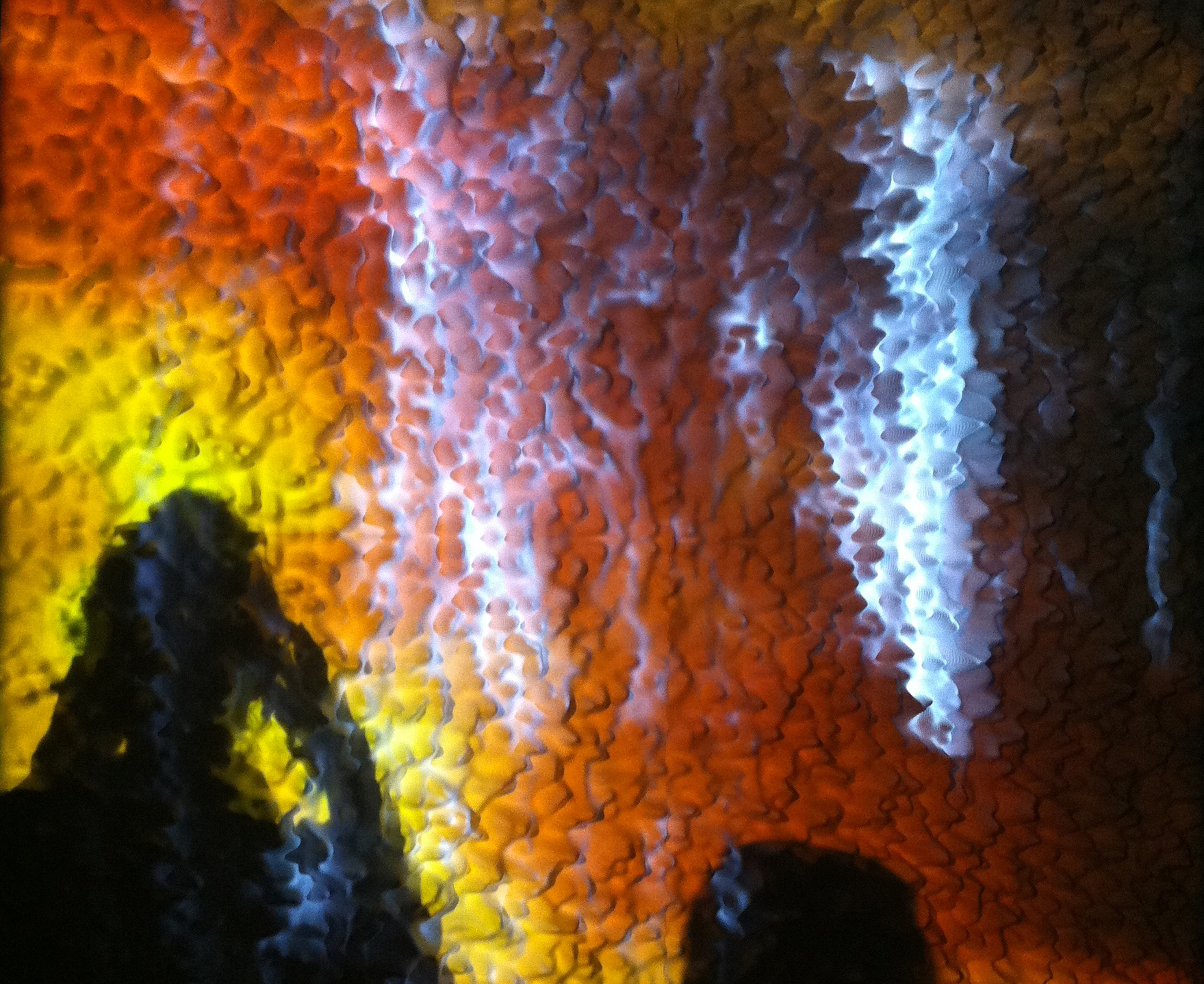
Dark Skies is a multi channel projection on CNC routed tiles inspired by the concept of biomimicry. The surfaces of the tiles themselves are based loosely on the shape and topography a wildmouse tastebud. The installation also includes an evocative soundscape, drawn primarily from field recordings captured at twilight in the Rocky Mountains during high summer. "Dark Skies" is an astronomical reference, referring to remote places free of hazy city light that allow for an extended view into deep space and time. This insight offers not only a unique perceptual and psychological experience but the promise of new discovery.
Patricia Olynyk is an artist whose prints and installations frequently employ microscopy and biomedical imaging technologies to explore the intersections between art and the life sciences. Currently she is Chair of the Leonardo Education and Art Forum (LEAF). Exhibition opening to follow the lecture.
The Wild West of Chronic Pain:
Collaborations among Artists, Scientists and Health Care Experts
Why is a media technology -- immersive VR -- known as a "non-pharmacological analgesic"?
Can a robot reduce anxiety?
How might novel forms of social media combat the social isolation experienced by seniors who have chronic pain?
What do Sufi practices and phosphorescent creatures have to do with pain?
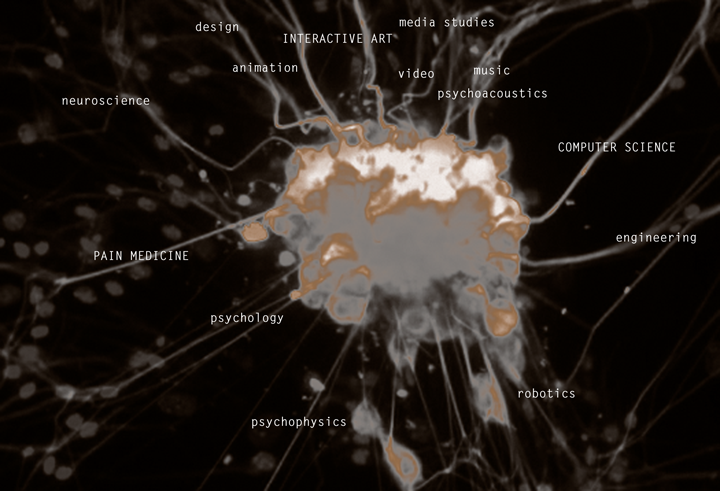
Members of the Transforming Pain Research Group comprise artists, musicians, computer scientists, engineers, designers, psychophysicists; and pain physicians. All are exploring the ways that new technologies may help the 1 in 5 people who suffer from chronic pain.
Referred to as the silent epidemic, this relatively new disease has no known cause and no cure. While health care researchers explore its etiology, experts from diverse disciplines are working on ways to help with managing chronic pain. See what a group of innovative researchers north of the border are doing.
November 30th: . Guided Tours: Noon to 5pm
ArtSci Gallery, CNSI Bldg., Room 5419 . Reception: 5:30-7:30pm
CNSI Lobby