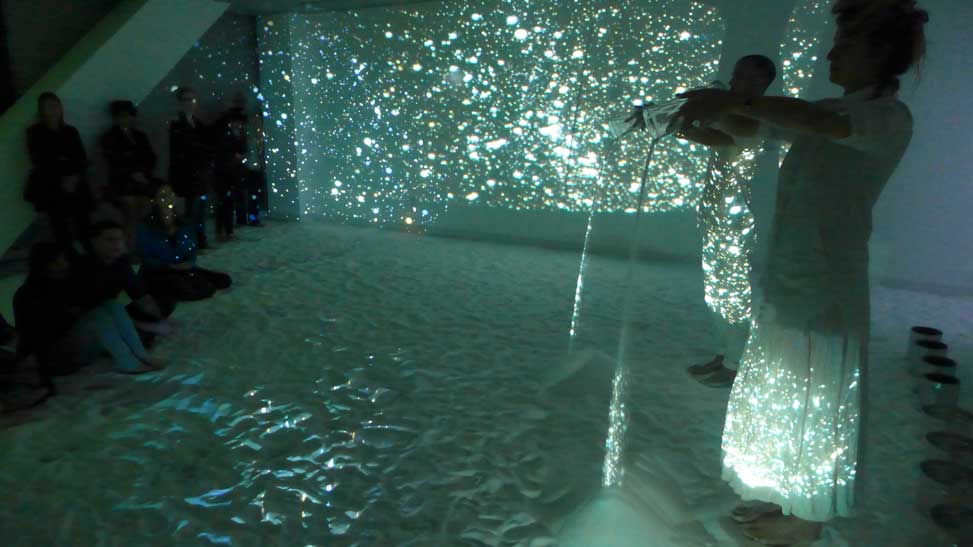
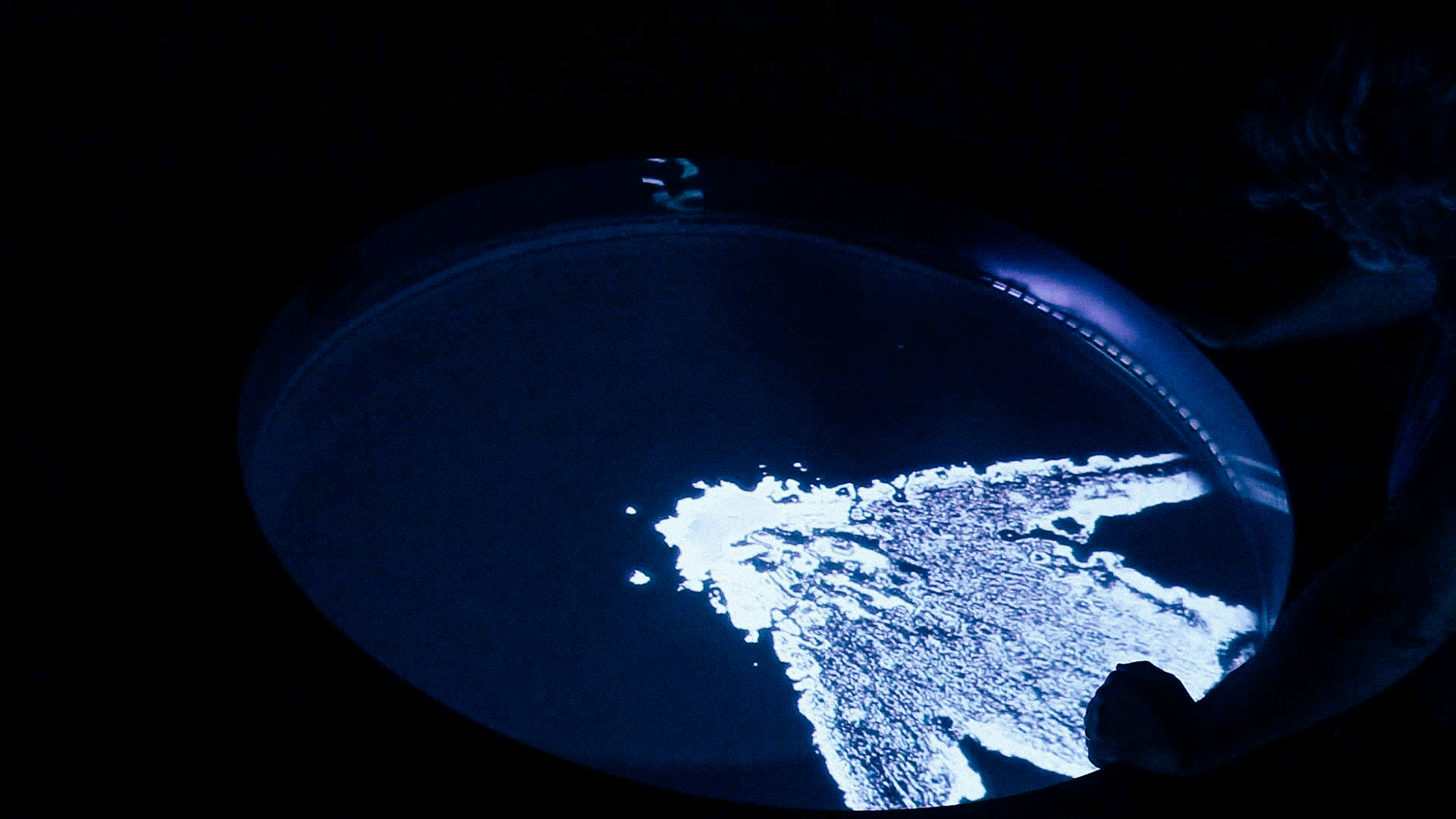
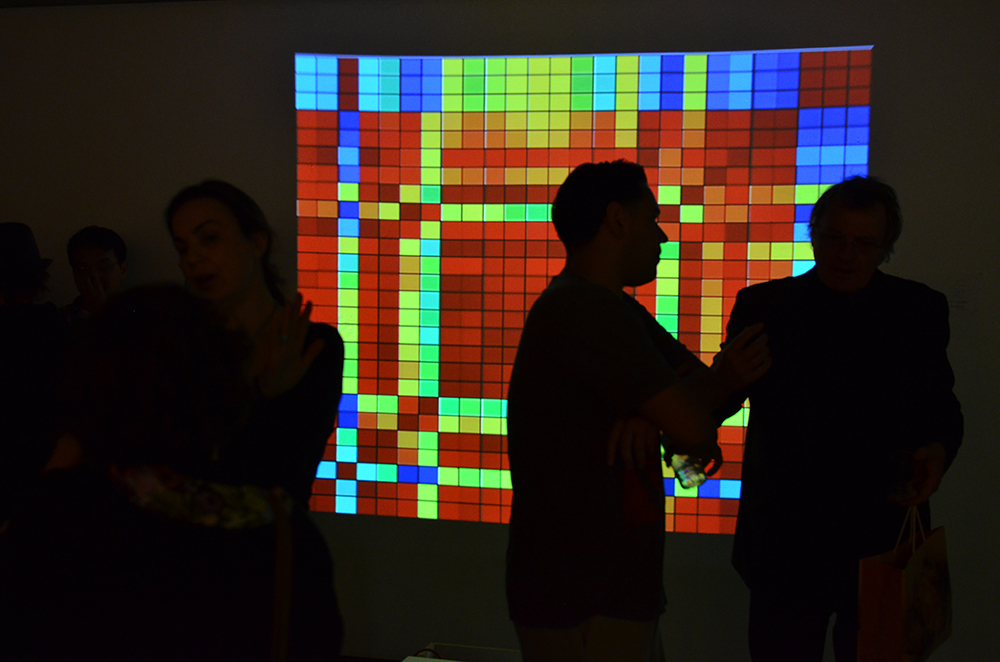
Presented by internationally renowned artist Lita Albuquerque, Prime Meridian: Zero Degrees explored the relationship between humanity and the movement of the cosmos. Albuquerque projected two videos on the walls of stellar rotation from the north and south poles and a projection on the ground of a body’s shadow running. In this projected world, Albuquerque suspended our ordinary reality. The normal ebb and flow of life ceased, in order to better understand our common bonds of time, stillness and motion.
With sound composed by Susan Deyhim, Prime Meridian: Zero Degrees was performed by Jasmine Albuquerque Croissant, Marc Breslin and Clarissa Ribiero.
Lita Albuquerque is an installation/environmental artist, painter and sculptor. She has developed a visual language that brings the realities of time and space to a human scale and is acclaimed for her ephemeral and permanent art works executed in the landscape and public sites.
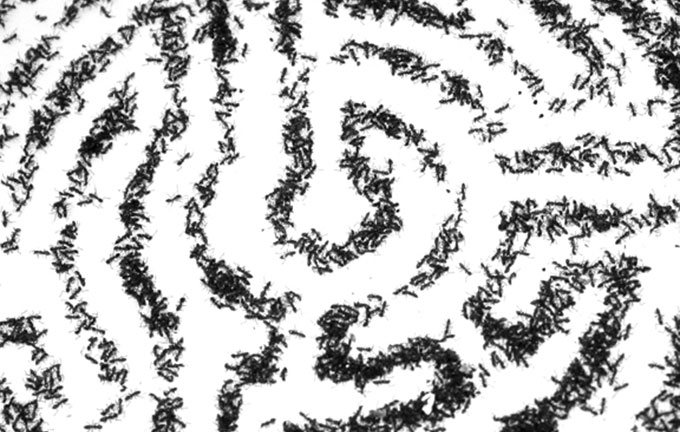
By approaching living material with the tools of artistic research, Ted Meyer worked to create poetic, yet absurd interactions between the individual and the environment, focusing on how creative impulse marks and alters the living world.
Loren Kronemyer is an internationally exhibiting artist from Los Angeles, California. After graduating with a BFA in New Genres from the San Francisco Art Institute, she moved to Perth to work with the SymbioticA lab to obtain a Masters of Biological Arts degree at the University of Western Australia. By approaching living material with the tools of artistic research, Loren works to create poetic, yet absurd interactions between the individual and the environment, focusing on how creative impulse marks and alters the living world
EVENTS ARE FREE and light refreshments are on the house. Parking is in lot 9, by the hour $12 all day. Drive up to the top of the parking structure to reach the entrance of the building.
Joyce Cutler-Shaw is an artist of intermedia, although drawing is at the heart of her work. She considers drawing to be a primary language, a way of knowing, a mode of inquiry, and an act of empathy. She has exhibited internationally since 1972. Joyce Cutler-Shaw’s works—public installations, drawings and artists books—are represented in both Museum and Library Special Collections including the Albertina Museum in Vienna, New York’s Museum of Modern Art, The 42nd Street Library, the Klinspor Museum in Germany, the Teylers Museum in The Netherlands, and the Herbert Johnson Museum at Cornell.
The olfactory sense, though often forgotten, is a powerful connector to memory and emotions. Diary of Smells: Shards (Estilhaços) is an on-going multi-sensorial interactive & interdisciplinary project comprised of various stages of smell production, photographs and sound design.
Josely Caravalho, a Brazilian multi-media artist lives in New York and Rio de Janeiro. Over the past three decades, she has assembled a body of work in a wide range of media that gives eloquent voice to matters of memory, identity and social justice while consistently challenging the boundaries between artist and audience and between politics and art. She received her BA from Washington University, St. Louis and has taught at the School of Architecture, National University of Mexico and SUNY at Purchase. She is founder and director of The Silkscreen Project, St. Mark’s Church in-the-Bowery in New York City.
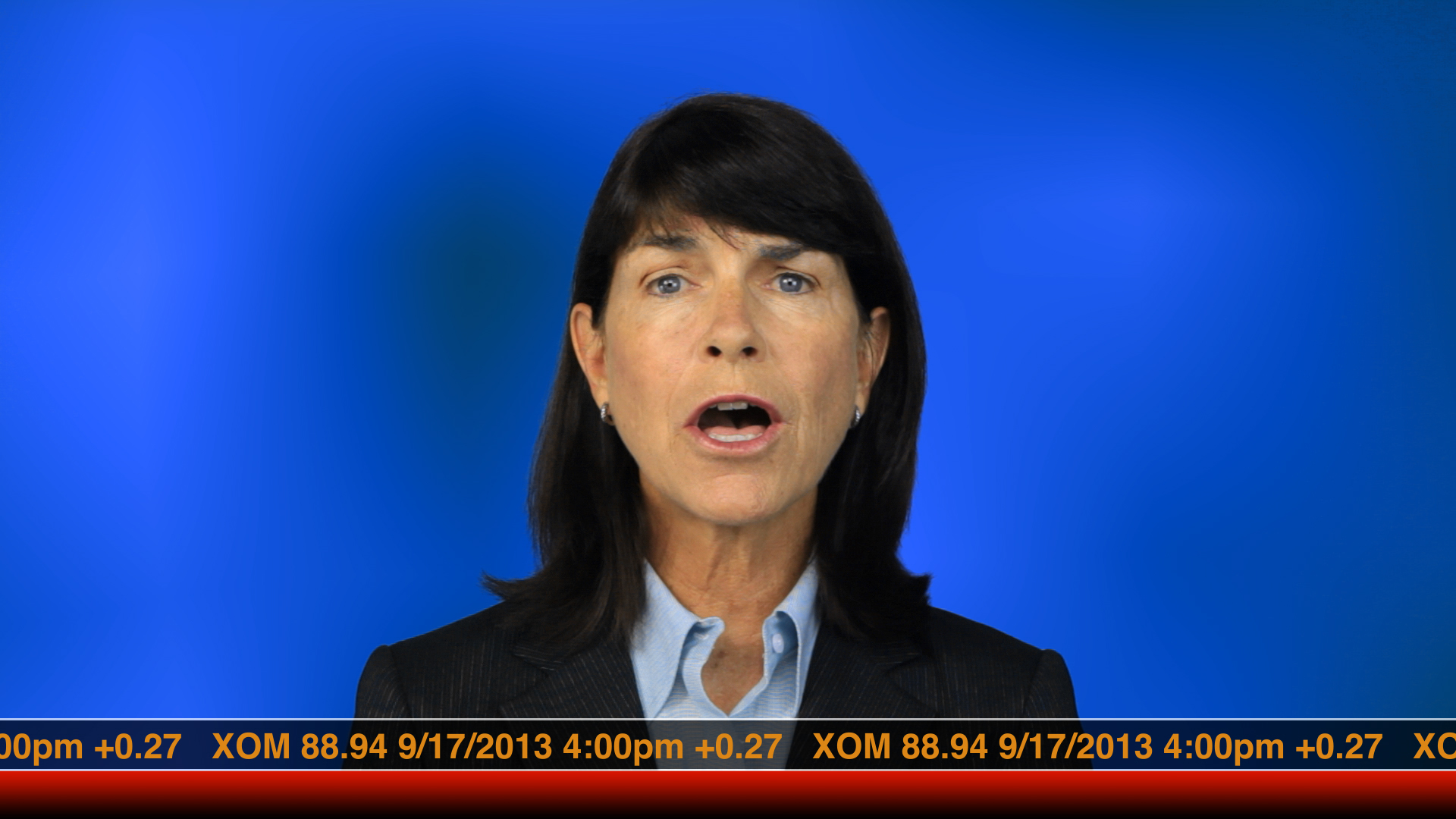
Dow Jones: A Solfége Economy was a real-time singing portrait of the US stock market, and by extension, the U.S. economy. Each business day, millions of publicly owned company stocks and shares are bought, sold and exchanged in a perpetual cycle for capital gain. Dow Jones interpreted the resulting fluctuations in share values to create a continuous sound of economic highs and lows.
Echo & Narcissus was an installation that explores this ancient myth as a metaphor for the interaction between two individuals who cannot communicate. An interactive visual projection on water and multi-channel soundtrack of Echo’s voice used counterpoint to produce a series of visual and sonic relationships.
As one looked into the water one would see an image of their own face gradually materializing, dematerializing, disappearing, then reappearing once again. Echo’s voice permeates the space, moving throughout the gallery creating a haunting affect.
Echo & Narcissus is directed and produced by artist/curator David Familian, who is artistic director of the Beall Center for Art + Technology at the Claire Trevor School of the Arts in UC Irvine. His collaborating team included actor Marie Chambers (voice of Echo), media artist Eric Parren (programmer of the interactive elements) and author Terry Wolverton (writer of the Echo’s monologue).
Fallen Fruit presents a set of their Public Fruit Maps paired with their 2010 video, “The Loneliest Fruit in the World.” The maps are one of the collaboration’s signature projects: mapping all the fruit trees that grow in or over public space in neighborhoods around the world to which they are invited. The maps are hand-drawn and distributed free of copyright; they serve as guides for foraging but more importantly as visionary representations of what we hope to see: alternative urban spaces that engender new forms of sharing and thereby create new public experiences. “The Loneliest Fruit in the World” addresses a different kind of public fruit, berries that grow wild in the Arctic. The lingonberry, the salmonberry and the blueberry grow without any human involvement, and for a few short weeks become the site of intense activity as people flock to pick them on all public land. Shot in a residency in Tromsø, Norway, 200 miles above the Arctic Circle, the video follows a group of Norwegians through a beautiful, spare landscape; while picking, they negotiate the relation between solitude, gleaning and company.
ARTIST BIO: Fallen Fruit is a long-term art collaboration that began by mapping fruit trees growing on or over public property in Los Angeles. The collaboration has expanded to include serialized public projects, site-specific installations and happenings in various cities around the world. By always working with fruit as a material or media, the catalogue of projects and works reimagine public interactions with the margins of urban space, systems of community and narrative real-time experience. From participatory performances such as Public Fruit Jams and Fruit Meditations, to ongoing indexical work such as Public Fruit Maps and curated exhibitions that reorganize the social and historical complexities of museums and archives by re-installing their collections through syntactical relationships of fruit as subject, the three artists of Fallen Fruit — David Burns, Matias Viegener, and Austin Young — deploy fruit as a lens through which to see the world.
Project Eureka is a shapeshifting narrative that will unfold over the course of 2013. Through performance, installation, and video the project will follow the first and last designer baby, as she struggles to contribute to the future of humanity in a post-climate change world.
This iteration of Project Eureka will introduce two characters from Eureka's world.
Featuring interviews with Laurie Zoloth, PhD (Professor of Medical Humanities & Bioethics and Religion; Director of Center for Bioethics, Science and Society) and Gizmo Jon (of Slab City)
Between 7 & 8, the gallery will become a dance floor.
Thursday, April 25th, 2013
5-7pm
Art|Sci Gallery, CNSI 5419
Click here for a downloadable PDF map and here for an interactive campus map.
Duality is an Art|Sci manifestation of complexity emerging from a tiny network of billions of tiny self assembled, self-organized, non-linear connections that materialize in time and space through holistic processes and which are a kinesthetic visualization of wandering in and out of the fuzzy borders of chaos and order. We use a real network, where the creator has given permission to its expanding and collapsing spatio-temporal morphogenic and often catastrophic dynamics.
This project represents the transition in science and art from giving up on the clock to embrace a cloud in terms of Karl Popper’s important statement “we live in a universe not of clocks but of clouds.” In the laboratory we build electro-ionic clouds. In the gallery we let them self create images songs and dance for this Art|Sci exhibition entitled Duality. It is the duality of the dark space between the known and unknown, determinism and surprise, mathematical form and fuzziness from which the atoms, electrons and ions speak to the visitors without censorship.