Performing Quantum Entanglement: Subtle Apparatuses for Extrasensory Affectiveness
Clarissa Ribeiro
Opening Reception: Thursday, June 5th | 5-7 p.m.
Art|Sci Gallery, 5th Floor CNSI
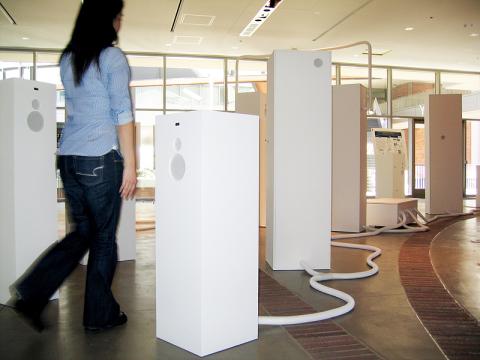
What does it mean to be entangled? In this experimental work, composed of three interactive video installations, Ribeiro invites us to think about ourselves and our affective dimension from a semi-material and non-local perspective.
The olfactory sense, though often forgotten, is a powerful connector to memory and emotions. Diary of Smells: Shards (Estilhaços) is an on-going multi-sensorial interactive & interdisciplinary project comprised of various stages of smell production, photographs and sound design.
Josely Caravalho, a Brazilian multi-media artist lives in New York and Rio de Janeiro. Over the past three decades, she has assembled a body of work in a wide range of media that gives eloquent voice to matters of memory, identity and social justice while consistently challenging the boundaries between artist and audience and between politics and art. She received her BA from Washington University, St. Louis and has taught at the School of Architecture, National University of Mexico and SUNY at Purchase. She is founder and director of The Silkscreen Project, St. Mark’s Church in-the-Bowery in New York City.
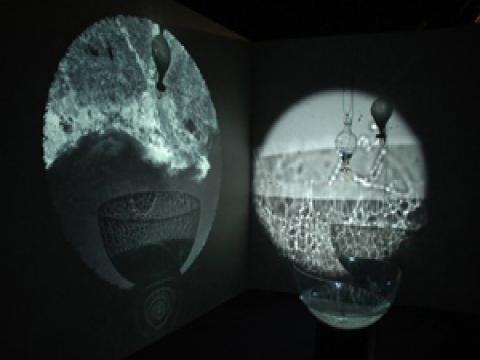
Echo & Narcissus was an installation that explores this ancient myth as a metaphor for the interaction between two individuals who cannot communicate. An interactive visual projection on water and multi-channel soundtrack of Echo’s voice used counterpoint to produce a series of visual and sonic relationships.
As one looked into the water one would see an image of their own face gradually materializing, dematerializing, disappearing, then reappearing once again. Echo’s voice permeates the space, moving throughout the gallery creating a haunting affect.
Echo & Narcissus is directed and produced by artist/curator David Familian, who is artistic director of the Beall Center for Art + Technology at the Claire Trevor School of the Arts in UC Irvine. His collaborating team included actor Marie Chambers (voice of Echo), media artist Eric Parren (programmer of the interactive elements) and author Terry Wolverton (writer of the Echo’s monologue).
Launch of card game conceptualized by Victoria Vesna and neuroscientist Siddharth Ramakrishnan, graphics / game design by Adeline Drucker (DMA Game Lab).
Reception and introduction to project: Friday, November 9th – 6-8pm Game testing workshop: Saturday, November 10th – 3-6pm
Harvestworks 596 Broadway, #602 | New York, NY 10012 | Phone: 212-431-1130
Join us for this unique opportunity to hear the artist / scientist discuss their exhibited works resulting from their decade long collaboration. Works on view include Zero@Wavefunction, Nanomandala, Blue Morph and Brain Storming a work in progress. After the overview of the works in the gallery, you will be able to follow the Brain Storming session on Alan Turing and the Brain. Neuroscientist Mark Cohen, engineer Ramesh Jain, and artist Connie Samaras will be participating in this live discussion. The exhibition is organized by David Familian who will be moderating the session.
MORPHONANO Artist Lecture
Saturday, May 5, 2012
6pm - 8pm - at the Beall Center
Leonardo Art Science Evening Rendezvous (LASER)
Stanford University
Geology Corner (Bldg 320), Room 105
Palo Alto, CA
LASER is a monthly series of lectures and presentations organized by Piero Scaruffi on behalf of Leonardo/ISAST. LASER is sponsored by School of Visual Arts MFA Computer Art Department, Arizona State University Art Museum, Srishti School of Art, Design and Technology, and School of the Art Institute of Chicago Sound Department.
Schedule:
6:45pm-7pm: Socializing/networking.
7pm - 7:25pm: Shona Kitchen (San Jose State Univ's CADRE) on "Speculation of an Alternative Today"
A fresh outlook at technological adaptations and how they can enhance and enrich our surroundings rather that distract us from them.
7:25-7:50pm: Carlo Sequin (U.C. Berkeley) on "Knotty Sculptures"
Simple knots can be used as constructivist building blocks for abstract geometrical sculptures.
7:50-8:05: BREAK
Before or after the break, anyone in the audience currently working within the intersections of art and science will have 30 seconds to share their work. Please present your work as a teaser so that those who are interested can seek you out during social time following the event.
8:05-8:30pm: Margarita Marinova (NASA) on "The Dry Valleys of Antarctica as an Analogue for Mars"
The Dry Valleys of Antarctica are a unique place on Earth: the coldest and driest rocky place, with no plants or animals in sight. Studying the Dry Valleys allows us to understand how the polar regions on Earth work, what the limits of life are - and to apply these ideas to the cold and dry environment of Mars.
8:30pm-8:55pm: Peter Foucault (SFAI) on "Systems and Interactivity in Drawing"
A discussion on how drawings are constructed through mark making systems, and how audience participation can influence the outcome of a final composition, focusing on an interactive robotic drawing installation.
Prof. Diane Gromala, Founding Director of the Transforming Pain Research Group (TPRG) will be exhibiting the evolving work of this team of world-class researchers. Building on an extensive knowledge base from the fields of Pain Medicine, Interactive Art & Design, Computer Science, Neuroscience and Psychophysics, the research group is developing innovative technologies to address chronic pain, a disease that affects 1 in 5 North Americans. Technologies include meditation, biofeedback, immersive Virtual Reality, visualization, robotics and social media.
Diane Gromala is an Associate Professor in the School of Literature, Communication, and Culture, where she teaches in the graduate program in Information Design and Technology at Simon Fraser University. She is an adjunct faculty member in Industrial Design and a faculty member of the transdisciplinary GVU (the Graphics Visualization and Usability Center). Dr. Gromala was one of the first artists to work with immersive virtual reality, beginning with Dancing with the Virtual Dervish. Co-created with Yacov Sharir at the Banff Centre for the Arts' Art & Virtual Environments residency, this piece has been exhibited worldwide from 1993-2004. Subsequent immersive VR work was designed for stress-reduction and pain distraction during chemotherapy. Dr. Gromala's work is currently in use in over 20 hospitals and clinics.
Exhibition Dates: September 29 — October 31, 2011
Art + Sci Gallery
California NanoSystems Institute – UCLA
Room 5419
excerpt from Water Matters: Why We Need to Act Now to Save our Most Critical Resource
The exhibition, the largest to ever appear at the Cathedral, will feature the work of 41 contemporary visual artists, including Mark Rothko, Jenny Holzer, Wiliam Kentridge, Kiki Smith, Bill Viola, Pat Steir, Gregory Amenoff, and others whose work focuses on depicting and reflecting on water.
The 18th century philosopher Novalis wrote, “Our bodies are molded rivers.” Such poetic sentiment is easy to appreciate even in the less-than-poetic age in which we live. We are generally aware of our bodies as organic compositions attuned to the dynamics of nature. It is more difficult, perhaps, to think of buildings as organic bodies in quite the same way. Imagine, for instance, streams of water coursing through the seemingly solid stones of The Cathedral of St. John the Divine in New York; water rising up through the pillars like sap in a soaring forest.
Outside, the Gothic-styled Cathedral seems impressively massive, built to withstand the tempering of time. Inside, the breathtaking view from the Bronze Doors to the far end of the building presents an even more compelling vision: stone, wood and glass, all hard materials of the Earth that have been molded into an architectural body of wondrous dimension. So, where’s the water, that element that makes it a living cathedral rather than just a pile of stones?
The simple answer is that there’s water, water everywhere, as the imagination might fashion it, since none of the stone, wood or glass would exist without the presence and power of water over geological time. As biblical tradition has it, human beings bear the image of their Creator. Perhaps in like manner, all the materials in the Cathedral bear the mark of water, that first element of Creation from which all things were made.
Another simple answer is that water is at the very foundation of the Cathedral. The land on which it stands is dotted with wells, springs, and underground streams. For decades water for the Baptismal Font was drawn from one of them. So, even while we think of the building as the solid monumental body it surely is, we can also envision the water-laced land from which it rises.
Shortly there will be yet another answer to the question, “ Where’s the water in the Cathedral?” “The Value of Water,” an ambitious installation of art opens in September, 2011. Works by painters, sculptors, and media artists, including the seven presented in the following pages, will be installed in bays of the nave, in various chapels, and along the walls of the Great Crossing. As interpreters of the unseen, artists will help us to see what has been there all along; to strengthen our awareness of water, and to prompt our imaginations in the contemplation of water, from wells and underground springs to surging seas and mighty rivers. With this collection of powerful presentations, there really will be water, water everywhere.
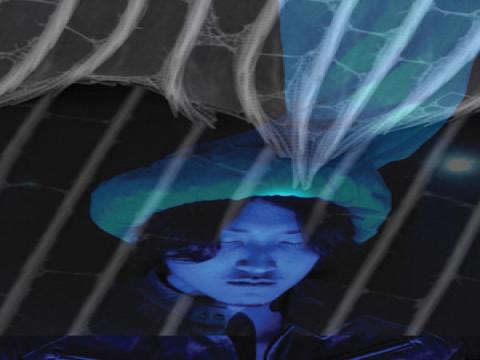
Blue Morph by Victoria Vesna and nanoscientist Jim Gimzewski, is an interactive installation that uses nanoscale images and sounds derived from the metamorphosis of the Blue Morpho butterfly presented in historic St. Cornelius Chapel
Nanotechnology is changing our perception of life and this is symbolic in the Blue Morpho butterfly with the optics involved -- that beautiful blue color is not pigment at all but nano-photonic patterns and structure. The optics are fascinating but the real surprise is in the discovery of the way cellular change takes place in a butterfly. Sounds of metamorphosis are not gradual but rather the cellular transformation happens in sudden surges that are broken up with stillness and silence. Nano is not only making the invisible visible but also changing our way of relating to "silence" or making the in-audible audible. With all the noise of chattering technologies and minds, we propose the interactivity to be stillness for in this empty space of nano we can get in touch with the magic of continuous change. The piece fully emerges in sound and pattern only when the participant is STILL and SILENT.
Credits:
Surround sound: Paul Geluso, Sound processing: Gil Kuno, Interactivity: Paul Geluso, Tyler Adams, Miu Ling, Danaus plexippus chrysalis recording: Andrew Pelling and Paul Wilkinson, Interactive seat construction: Romie Littrell, Knitted morph hat: Silvia Rigon
Installation Designa and Coordination: Aliki Potiris, Interns: Caitlin Morris, Nick Engel, Aliza Simons
Butterfly wing imaging: Marc Castagna, Senior Application Engineer, SEM operator. Thanks to Don Kenia, CEO of FEI Corp. for permission to use the Scanning Electron Microscope.
Morpho peleides and Danaus plexippus wings and pupa provided by Dr. Richard Stringer Department of Math, Science and Allied Health, Harrisburg Area Community College.
More information about the Blue Morph: artsci.ucla.edu/BlueMorph
Incheon International Digital Art Festival - INDAF 2009
Incheon, Korea
Victoria Vesna with Sidarth Ramkrishnan & Gil Kuno
Hox Zodiac 2009 / Interactive Installation
This interactive project is inspired by the properties of the Homeobox genes which essentially define body regions in all animals as well as humans. We seek to create experiential space that relates the idea that we are all interconnected.
The goal is to entice the audience with these fascinating genes that are responsible for many different variations of legs, arms and other parts of the body that exist in the animal kingdom. The hox gene also plays a role in many dynamic changes in human development and continues to be an important subject for scientific exploration in the areas of brain development, body patterning, and variation across species.
The audience's silhouette is generated from a video capture and connected to an abstract rendition of a hox gene. The participant influences the transfprmation into different creatures that emerge and respond to different movements. The animals correspond to the twelve signs of the Chineses zodiac that morph into new creatures and mirror the movement of the person captured. Sounds attached to the animals are composed by Gil Kuno who created a parallel 'Scopic' world to the creatures with visual sound waves on the opposing wall.