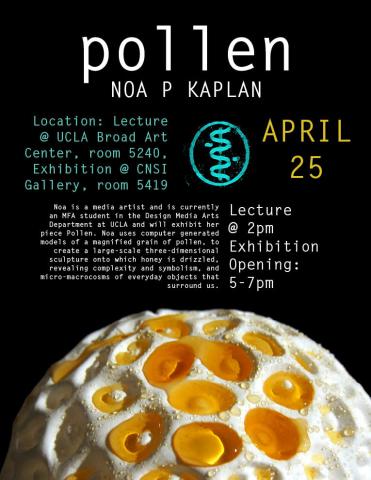
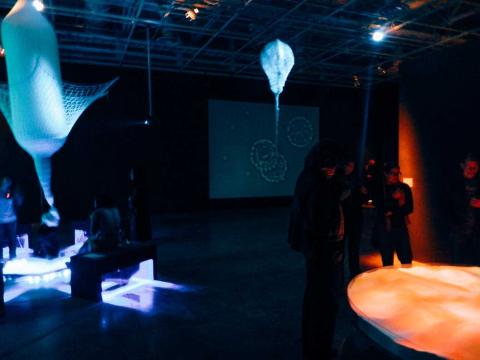
Kaplan, a media artist and MFA student in the Design Media Arts Department at UCLA, will exhibit her piece Pollen. Noa uses computer generated models of a magnified grain of pollen, to create a large-scale three-dimensional sculpture onto which honey is drizzled, revealing complexity, symbolism and micro-macrocosms of everyday objects that surround us.
Time:
Lecture @ 2pm
Exhibition Openings: 5-7pm
Location: Lecture @ UCLA Broad Art Center, EDA, Exhibition @ CNSI Gallery
Paul Thomas gave a guest lecture on his work, New Materialities. Thomas is the Head of Painting at the College of Fine Art, University of New South Wales. Paul has been working in the area of electronic arts since 1981 when he co-founded the group Media-Space. Paul’s current research interests explore the space between life and death at a nano level.
Time:
Lecture @ 2pm
Exhibition Openings: 5-7pm
Location: Lecture @ UCLA Broad Art Center, room 5240, Exhibition @ CNSI Gallery
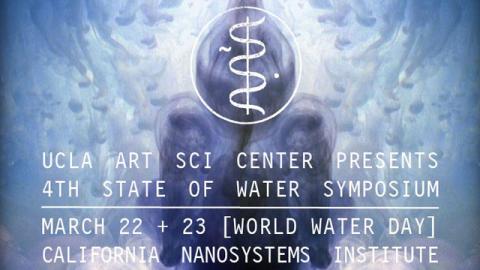
In connection with the 4th State of Water: From Macro to Micro exhibition at CoCA Torun, UCLA is hosting the 4th State of Water Symposium on March 22 (World Water Day) and March 23, 2012 at the California NanoSystems Institute. The opening keynotes will be given by renowned science writer Dr. Philip Ball, author of “Why Water is Weird” and “H20: A Biography of Water”, and Gerald Pollack from the Department of Bioengineering at the University of Washington, speaking on the “Fourth Phase of Water”.
The event will additionally feature a joint online session powered by Waterwheel, an interactive, collaborative platform for sharing media and ideas, performance and presentation. The Art|Sci Center invites all artists and scientists to participate in an OPEN CALL for a collaborative 15 minute performance on Tap. For more information on Waterwheel and Tap, please click here.
Victoria Vesna’s artistic work as well as her theoretical background were motivations to invite her to curate a project that will bring to CoCA Torun some of the most advanced and experimental artistic practices, but not only. The project curated by Victoria Vesna is conceived to be first and foremost an exciting collaborative experience, based on the exchange and dialogue through the creation of a social network and meta-interface that will involve artists, scientists, curators and theoreticians, journalists and other interested intellectuals. This project is developed around the theme of water, understood not only through the multiplicity of its symbolical and metaphorical meanings but also as one of the life and energy sources which today demands a serious political and social discussion.
Bio artists tamper with elemental units of living matter and are a
source of many controversial debates. The talk will attempt to ground
arguments of sceptics and supporters by positioning these considerations
within the context of fundamental life processes that are essential for
maintaining life on Earth and supportive of environmental reform.
Time: 2pm Location: Lecture @ UCLA Broad Art Center, room 5240
Morphonano explores a number of artworks created by Victoria Vesna and nano-scientist James Gimzewski. Their collaborative works create an intersection of space, time and embodiment by employing a very subtle and responsive energetic exchange.
FREE ADMISSION. PUBLIC IS WELCOME.
Time:
Artists’ Reception: 6-9pm
Location: Beall Center for Art + Technology
Building 712 in the Arts Plaza of the Claire Trevor School of the Arts
Opening March 7
Lecture @ 2pm
Exhibition Openings: 5-7pm
Location: Lecture @ UCLA Broad Art Center, room 5240, Exhibition @ CNSI Gallery
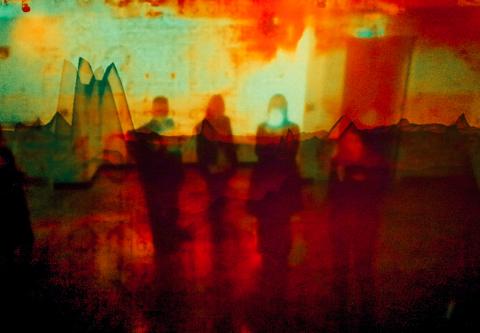
Exposure is an exhibition of work by Mike Phillips, Professor of Interdisciplinary Arts, School of Art & Media at Plymouth University. Mike Phillips is director of i-DAT, a Principal Supervisor for the Planetary Collegium and a supervisor of the Transtechnology Research Groups. His R&D orbits digital architectures and transmedia publishing, and is manifest in a series of ‘Operating Systems’ to dynamically manifest ‘data’ as experience in order to enhance perspectives on a complex world. The year that Eastman Kodak filed for bankruptcy protection was the same year Fujifilm moved from film production to beauty products1. This did not just mark a technological shift from film grain to nanoparticles but also a massive cultural shift - a shift from capturing the face on film to the embedding of ‘film’ in the face. The thing that once froze the face in an eternal youthful smile is now the anti-aging nanoparticle that preserves the face we wear. Barthes described the face on film as representing “a kind of absolute state of the flesh, which could be neither reached nor renounced”2. Now this absolute state is closer to hand and we will walk around wearing our old photo albums as our face, peeling away the frames like layers of dead skin. Our essence, like Garbo’s, will not degrade or deteriorate. ‘Viewed as a transition’ Exposure explores the deterioration of the flesh through the temporality of the Atomic Force Microscope (AFM). From the 60th of a second exposure of the Kodak Brownie camera to the 20-minute scan of the AFM - the closer the subject the longer the ‘exposure’. Incorporating data from an AFM scan of a basal cell carcinoma Exposure explores the convergence of ideologies constructed around imaging technologies. Through a subtle interaction the viewer conjures up a dynamic data/image of a skin cancer - over exposed to the sun - or the intense light of the camera flashgun.
Lecture @ 2pm
Exhibition Openings: 5-7pm
Location: Lecture @ UCLA Broad Art Center, room 5240, Exhibition @ CNSI Gallery
Dark Skies is a work by Patricia Olynyk in Collaboration with Axi:Ome and Christopher Ottinger.
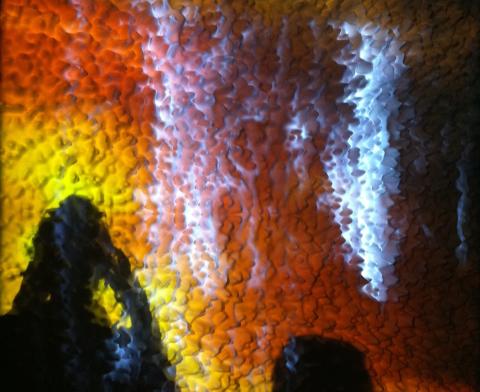
Dark Skies is a multi channel projection on CNC routed tiles inspired by the concept of biomimicry. The surfaces of the tiles themselves are based loosely on the shape and topography a wildmouse tastebud. The installation also includes an evocative soundscape, drawn primarily from field recordings captured at twilight in the Rocky Mountains during high summer. "Dark Skies" is an astronomical reference, referring to remote places free of hazy city light that allow for an extended view into deep space and time. This insight offers not only a unique perceptual and psychological experience but the promise of new discovery.
Patricia Olynyk is an artist whose prints and installations frequently employ microscopy and biomedical imaging technologies to explore the intersections between art and the life sciences. Currently she is Chair of the Leonardo Education and Art Forum (LEAF). Exhibition opening to follow the lecture.
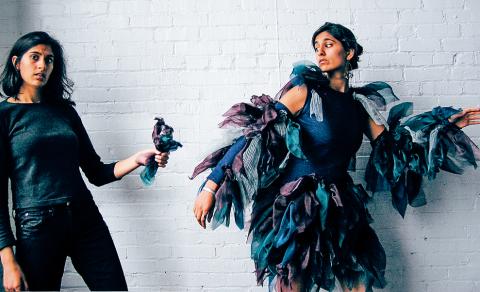
Amisha Gadani is a Los Angeles artist interested in curious creatures and their unique adaptations. She is an artist in resident at the Alfaro Lab and the Center for Society and Genetics at UCLA.
Time:
Lecture @ 2pm
Location: UCLA Broad Art Center, room 5240
Robert Bilder Lecture (hosted by Prof. Barbara Drucker, Dept. of Art)
Dr. Bilder is a Clinical Neuropsychologist who has been actively engaged for over 20 years in research on the neuroanatomic and neuropsychological bases of major mental illnesses. Dr. Bilder’s current research focuses on transdisciplinary and translational research. Among other prominent positions, he directs the Tennenbaum Center for the Biology of Creativity.