April 11th, 2024
3:00-6:00 PM PDT
UCLA Broad Art Center
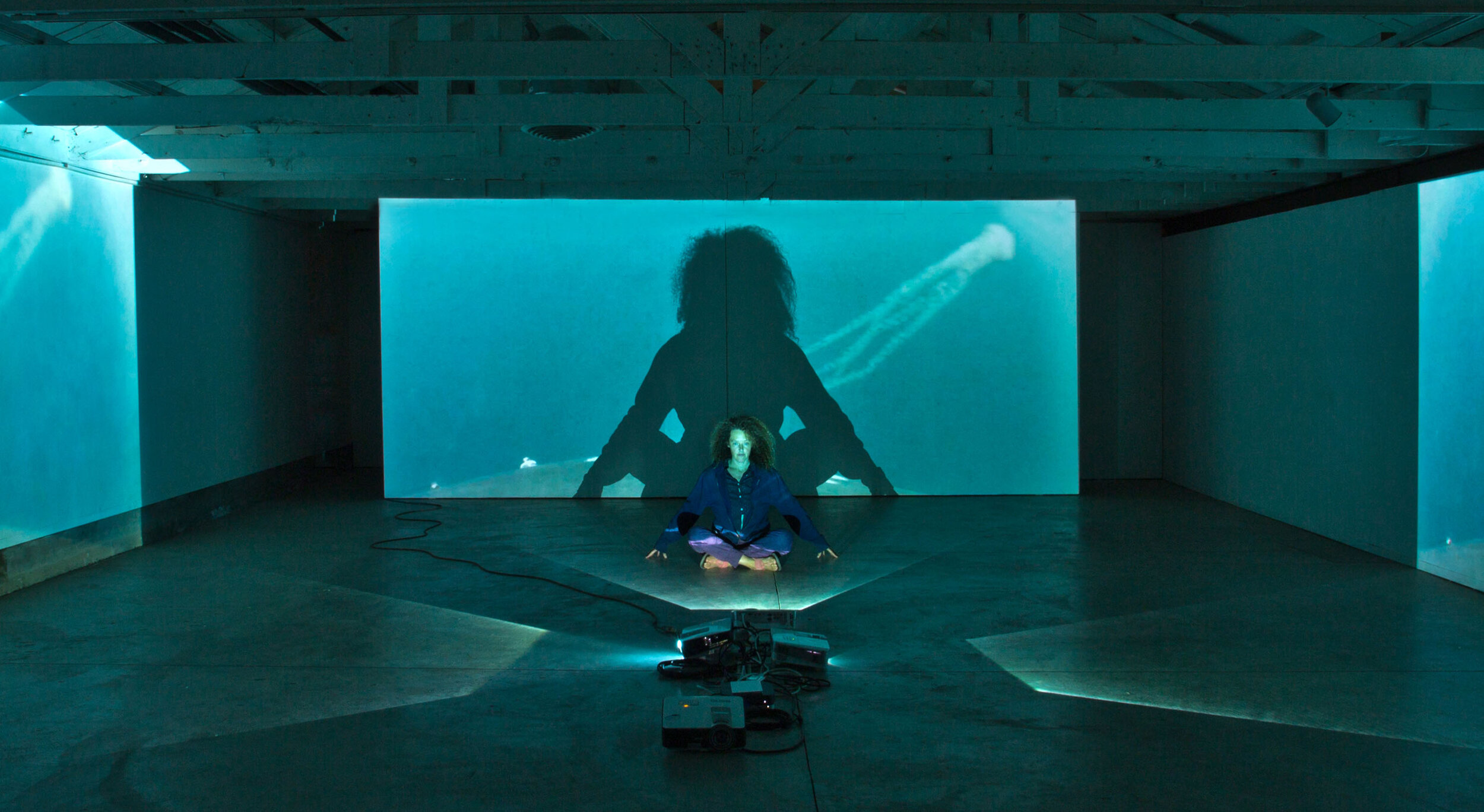
Join the Art|Sci Center in learning about Yolande Harris’ artistic research conducted with Dr. Ari Friedlaender of UCSC. Harris incorporates underwater field recordings of whale vibrations, and realizes her work in glass, bronze, and multi-media forms. She will exhibit in our forthcoming exhibition, Atmosphere of Sound: Sonic Art in Times of Climate Disruption, scheduled to open in September of 2024 in partnership with the 2024 Getty PST initiative.
featuring Hannah Landecker
responder Patricia Olynyk
Chaired by Victoria Vesna
Location: UCLA CNSI, 5th Floor, Presentation Room
This LASER is connected to the exhibition opening at the UCLA ArtSci gallery at CNSI – developed by Professor Hannah Landecker with her students: "Hot Cling, Shear Magic, and the Mouthfeel of Capitalism:
Images From the History of Ultra Processed Foods" ABOUT THE EXHIBITION: http://artsci.ucla.edu/node/1709
Guest responder is artist Patricia Olynyk, who is a fellow of the UCLA Art Sci Medicine & Media Arts initiative: https://medicineandmediaarts.com
Hannah Landecker, with a Ph.D. in Science and Technology Studies from MIT and a B.Sc. in Cell and Developmental Biology from the University of British Columbia, uses the tools of history and social science to study contemporary developments in the life sciences, and their historical taproots in the twentieth century. She has taught and researched in the fields of history of science, anthropology and sociology. At UCLA she is cross-appointed between the Institute for Society and Genetics, and the Sociology Department. She is currently working on a book called “American Metabolism,” which looks at transformations to the metabolic sciences wrought by the rise of epigenetics, microbiomics, cell signaling and hormone biology.
MORE INFO https://soc.ucla.edu/person/hannah-landecker/
Patricia Olynyk is an artist, writer, and educator whose work explores science and technology-related themes and the ways in which social systems and institutional structures shape our understanding of our place in the world. She is the former director of Washington University’s Graduate School of Art and the Florence and Frank Bush Professor in Art. She holds a courtesy appointment in WashU’s School of Medicine and fellowships in the Institute for Public Health and Living Earth Collaborative, both interdisciplinary hubs that facilitate research across a wide range of fields.
MORE INFO https://patriciaolynyk.com
Join us for the second annual Lightfest! Advanced Light Microscopy Symposium at CNSI. A celebration of UNESCO’s International Day of Light, this event will be held from May 15 – 17, in honor of Theodore Maiman, who fired the first laser right here in southern California on May 16th, 1960.
This symposium will feature invited talks from a selection of light microscopy users, poster presentations and awards, an image contest, and vendor booths. This event is free and open to anyone, we hope to see you there!
Opening Keynote: Adding Dimensions to Intravital Imaging to Better Eavesdrop on Biology
Scott E. Fraser, PhD
University of Southern California
Wednesday, May 15, 2024
Imaging of living specimens can animate the wealth of high-throughput molecular data to better understand complex events ranging from embryonic development to disease processes. We are advancing this approach despite the unavoidable tradeoffs – between spatial & temporal resolution, field of view, limited photon budget – by constructing faster and more efficient light sheet and laser-scanning microscopes that maintain subcellular resolution.
Our two-photon light-sheet microscope combines the deep penetration of two-photon microscopy and the speed of light sheet microscopy to generate images with more than 10x improved imaging speed & sensitivity. Better engineering of the detection objective’s point-spread-function improves this another 3-fold. Two-photon excitation light is far less scattered, permitting subcellular resolution to be maintained better than conventional light sheet microscopes, resulting in 4D (3D over time) cell and molecular imaging with sufficient speed and resolution to unambiguous trace cell lineages, movements and signals in intact systems.
To increase the 5th Dimension (# of simultaneous labels), we are refining new multispectral image analysis tools that exceed the performance of our previous work on Linear Unmixing by orders of magnitude in speed, error propagation and accuracy. Novel denoising strategies using machine learning permit imaging at far lower light levels, yielding rapid and unambiguous analyses without perturbing even fragile multiplex-labeled specimens.
Parallel refinements in label-free approaches extend imaging to patient-derived tissues and even human subjects. The low concentrations of these intrinsic labels required us to refine fluorescence lifetime imaging (FLIM), and combine it with multispectral and advanced denoising tools, to perform intravital imaging in such challenging settings.
Combined, these imaging and analysis tools offer the multi-dimensional imaging required to follow key events in intact systems as they take place, and allow us to use noise and variance as experimental tools rather than experimental limitations.
Schedule:
Day 1 – Wednesday May 15 – CNSI Alfred E Mann Auditorium & Lobby
1:30pm – 2:00pm Participant Registration & Check-In
2:00pm – 3:00pm Welcome & Introduction to UNESCO’s International Day of Light
3:00pm – 4:00pm Session 1: Art in Science – Session Chair Victoria Vesna (UCLA)
Daniel G. Jay (Tufts) | Chromophore assisted light inactivation, fluorescence & electrophoresis art
Walter Gekelman (UCLA) | Using lasers to map the motion of ions in a plasma physics experiment
4:00pm – 5:00pm Session 2: Keynote – Session Chair Laurent Bentolila (UCLA)
Scott E. Fraser, Ph.D. – Provost Professor, Director of Science Initiatives, USC
Adding dimensions to intravital imaging to better eavesdrop on biology
5:00pm – 5:30pm Interactive Fiat Lux installation by the Art|Sci Collective
5:30pm – 7:00pm Networking reception
Day 2 – Thursday May 16 – CNSI Alfred E Mann Family Foundation Auditorium and Lobby
9:00am – 9:30am Light breakfast and vendor showcase
9:30am – 10:45am Session 3: Navigating Neuroscience in 3D – Session Chair Esteban Fernandez (CHLA)
Ivan Lopez (UCLA) | Laser confocal imaging of sensory neurons of the human internal ear
Ranmal Samarasinghe (UCLA) | Modeling and Imaging Neural Networks using Human Brain Assembloids
Peyman Goldshani (UCLA) | New generation 1P & 2P miniaturized microscopes for in-vivo imaging during free behavior
10:45am – 11:00am Coffee break and vendor showcase
11:00am – 12:15pm Session 4: Multiphoton in the Musculoskeletal System – Session Chair Blaise Ndjamen (UCSF)
Jimmy Hu (UCLA) | Multiphoton of living craniofacial stem cells
Kristen Reider (UCLA) | Correlated two photon and atomic force microscopy for characterizing surgically extracted tissues
Tad Kremen (UCLA) | Soft tissue-to-bone healing: Defining the problem and potential solutions
12:15pm – 1:15pm Lunch break and vendor showcase
1:15pm – 2:30pm Session 5: Multimodal and Multiplexed Imaging – Session Chair Brian Jeong (UCLA)
Janielle Cuala (USC) | Multimodal imaging reveals changes in beta cell metabolism and heterogeneity over the course of pregnancy
Lior Kashani Ligumsky (UCLA) | Stop blaming the placenta: Label-free multiphoton microscopy reveals previous cesarean scars are a defining pathology of the Placenta Accreta Spectrum (PAS)
Niles A. Pierce (Caltech) | HCR imaging: multiplexed, quantitative, sensitive, versatile, robust
2:30pm – 2:45pm Coffee break and vendor showcase
2:45pm – 4:00pm Session 6: Beyond the Visible Spectrum – Session Chair Haley Marks (UCLA)
Justin Caram (UCLA) | Seeing the shortwave infrared with novel materials, detectors and interferometric methods
Ellen Sletten (UCLA) | Multiplexed in vivo imaging with near and shortwave infrared polymethine
fluorophores
Eric Potma (UCI) | Nonlinear optical imaging with mid-infrared light
4:00pm – 5:00pm Vendor showcase/poster session
5:00pm – 6:15pm Session 7: Cutting Edge Microscopy Modalities – Session Chair Laurent Bentolila (UCLA)
Enbo Zhu (UCLA) | Multi-View light-sheet imaging system with comprehensive tissue clearing compatibility and large field of view
Liang Gao (UCLA) | Breaking the speed barrier: high-speed light-field microscopy for kilohertz to terahertz 3D imaging
Aydogan Ozcan (UCLA) | Virtual Staining of Label-free Tissue Using Deep Learning
6:15pm – 7:30pm Networking Reception
Day 3 – Friday May 17 – CNSI 3rd Floor Executive Conference Rooms – Brunch & Learn – 10:00 am Vendor Slam Talks (3rd Floor Executive Conference Room)
10:00 am – 2:00 pm Vendor Demo Fair (Labs/Booths)
10:00 am – 2:00 pm
10:30 am – Evan Darling (ONI) | Blinky Blink Blink: A Short Introduction to STORM Super-Resolution
11:00 am – Jan Otto Wirth (Abberior) | MINFLUX tracking of kinesin-1 at the nanometer and millisecond scale
11:30 am – Chris Tsang (LifeCanvas Technologies) | What insights are possible if you could image in 3D
12:00 pm – Gert Vreede (Zeiss) | Lightsheet at Lightfest: Versatile 3D imaging from micro- to mesoscale
12:30 pm – Kevin Mann (Bruker) | Illuminating the Brain:
Mapping and Manipulating Neural activity in 3D
1:00 pm – Fred Sala (Leica Microsystems) | Stellaris FLIM: Rainbow of possibilities
Room 6350 | Andor (Benchtop Confocal BC43)
Lobby | LifeCanvas (SmartBatch Automated Tissue Clearing)
Lobby | Ibidi (perfusion & incubation systems)
Room 2152 | Abberior (MINFLUX & STEDyCon)
2:00 pm Closing Remarks & Awards Ceremony (Auditorium)
Aaron Blaisdell, UCLA Psychology Professor and Chair of the Behavioral Neuroscience
EVENT INFO
Exhibition opening: Wednesday, April 24th, 4- 6 pm
CNSI ArtSci Gallery, 5th floor
570 Westwood Plaza, Los Angeles, CA 90095
The exhibition will be on display through May 2nd, 2024
Please note that visits during workdays are by appointment only. Contact us at least a day in advance to schedule: artscicenter@gmail.com
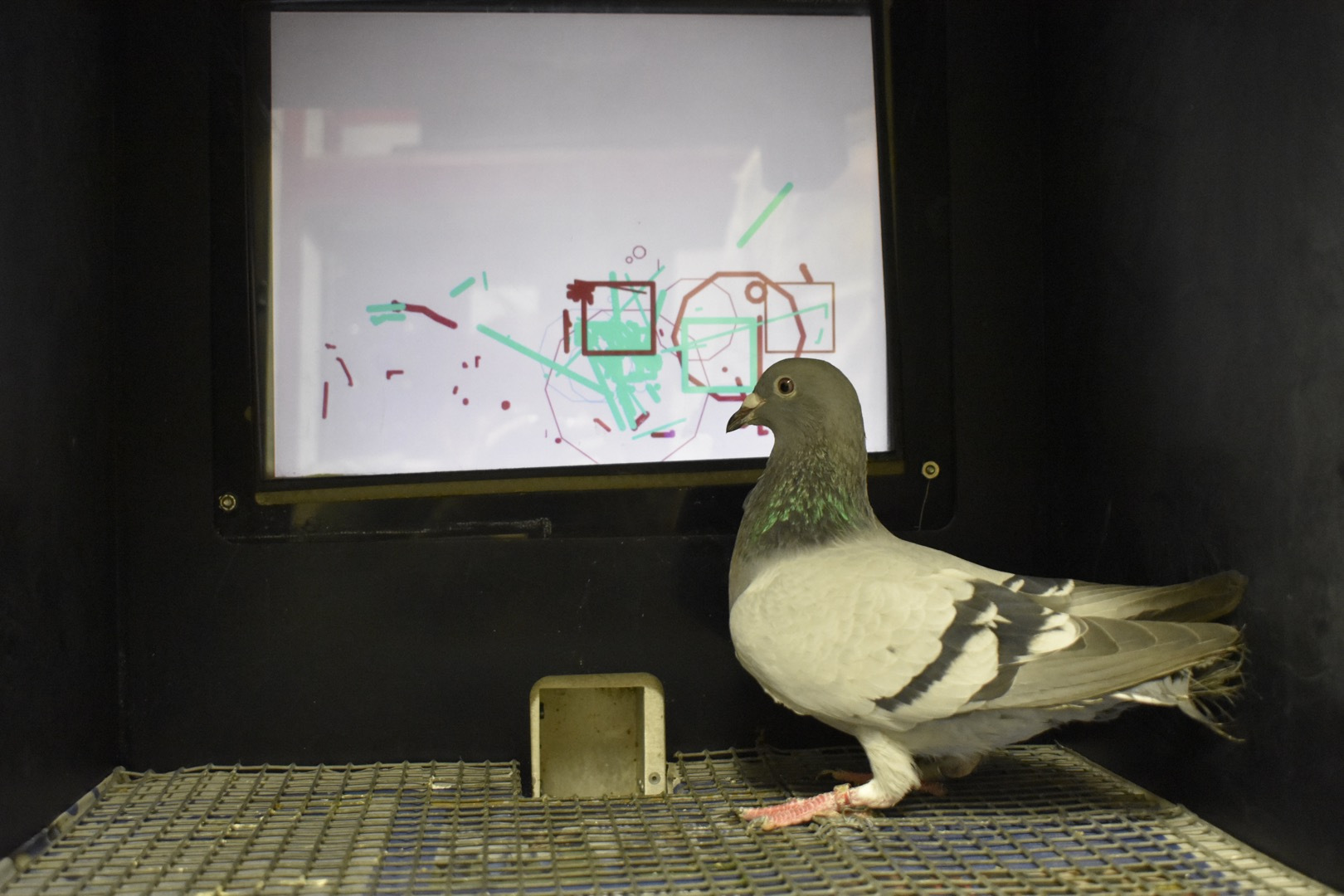
Pigeons have provided a power house of knowledge on learning, memory, and cognition. Now, they also paint! The Blaisdell lab at UCLA has been studying pigeons making digital art using a touchscreen. The goal is to understand the "why" and the "how" of why pigeons make art. What can this tell us about human art? This exhibit features two collections from our pigeon artists. Step into the pigeon artist studio and see what they've been up to!
Dr. Blaisdell is a Psychology Professor and Chair of the Behavioral Neuroscience area at UCLA, overseeing the Comparative Cognition Lab and the Pigeon Art Project. As a member of the UCLA Brain Research Institute, the UCLA Integrative Center for Learning & Memory, and the UCLA Evolutionary Medicine program, Dr. Blaisdell has an extensive academic background with a BA in Anthropology from SUNY Stony Brook, an MS in Anthropology from Kent State University, a Ph.D. in Behavioral Neuroscience from SUNY Binghamton, and two years of NIH-funded postdoctoral training at Tufts University.
EVENT INFO
Exhibition opening: Wednesday, April 10th, 4- 6 pm
CNSI ArtSci Gallery, 5th floor
570 Westwood Plaza, Los Angeles, CA 90095
The exhibition will be on display through April 17th, 2024
The images in this collection induct the viewer into a fantastic universe of textures and viscosities generated in the making of processed foods. In a set of advertisements exhumed from back issues of industry trade journals in food engineering from the 1960s through the 1990s, this exhibit explores the values and the chemistry of an otherworldly scene in which there are no lumps, inconsistencies, or bubbles. Emulsifiers, clouding agents, gums, thickeners, anti-foaming agents, and antioxidants ensure that the marshmallows remain eternally fluffy, the particles are all the same size, mixtures never separate, and the sauce stays on top. Produced by upstream chemical manufacturers and aimed at an audience of food processors, these messages were not intended for the end consumer - and indeed often extolled the invisibility of their products to the eating public. Now that the health impacts of highly processed foods are increasingly ringing alarm bells in medicine and epidemiology, and the environmental footprint of these industrialized systems of production becomes ever more evident, this exhibit invites the eating public to see into the process for themselves.
This exhibit leverages the deep collections of the UCLA Library system in bringing these material off the page and onto the wall. It is curated by the Hot Cling and Shear Magic Research Group, a team of UCLA undergraduates led by Professor Hannah Landecker, pied piper of the grim joy of historical excavation of apparently banal but terribly consequential social and technical events shaping our biological lives. The team, composed of undergraduates majoring in Human Biology and Society and Psychobiology, is comprised of Xian Zeng, Nicole Vasquez, Emily Sutherland, Kianna Satari, Manasi Sastry, Chloe Nelson, Max Kokka, Kiana Karimi, Rayna Irving, Sara Herron, Xavier Herrera, Haley Ficker, Lea Dahlke, and Shelsy Aragon.
Hannah Landecker, with a Ph.D. in Science and Technology Studies from MIT and a B.Sc. in Cell and Developmental Biology from the University of British Columbia, uses the tools of history and social science to study contemporary developments in the life sciences, and their historical taproots in the twentieth century. She has taught and researched in the fields of history of science, anthropology and sociology. At UCLA she is cross-appointed between the Institute for Society and Genetics, and the Sociology Department. She is currently working on a book called “American Metabolism,” which looks at transformations to the metabolic sciences wrought by the rise of epigenetics, microbiomics, cell signaling and hormone biology.
Landecker’s work focuses on the social and historical study of biotechnology and life science, from 1900 to now. She is interested in the intersections of biology and technology, with a particular focus on cells, and the in vitro conditions of life in research settings.
Ingeborg Reichle is a Berlin-based contemporary art historian and curator at the intersection of art and technoscience. In 2004 she gained her Ph.D. from the Humboldt University Berlin with the dissertation Art in the Age of Technoscience: Genetic Engineering, Robotics, and Artificial Life in Contemporary Art (Springer 2009). In recent years she served as Professor in the Department of Media Theory at the University of Applied Arts in Vienna, Austria, and as founding chair of the Department of Cross-disciplinary Strategies (CDS), where she designed an integrated BA study program on applied studies in art, science, philosophy, and global challenges. Recent curatorial projects include the sci-art program NaturArchy at the Joint Research Centre (JRC) in Ispra, Italy, the European Commission’s science and knowledge service and the sci-art program NanoARTS by the Swiss Arts Council Pro Helvetia. In 2022 she joined the Board of Trustees of the ZKM Center for Art and Media Karlsruhe and since 2023 she serves on the Board of Trustees of Fritz and Trude Fortmann Foundation for Building Culture and Materials.
Reichle’s recent book Plastic Ocean: Art and Science Responses to Marine Pollution (De Gruyter 2021) brings together numerous international art projects related to marine plastic pollution, environmental emergencies, and climate science, and draws attention to the irreversible destruction of our marine ecosystems.
Guest Responder: María Antonia González Valerio
María Antonia González Valerio holds a PhD in Philosophy. She is a full-time professor at the Faculty of Philosophy and Literature at the National Autonomous University of Mexico (UNAM). Her academic pursuits are situated within the intersection of ontology and aesthetics, as well as the interdisciplinary realm of arts, sciences, and humanities, with a specific focus on art involving biomedia. As the director of the Seminar Arte+Ciencia, she facilitates collaborative engagements between artists, academics, and scientists, fostering interdisciplinarity that yields graduate education, specialised theoretical research, artistic creations, and exhibitions. Additionally, she is a curator and the driving force behind the artistic collective Bios ex Machina. She is the author of the books (selection): Through the Scope of Life. Art and (Bio)Technologies Philosophically Revisited (Springer, 2023), Cabe los límites: Escritos sobre filosofía natural desde la ontología estética (México: UNAM/Herder, 2016), Un tratado de ficción (México: Herder, 2010), and El arte develado (México: Herder, 2005).
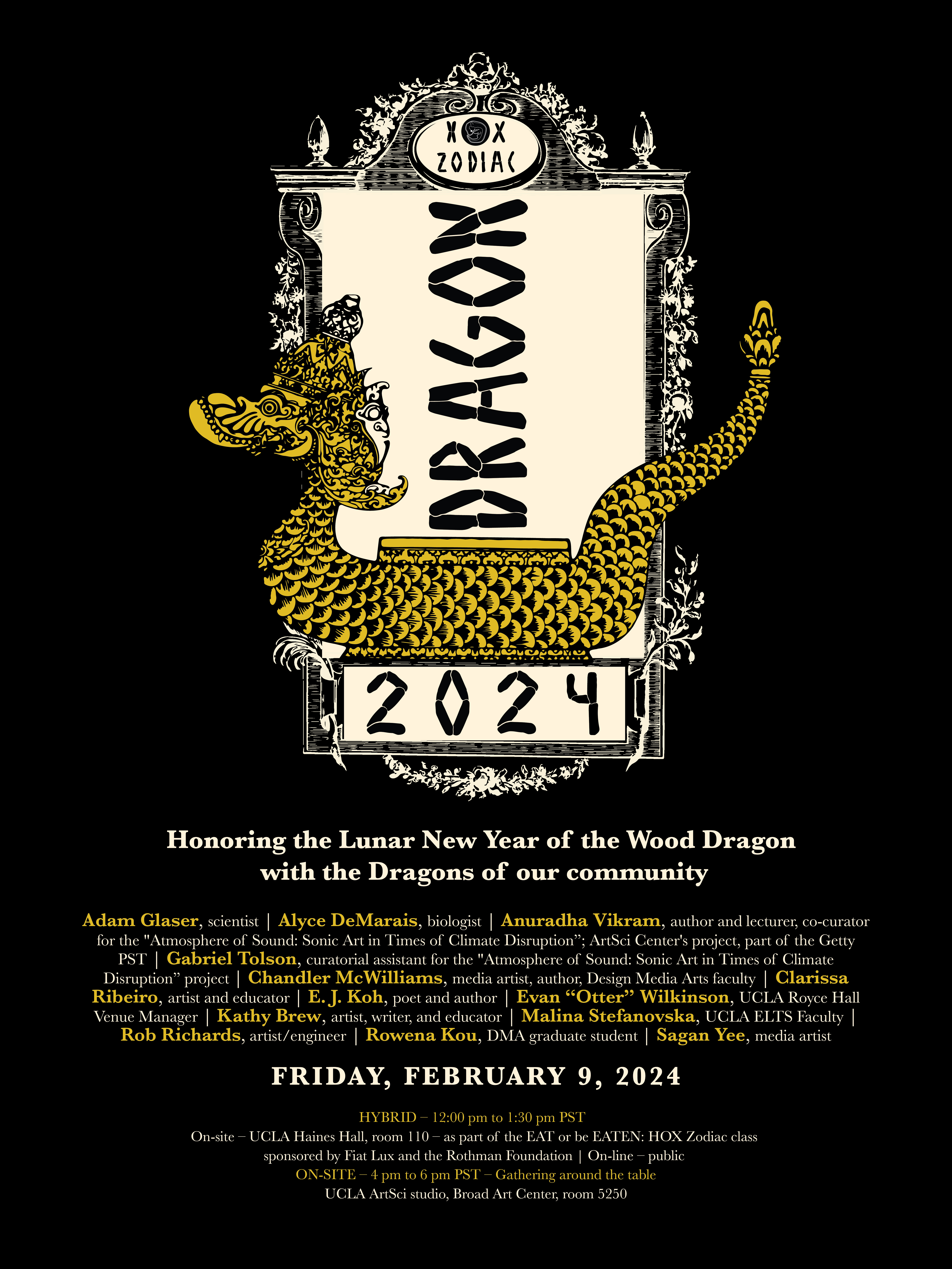
February 10th marks the official start of the Lunar New Year of the Wood Dragon, and as part of our ritual series of gatherings, we will host two celebrations honoring the dragons of our community on
FRIDAY, FEBRUARY 9, 2024!
HYBRID – 12:00 pm to 1:30 pm PST
On-site – UCLA Haines Hall, room 110 – as part of the EAT or be EATEN: HOX Zodiac class sponsored by Fiat Lux and the Rothman Foundation
On-line – public
ON-SITE – 4 pm to 6 pm PST – Gathering around the table
– UCLA Art Sci studio, Broad Arts Center, room 5250
WATCH THE RECORDING:
Honoring the Dragons in our community:
Adam Glaser, scientist (online from Seattle)
Alyce DeMarais, Professor in the Biology department at the University of Puget Sound (online from Seattle)
Anuradha Vikram, author and lecturer, co-curator for the "Atmosphere of Sound: Sonic Art in Times of Climate Disruption”; ArtSci Center's project, part of the Getty PST;
Gabriel Tolson, curatorial assistant for the "Atmosphere of Sound: Sonic Art in Times of Climate Disruption” project, part of the Getty PST;
Chandler McWilliams, media artist, author, Design Media Arts faculty
Clarissa Ribeiro, artist and educator (online from Brazil)
E. J. Koh, poet and author (online from Seattle)
Evan “Otter” Wilkinson, UCLA Royce Hall Venue Manager
Kathy Brew, artist, writer, and educator (online from NY)
Malina Stefanovska, Professor of French and Francophone Studies, UCLA ELTS Faculty
Rob Richards, artist/engineer
Rowena Kou, DMA graduate student.
Sagan Yee, media artist
María Antonia González Valerio, Polona Tratnik, Ingeborg Reichle, Claudia Schnugg
Join us for a panel discussion featuring María Antonia González Valerio, Polona Tratnik, Ingeborg Reichle, and Claudia Schnugg as they explore the themes and insights of "Through the Scope of Life: Art and (Bio)Technologies Philosophically Revisited," a book co-authored by María Antonia González Valerio and Polona Tratnik.
This book offers intriguing philosophical inquiries into biotechnological art and the life sciences, addressing their convergences as well as their epistemic and functional divergences. Rooted on a thorough understanding of the history of philosophy, this work builds on critical and ontological thought to interpret the concept of life that underscores first-hand dealings with matter and experimentation. The book breaks new ground on the issue of animality and delivers fresh posthumanist perspectives on the topics addressed. The authors embark on a deep ontological probe of the concept of medium as communication-bridging and life-bearing. They also take on the concept of performativity as biotechnological art.
The book includes concrete, well-documented case studies and shows how certain narratives and practices directly impact ideas surrounding science and technologies. It will interest philosophers in art and technology, aesthetics, ontology, and the life sciences. It will also engage art practitioners in art and science, curators and researchers.
-----
María Antonia González Valerio holds a PhD in Philosophy. She is a full-time professor at the Faculty of Philosophy and Literature at the National Autonomous University of Mexico (UNAM). Her academic pursuits are situated within the intersection of ontology and aesthetics, as well as the interdisciplinary realm of arts, sciences, and humanities, with a specific focus on art involving biomedia. As the director of the Seminar Arte+Ciencia, she facilitates collaborative engagements between artists, academics, and scientists, fostering interdisciplinarity that yields graduate education, specialised theoretical research, artistic creations, and exhibitions. Additionally, she is a curator and the driving force behind the artistic collective Bios ex Machina. She is the author of the books (selection): Through the Scope of Life. Art and (Bio)Technologies Philosophically Revisited (Springer, 2023), Cabe los límites: Escritos sobre filosofía natural desde la ontología estética (México: UNAM/Herder, 2016), Un tratado de ficción (México: Herder, 2010), and El arte develado (México: Herder, 2005).
Polona Tratnik holds a PhD in philosophy. She is full professor at the Faculty of Arts at the University of Ljubljana and senior researcher at the Institute IRRIS for Research, Development and Strategies of Society, Culture and Environment, where she leads a project on political functions of folktales. Her recent publications include: Art as Capital: The Intersection of Science, Technology, and the Arts (Rowman & Littlefield, 2021) and The European Avant-Garde – A Hundred Years Later (ed., Brill, 2024).
Ingeborg Reichle is a Berlin-based contemporary art historian and curator at the intersection of art and technoscience. In 2004 she gained her Ph.D. from the Humboldt University Berlin with the dissertation Art in the Age of Technoscience: Genetic Engineering, Robotics, and Artificial Life in Contemporary Art (Springer 2009). In recent years she served as Full Professor in the Department of Media Theory at the University of Applied Arts in Vienna, Austria, and as founding chair of the Department of Cross- disciplinary Strategies (CDS), where she designed an integrated BA study program on applied studies in art, science, philosophy, and global challenges. Recent curatorial projects include the sci-art program NaturArchy at the Joint Research Centre (JRC) in Ispra, Italy, the European Commission’s science and knowledge service and the sci-art program NanoARTS by the Swiss Arts Council Pro Helvetia. In 2022 she joined the Board of Trustees of the ZKM Center for Art and Media Karlsruhe and since 2023 she serves on the Board of Trustees of Fritz and Trude Fortmann Foundation for Building Culture and Materials.
Dr. Claudia Schnugg is curator and artscience scholar based in Austria. Her ongoing practice in the field of art and science is twofold: as scholar she is researching artscience collaborations, investigating effects and impact of such art-science exchange on actors, organizations involved and the relevance of the outcome. In 2019 she published her book Creating ArtScience Collaborations with Springer/Palgrave Macmillan. ArtScience programmes she curates at institutions such as European Space Agency/ESTEC, Helmholtz Center München, the EC funded ITN network RepliFate, BIFOLD at TU Berlin, and Resonances IV “NaturArchy” of the SciArt Project at the Joint Research Center of the European Commission in Ispra. Most recent exhibitions are CORALS – Marco Barotti (Berlin, 2023), Intersecting Realities (Timisoara, 2023), Cosmic Elements: Star-Pacing Songs (Beijing, 2023), Cosmological Elements (Shanghai, 2022). Claudia is member of international juries for art prices, residency projects, and scientific boards for artscience projects.
COLOR, LIGHT, MOTION is an online series featuring media artists and scholars in dialogue about artworks from the Bermant Collection of media and kinetic arts. Each featured presenter will discuss selected artworks in history and context and in relation to their own work and connections. This series is sponsored by the David Bermant Foundation, partnered with Harvestworks NY and the UCLA Art Sci center.
Ivana Dama was born and raised under the socialist regime in Belgrade shortly after the end of the civil war and during the time of NATO bombing. The tension between the former Yugoslavian countries was still undoubtedly present. Even though she was only a young child when the bombing began, images and sounds of the destruction still clearly permeate her mind. The memories of living in a small shelter with the sounds and vibrations of the air raid sirens have contributed to her interest in using air and sound as a primary medium. Her work, which includes audio-video installations, robotics, web projects, and music performances, explores the deep connections between sound, memory, and human experience. Currently pursuing a graduate degree in Sculpture at Yale University, Ivana holds a previous degree in Media Arts and Digital Humanities from UCLA's School of Arts and Architecture. Her work explores the different realms of space encompassing the microscopic, architectural, and satellite scale. Through various experiments she explores how sounds behave in different environments such as vacuum, water, and outer space. Ivana has participated in over 30 group shows and had solo exhibitions in Portland and Los Angeles.
Humans are just one species among millions, coexisting in an expansive living network. Immerse yourself in installations envisioned by artists, designers, scientists, technologists and changemakers from across 12 countries. Their cross-cultural and interdisciplinary collaborations open portals to a shared future, in which planet and people flourish together.
Part of PEM’s Climate + Environment Initiative, this traveling exhibition from the Barbican Centre in London celebrates the power of global creativity to transform the conversation around the climate emergency. The structures and design featured in the exhibition are sourced from biodegradable, sustainable materials to minimize carbon footprint. We invite you to imagine our ideal future world. What will it look like? How will we use the precious time we have here? Technology has brought us closer to nature than we have ever been before, and Indigenous insight continues to reconnect us to our roots. What will it take to live together in harmony?
Walk up to a table set for dinner, but imagine the guests include a fox and a wasp. Plunge into a virtual ocean with magnified plankton, and peer through the layers of a tree to experience the microscopic foundations of life.
Our Time on Earth is produced and curated by the Barbican with guest curators FranklinTill and co-produced by Musée de la civilisation, Québec City, Canada. This exhibition is made possible by Carolyn and Peter S. Lynch and The Lynch Foundation. We thank James B. and Mary Lou Hawkes, Chip and Susan Robie, and Timothy T. Hilton as supporters of the Exhibition Innovation Fund. We also recognize the generosity of the East India Marine Associates of the Peabody Essex Museum.
Share your impressions, snapshots and tales with us on social media using #OurTimeOnEarth.